Tuesday, March 29, 2016

Mechanism For Radioactive Decay

It is really arbitrary how the mechanisms for \(\beta\) decays are cooked up using particle collisions.


Mathematically, the resulting wave after the time axes swap is equivalent to the wave before the swap.  The time axes variables are arbitrary, but we know that, either,

\(t_c=i.t_T\)  ot  \(t_T=i.t_c\)

that the time axes are orthogonal.

How much energy is expended when we multiply a time axis \(t\) by \(i\)?  For the swap process as a whole, nothing, since mathematically the waves are equivalent, no net energy input is required.

Which brings us to the other colliding particle,


On collision, the photon \(P_{g^{+}}\) stops along the space dimension \(x\) but has speed \(v=c\) along \(t_c\).  It then splits into two along the \(t_g\) axis.  Part of it \(g^{+}\) travels along the positive \(t_g\), \(v=c\) and the other part travels along \(t_g\) negative; ie. \(v=-c\).  The momentum of the photon is either split equally between the particle and the antiparticle or, only the anti-particle has \(v=c\) in space when \(g^{+}\) is captured (\(p^{+}\) is originally in orbit).

Why should one particle be sent back in time?  This particle is otherwise an electron, the negative particle of \(p^{+}\).

One particle is sent back in time because \(P_{g^{+}}\) is stationary along \(t_c\) before the collision and \(p^{+}\) is at light speed along \(t_c\).  After the collision, part of \(P_{g^{+}}\) is propelled forward, the other part is repelled backwards along \(t_c\).  Then the time axes swapped, \(t_g\leftrightarrow t_c\).  \(t_g\) now has two velocity vectors positive and negative that sum to zero, and \(t_c\) has a vector component \(v=c\).

On the \(p^{+}\) particle \(t_c\leftrightarrow t_T\) and on the photon, \(P_{g^{+}}\), \(t_c\leftrightarrow t_g\).

In the case of \(\beta^{-}\) decay, there is only one time axis swap,


and the photon stopped along the space dimension after the collision,


In this case both colliding particles have speed \(v=c\) along \(t_c\) when they collided.  The photon \(P_{g^{-}}\) has \(v=0\) on \(t_T\), in the particle \(g^{+}\), \(t_T\) is the oscillatory component of the wave.  In the previous case,  the photon \(P_{g^{+}}\) is stationary along \(t_c\), \(v=0\) and the particle \(p^{+}\) is at light speed, \(v=c\) along \(t_c\).  Momentum along \(t_c\) is split into two, a negative part and a positive part, they sum to zero.

In both cases, the oscillatory components remain intact.  After the collision, except for the photon/particle that slowed, all non oscillatory time axes swapped.  If one of the colliding, non oscillatory time axes has zero velocity, momentum along that time axes splits into a negative and positive part and an anti-particle is created.

In summary...

In both cases, the particles involved in the decays in the nucleus is first identified.  And appropriate photon that provides for the resultant particles after the decay is made to collide with the nucleus particle.  The nucleus particle is transmuted by swapping non oscillatory time axes.  If between the photon and the nucleus particle, any of the non-oscillatory time axes has zero velocity, a anti-particle is produced.  This anti-particle is identified after the time axis swap.

Is this a scheme for general radioactive decay?  Maybe.


Monday, March 28, 2016

Magnetic Monopoles

In the presented schemes for \(\beta\) decays are correct, \(T^{+}\) emitted from the nucleus during \(\beta^{-}\) decay is the electron anti-neutrino and \(T^{-}\) changed from \(p^{+}\) and emitted during \(\beta^{+}\) decay is the electron neutrino.

If \(T^{+}\) and \(T^{-}\) are particles that produces \(B\) fields, they are then the magnetic monopoles.

But under normal circumstances these particles behave as waves not as particles.  This is the reason why they are not noticeable as opposing particles, like opposing charges.

Furthermore, \(g^{+}\) particles are neutrons.  But what are then, \(g^{-}\) particles?

If all nuclei have \(g^{+}\) particles, then Earth should be a positive gravity particle not a negative particle.
We may have a problem.

Correcta. Correcta.


\(\beta^{+}\) Decay

If this is \(\beta^{+}\) decay,

\(p^+\)+\(P_{g^{+}}\)\(\rightarrow\)\(T^{-}+e^{+}+g^{+}\)

where the collision of photon, \(P_{g^{+}}\) with \(p^{+}\) reverses \(t_c\) and \(t_T\) on \(p^{+}\) changing it into a \(T^{-}\) particle that is detected as the electron neutrino.  The photon is completely slowed in space to give an \(g^{+}\) particle and, to provide more energy to the collision, a \(e^{+}\) particle is produced also.  On the \(e^{+}\) particle, velocity along \(t_g\) is completely reversed.


The problem with \(\beta^{+}\) decay is that it normally occurs with the emission of two \(g^{+}\) particles also.  For example,

(\(T^+\), \(p^+\), \(g^+\), \(T^+\))\(\rightarrow\)(\(2T^{+})+2g^{+}+e^{+}+T^{-}\)

Only when the \(p^{+}\) particle involved are at the innermost end of the nucleus set, eg.

(\(p^+\), \(g^+\), \(T^+\))\(\rightarrow\)(\(2g^{+},\,\,T^{+})+e^{+}+T^{-}\)

does \(\beta^{+}\) decay not emit the two \(g^{+}\) particle and it would seem that the \(p^{+}\) particle has converted into a \(g^{+}\) particle.

What?  Radioactive decays do not involved photons?  Maybe.


Photons Destroy Everything

The scheme for \(\beta^{-}\) decays suggests that all \(g^{+}\) particles in the nucleus are susceptible to radioactive decay when bombarded with photons of high enough energy.  And that all nuclei with \(g^{+}\) particles can decay.  The nucleus collapses with the release of a electron or positron.

The resulting nucleus set up is unstable.

Photons destroy everything except nuclei without \(g^{+}\) particles, ie. hydrogen.  So, the only effective sun block is hydrogen.

Helium Isotopes And General Periodicities

Stable Helium-3, \(^3He\)

(\(T^+\), \(p^+\), \(g^+\), \(T^+\), \(p^+\))

and

(\(p^+\), \(g^+\), \(T^+\), \(p^+\))

where the spin of \(p^{+}\) particles contributes to atomic mass.

Maybe possible Helium-3, \(^3He\)

(\(g^+\), \(T^+\), \(2p^+\))

where the last particle is doubled in numbers.

Stable Helium-4, \(^4He\)

(\(g^+\), \(T^+\), \(p^+\), \(g^+\), \(T^{+}\), \(p^+\))

Unstable Helium-2, \(^2He\)

(\(T^+\), \(2p^+\))

where the \(T^{+}\) particle left behind after decay has it mistaken as \(\beta\) decay.

(\(2p^+\))

this is more likely, and it splits into two \(^1H\).

The problem is Hydrogen has many isotopes.  All of which can be turned into a Helium isotopes by adding to the hydrogen nucleus set (\(p^{+}\)) or (\(g^+\), \(T^{+}\), \(p^+\)) when the hydrogen nucleus set ends in \(p^{+}\) or, by adding \(p^{+}\) when the hydrogen nucleus set ends in \(T^{+}\) and, by adding (\(T^{+}\), \(p^+\)) when the hydrogen nucleus set ends in \(g^{+}\).

The simple idea of building the nucleus up from weak fields holds.  Although this view includes isotopes naturally as the nucleus is built up, there is no simple periodicity.  Periodicity in chemical reactions involving charges occurs when we consider the addition of \(p^{+}\) particles only and  group all nuclei with the same number of \(p^{+}\) particles together.

So there are two other periodicities, when we group nuclei with the same number of \(g^{+}\) or the same number of \(T^{+}\) particles.  These are periodicities of chemical reactions involving \(g^{-}\) and \(g^{+}\) particles, and \(T^{+}\) and \(T^{-}\) particles separately.


Reconsidering \(\beta^{-}\) Decay

Consider all the stable isotopes of hydrogen,

(\(T^+\), \(p^+\))

(\(p^+\))

(\(g^+\), \(T^+\), \(p^+\))

(\(T^+\), \(p^+\), \(g^+\))  and  (\(T^+\), \(p^+\), \(g^+\), \(T^+\))

(\(p^+\), \(g^+\))  and  (\(p^+\), \(g^+\), \(T^+\))

(\(g^+\), \(T^+\), \(p^+\), \(g^+\))  and  (\(g^+\), \(T^+\), \(p^+\), \(g^+\), \(T^{+}\))

If \(\beta^{-}\) decay is still centered around \(g^{+}\) particles then the following scheme maybe possible,


Where a photon, \(P_{p^{+}}\) collides with a \(g^{+}\) particle.  The two time axes, \(t_c\) and \(t_g\) of \(g^{+}\) swapped and transmute it to a \(e^{-}\) particle which is ejected from the nucleus.  The photon slows down and becomes a proton, \(p^{+}\).  This proton merged with the lower or higher layer proton, \(p^{+}\) in the nucleus to give \(2p^{+}\). When the proton merged with  a higher particle, the falling particle will emit a small amount of energy.  For example,

(\(g^+\), \(T^+\), \(p^+\))\(\rightarrow\)(\(2p^{+}\)) + \(e^{-}\) + \(T^{+}\)

in this case, \(T^{+}\) is the electron anti-neutrino and the captured photons merge with a higher layer proton to give two protons.  Furthermore,

(\(T^+\), \(p^+\), \(g^+\))\(\rightarrow\)(\(T^{+}\), \(2p^{+}\)) + \(e^{-}\)

without the emission of an electron anti-neutrino.  And,

(\(T^+\), \(p^+\), \(g^+\), \(T^+\))\(\rightarrow\)(\(T^{+}\), \(2p^{+}\)) + \(e^{-}\) + \(T^{+}\)

with the emission of an electron anti-neutrino and the photons merged down one layer.

The set (\(T^+\), \(p^+\), \(g^+\)) arises from considering positive particles being captured by weak fields due to positive particle spins in the hydrogen nucleus.  It is a repeating series that occurs in the nuclei of other elements.  If this \(\beta^{-}\) decay scheme is true, it will also apply to all nuclei susceptible to such decays.

The \(T^{+}\) particle originates from the nucleus.  It is released as the weak field holding it disappeared when the spinning \(g^{+}\) particle generating the field is transmuted to a \(e^{-}\) particle after colliding with a photon.

Note: How does a photon slow down?  The time dimension wrap around a space dimension.  When the particle has light speed in space, its time speed is zero.  It is a photon.  When the photon slows down in space, its time speed increases towards light speed.  When its speed in space is zero, it becomes a particle, its speed along \(t_T\) is light speed, \(c\).


Told You It Is Just For Fun

From the post "How Much Further Still Can Gravity Particles Go?" dated 29 Jun 2015, it was proposed that a nucleus can be made up of hydrogen particles (neutral hydrogen nuclei),

\((e^{-},\,g^{-},\,g^{+})\)

\((e^{-},\,T^{-},\,T^{+})\)

and

\((e^{-},\,p^{+})\)

and that the pairs,

\((g^{-},\,g^{+})\) and \((T^{-},\,T^{+})\) are equivalent to \(p^{+}\) and are called proton pair.

In particular \(g^{+}\) acts like a electron anti-neutrino AND a electron neutrino in some radioactive decays.

In the previous posts "Stable, Unstable, All Mental", "Where's Sneezy?", "Order, Order Please!",etc the role of the negative particles are ignored and the focus is on positive particles in the nucleus of hydrogen.  The atomic mass is solely contributed by \(g^{+}\) particles and \(p^{+}\) particles in spin and the nucleus is built up from weak fields due to particle spins.

The latter posts concerns the hydrogen nucleus only, consideration given to the weak fields suggests that the previous posts are too simplistic.  In particular, the addition of a proton, \(p^{+}\) to the nucleus also requires the addition of other particles, (\(g^{+}\), \(T^{+}\)) or (\(T^{+}\)), in view of the weak fields.  Unless, the nucleus set ends with a \(p^{+}\) particle, for example,

(\(g^+\), \(T^+\), \(p^+\))

then on receiving an extra \(p^{+}\), becomes,

(\(g^+\), \(T^+\), \(2p^+\))

where the weak field due to the spinning \(T^{+}\) particle attracts two \(p^{+}\) particles.

Thus \(\beta\) decays have to reconsidered in this new light.

Note:  The post "How Much Further Still Can Gravity Particles Go?" dated 29 Jun 2015 and other posts suggesting that the hydrogen nucleus can be,

\((e^{-},\,g^{-},\,g^{+})\) or

\((e^{-},\,T^{-},\,T^{+})\)

are defunct.

Sunday, March 27, 2016

Stable, Unstable, All Mental

Oh no, these are all stable isotopes,

(\(T^+\), \(p^+\))

(\(p^+\))

(\(g^+\), \(T^+\), \(p^+\))

(\(T^+\), \(p^+\), \(g^+\))  and  (\(T^+\), \(p^+\), \(g^+\), \(T^+\))

(\(p^+\), \(g^+\))  and  (\(p^+\), \(g^+\), \(T^+\))

(\(g^+\), \(T^+\), \(p^+\), \(g^+\))  and  (\(g^+\), \(T^+\), \(p^+\), \(g^+\), \(T^{+}\))

the spins of \(p^{+}\) particles do not contribute to the mass of the nuclei, only the presence of \(g^{+}\) particle.  In which case, hydrogen isotopes have zero mass, mass of one \(g^{+}\) and the mass of two \(g^{+}\).  The relative abundance of these stable isotopes give rise to the decimals in hydrogen mass that can not be factored.

The notion of \(p^{+}\) having mass \(g^{+}\) is the result of having to add the tuple (\(g^+\), \(T^+\), \(p^+\)) to any nucleus ending with a \(p^{+}\) particle in the cyclic permutation set.  The tuple must contain a \(g^{+}\) particle.  Such an array of stable isotopes with different positions of \(p^{+}\) in the nucleus may also add to the decimal points in experimental isotope mass measurements, if the weak \(g\) field generated by the spinning \(p^{+}\) particles also contribute to mass.  What about spins?  Spins seem to be associated with \(g^{+}\) particles only.

Unstable nuclei are not any members of the cyclic permutation set.  For example,

(\(3g^+\), \(T^+\), \(p^+\))

(\(T^+\), \(p^+\), \(3g^+\))  and  (\(T^+\), \(p^+\), \(3g^+\), \(T^+\))

(\(p^+\), \(3g^+\))  and  (\(p^+\), \(3g^+\), \(T^+\))

are all Hydrogen-3, \(^3H\) with spin \(\small{\cfrac{1}{2}}^{+}\); the group \(3g^{+}\) spins as one.  What about \(^3H\) with \(2^{-}\) spin?

What is \(g^{+}\) and how can it transmute to a charge?


The time axes, \(t_g\) and \(t_c\) of a \(g^{+}\) particle swapped.  The result is an electron that leaves the nucleus; \(\beta^-\) decay.

How does such a swap occurs?  'Til next time...


Where's Sneezy?

And if we order the Hydrogen nuclei written down so far by their masses,

(\(T^+\), \(p^+\))

(\(p^+\))

(\(g^+\), \(T^+\), \(p^+\))

(\(T^+\), \(p^+\), \(g^+\))  and  (\(T^+\), \(p^+\), \(g^+\), \(T^+\))

(\(p^+\), \(g^+\))  and  (\(p^+\), \(g^+\), \(T^+\))

(\(g^+\), \(T^+\), \(p^+\), \(g^+\))  and  (\(g^+\), \(T^+\), \(p^+\), \(g^+\), \(T^{+}\))

keeping in mind that given equal number of \(g^{+}\) particles, the lower position of \(p^{+}\) in the set increases mass, and assuming that the addition of a \(T^{+}\) particle does not change mass.

Here, we are one short of the seven discovered Hydrogen isotopes.  Where's the last?

Note: Cyclic permutation, the particles are added in specific order.  No swapping of position nor adding other types of particle please.


Order, Order Please!

Are other nuclei made up of basic hydrogen nuclei Type I and III,

Type I (\(p^+\), \(g^+\), \(T^+\))

Type III (\(T^+\), \(p^+\), \(g^+\))??

No, because we have Helium-3 \(^3He\), by adding \(p^{+}\) to the Type I hydrogen nucleus \(^3H\)

(\(p^+\), \(g^+\), \(T^+\))+\(p^{+}\)\(\rightarrow\)(\(p^+\), \(g^+\), \(T^+\), \(p^{+}\))

and Helium-2 \(^2He\), by adding (\(T^+\), \(p^{+}\)) to the Type III hydrogen nucleus \(^2H\)

(\(T^+\), \(p^+\), \(g^+\), \(T^+\), \(p^{+}\))

Remember that the hydrogen nucleus Type I nucleus is the heaviest, followed by Type III then Type II, from which we made the correspondence,

Type I (\(p^+\), \(g^+\), \(T^+\)) is the Hydrogen-3 nucleus

Type III (\(T^+\), \(p^+\), \(g^+\)) is the Hydrogen-2 nucleus

and

Type II (\(g^+\), \(T^+\), \(p^+\)) is the Hydrogen nucleus

and we may have, without adding \(p^{+}\) particles which would increase the atomic number, create other Hydrogen isotopes from the Type II and III nuclei types,

From the Type II (\(g^+\), \(T^+\), \(p^+\)) nucleus,

(\(g^+\), \(T^+\), \(p^+\), \(g^+\))

and

(\(g^+\), \(T^+\), \(p^+\), \(g^+\), \(T^{+}\))

From the Type III (\(T^+\), \(p^+\), \(g^+\)) nucleus

(\(T^+\), \(p^+\), \(g^+\), \(T^+\))

It is not possible to add to a Type I (\(p^+\), \(g^+\), \(T^+\)) nucleus because the next particle to be added is \(p^{+}\) which would increment the atomic number.

It is possible to reduce the existing nuclei types I and III by one particle without changing the atomic number,

From Type I (\(p^+\), \(g^+\), \(T^+\)),

(\(p^+\), \(g^+\))

and

(\(p^+\)), which is mass-less unless the single \(p^{+}\) spins and generates a \(g\) field.

From Type III (\(T^+\), \(p^+\), \(g^+\))

(\(T^+\), \(p^+\))

which is also mass-less unless the single \(p^{+}\) spins and generates a \(g\) field.

Do all these fit well with hydrogen isotopes already discovered?  No!  There are nine different nuclei here but only seven discovered isotopes.  The assumption that the basic nuclei types are made up of all three positive particles may be wrong.  It could be that, the nucleus

(\(T^+\), \(p^+\))

reduced from a Type III nucleus (\(T^+\), \(p^+\), \(g^+\)) is Hydrogen-2, \(^2H\),

(\(p^+\), \(g^+\))

reduced from Type I (\(p^+\), \(g^+\), \(T^+\)) nucleus is Hydrogen-3 \(^3H\), and

(\(p^+\))

reduced from (\(p^+\), \(g^+\)) is Hydrogen-1, \(^1H\).

In which case, there is still two extra isotopes.

Order, order, order in the court of hydrogen please.

Note:  The difference in mass among the isotopes was previously attributed to the strength of the weak \(g\) field, which depended on the position of \(p^{+}\) particles (thus orbital radii) in the ordered set.


And The Word "Creation"

\(T^{+}\)~\(T^{-}\) bondings result in solids, which is broken by the application of heat.  Free \(T^{-}\) particles disrupt \(T^{-}\) particle sharing between \(T^{+}\) particles, and break the bond.  As the \(T^{+}\)~\(T^{-}\) bonding are broken discretely, one at a time with temperature, the solid collapses beyond an abrupt threshold number of \(T^{+}\)~\(T^{-}\) bondings broken.  The pure solid melts at a sharp temperature.  With less \(T^{+}\)~\(T^{-}\) bondings, the lattice flows as a liquid.

With even higher temperature (more \(T^{+}\) particles), \(T^{-}\) particles in spin around a nucleus with more \(T^{+}\) particles, generates a greater \(g\) field.  These stronger \(g\) fields have a anti-gravity effect on the atoms/molecules.  They turn into the gaseous state.  The liquid boils.

The introduction of \(T^{-}\) can also occurs at low temperature. \(T^{+}\)~\(T^{-}\) bondings are also broken at low temperature and results in cracks in the solid.  For the solid to liquidize, the atoms/molecules must have increase buoyancy as the result of greater \(g\) field.  This occurs only with increasing temperature; ie. an abundance of \(T^{+}\) particles.

It is this ability of \(T^{-}\) particles in spin to generate \(g\) fields that allows them to influence nuclear reaction that involves only gravity particles.

We did not detect gravity and temperature particles directly, but we have been living with their effects since Creation.

There is it again, the word "Creation".  And again.

Note:  Increasing pressure increases the density of participating particles at the reaction site.  The secondary effects of increasing uni-directional \(g\) fields due to increased spins on reactions depend on the other factors.  The absorption of a free \(g^{-}\) particles is impeded in the inward direction of the \(g\) fields, but is increased in the outward direction of the field.  Orientation is one such factor.

With increasing \(g\) field, high temperature can eject a \(g^{-}\) particle from the nucleus.


In Plain Sight...

From the Type II nucleus, the element Hydrogen, \(H\),

(\(g^+\), \(T^+\), \(p^+\))~\(e^{-}\)

But what are these?

From the Type I nucleus,

(\(p^+\), \(g^+\), \(T^+\))~\(T^{-}\)

From the Type III nucleus,

(\(T^+\), \(p^+\), \(g^+\))~\(g^{-}\)

May be all particle types must be paired, \(g^{+}\)~\(g^{-}\), \(T^{+}\)~\(T^{-}\) and \(p^{+}\)~\(e^{-}\)

And so, the Hydrogen element is actually,

(\(g^+\), \(T^+\), \(p^+\))~\(e^{-}\)~\(T^{-}\)~\(g^{-}\)

and the other isotopes are,

(\(p^+\), \(g^+\), \(T^+\))~\(T^{-}\)~\(g^{-}\)~\(e^{-}\)

and

(\(T^+\), \(p^+\), \(g^+\))~\(g^{-}\)~\(e^{-}\)~\(T^{-}\)

And where have \(T^{-}\) and \(g^{-}\) been hiding? 


Why Reactions Occurs And Nuclear Reactions

The presence of the three weak fields \(E\), \(g\), \(B\) is the reasons why reactions take place.

And we expand reactions to include two other types of interactions, that between bonded and orbiting gravitational particles and, between bonded and orbiting temperature particles, in addition to charge particles.

At this point however, there is no explanation for the relative abundance of hydrogen isotopes.  One possibility is that, Type I and Type III nucleus interacting through their outermost orbiting particle, \(T^{+}\) and \(g^{+}\) respectively, with the corresponding negative particles, \(T^{-}\) and \(g^{-}\), create other nuclei.  Both temperature and gravitational particles give rise to nuclear reactions.

Good night.

Hydrogen Gas

And behold, after much thought, the Hydrogen element, \(H\),


of the lightest Type II nucleus.  The electron is attracted to the outermost proton, it is not spinning under the influence of the \(E\) field generated by the spinning \(T^{+}\) particle.

And the weak fields around the nucleus is simplified to an triplet corner,


as each of the weak field emerge parallel to the axis of rotation of the previous orbiting particle which is along a diameter of the orbit of the previous particle.  Two consecutive weak fields are orthogonal.

This \(E\) field however can be attracted to the electron around another charge neutral hydrogen nucleus.  The geometry of their union however, depends on the interaction of all three weak fields.


The opposing \(E\) fields keeps the nuclei apart, the two \(g\) fields in parallel doubles its mass under gravity, and the aligned \(B\) fields result in a weak resultant magnetic field around the molecule.

Along the \(E\) fields the nuclei behave as particles, the weak fields are attracted to the electron around the other hydrogen nucleus.  Along the \(g\) fields the nuclei behave as waves and merged in parallel.  Along the \(B\) fields, alignment suggests that the axes of particles' spins are parallel and that the particles spin in the same sense.  This requires minimum energy.

The presence of weak fields around the nucleus that can be rotated, aligned and made to cancel (opposing spins) or add (parallel spins), provides explanations to other characteristics of a molecule such as bond angle, magnetic properties and dipoles.

Have a nice day...

Note: We have not included \(g^{-}\) and \(T^{-}\) particles in this model for Hydrogen.


Saturday, March 26, 2016

Hydrogen Isotopes

Does cyclic permutation of the layered nucleus accounts for isotopes in nature?  In the case of three layer nucleus involving all types of positive particles,

Type I (\(p^+\), \(g^+\), \(T^+\))

Type II (\(g^+\), \(T^+\), \(p^+\))

Type III (\(T^+\), \(p^+\), \(g^+\))

Outer layer orbits have larger radii that produce weaker weak fields.  So Type I nucleus has the strongest \(g\) field produced by an inner most \(p^{+}\) particle, followed by Type III then Type II nucleus.  If this is the main field that interacts with Earth's gravitational field, giving the nucleus weight then Type I nucleus is the heaviest, followed by Type III then Type II.

Type I hydrogen will also be most heat conductive with \(T^{+}\) particles at the outermost orbit.  Type II hydrogen nucleus behave more like a positive charge.  And Type III hydrogen nucleus in spin is a magnetic dipole.

Good night.


Follow The Inner

If there is a fourth layer,

(\(p^{+}\), \(g^{+}\), \(T^{+}\), \(p^{+}\))

or

(\(e^{-}\), \(T^{-}\), \(g^{-}\), \(e^{-}\))

we see that the first and fourth particle will both produce the same weak field and interact.  Would these two fields reinforce, cancel or be orthogonal?

In all cases, the spin axes of the inner and outer particles (of the same type), will be ordered.  Consecutive particles of the same type taking up orbits around the nucleus will align to generate fields that either reinforce, cancel or be orthogonal to the inner layer fields.

It is likely that the outer/added field cancels the inner field for a minimum energy system, such that on removing the outer particle, there is an increase in the inner field strength or a reversal of the observed field.

'Til next time...

Behold Another Onion...

The following is a template for a three layered nucleus of negative particles,


The fields generated by the negative particles point in the opposite direction given by the right hand rule.  The whole orbit of the inner particle (in black) spins along a diameter so that the outer particle (in red) spins along the red orbit.  In this way, the innermost particle has three spins, the next particle has two spins and the outermost particle has one spin.  The three types of negative particle nuclei are,

Type In (\(e^-\), \(T^-\), \(g^-\))

Type IIn (\(T^-\), \(g^-\), \(e^-\))

Type IIIn (\(g^-\), \(e^-\), \(T^-\))

This is not the same cyclic permutation as positive particle nuclei, two particles have swapped layers.  The new order is (\(e^-\), \(T^-\), \(g^-\)).

Could this layering go on to four, five and more layers?  What about the positive particles?

It is equally likely that a positive particle be caught in the weak field of the spinning negative particle and be sent into circular motion as the weak field spins with the orbit of the negative particle.  In general, the interaction with a mix of positive and negative particles is much more complex.  However, the general principle is that the particle is caught in a corresponding weak field of a spinning particle.  The orbit of the spinning particle itself is spinning about a diameter, and sends the captured particle into spin.  The spinning captured particle generates a weak field which in turn attracts another particle, ad infinitum.

A spinning fourth layer will result in the changes in at least one of the three spins of the innermost particle.  This fourth spin can be orthogonal to the two spins in the second layer or be orthogonal to the one spin in the third layer, in these cases, spins in the second and third layers are not affected by the addition of the fourth spinning particle to the nucleus.

Science is like a turban, you just know there is an onion inside.

Behold An Onion...

The following is a template for a three layered nucleus,


of which there can be three types,

Type I (\(p^+\), \(g^+\), \(T^+\))

Type II (\(g^+\), \(T^+\), \(p^+\))

Type III (\(T^+\), \(p^+\), \(g^+\))

assuming all three types of positive particles are involved.  It is possible that only the first or first and second layers of the nucleus exist.  In both cases, the nucleus can capture the next awaiting particle and be transmuted to a higher layered nucleus.  For example,

 (\(p^+\), \(g^+\)) two layered nucleus captures a \(T^{+}\) particle \(\rightarrow\)Type I (\(p^+\), \(g^+\), \(T^+\))

Similarly,

(\(g^+\), \(T^+\)) + \(p^+\) \(\rightarrow\)(\(g^+\), \(T^+\), \(p^+\))

(\(T^+\), \(p^+\)) + \(g^+\) \(\rightarrow\)(\(T^+\), \(p^+\), \(g^+\))

Notice that the three types of three layered nucleus are cyclic permutations of  (\(p^+\), \(g^+\), \(T^+\)).  The generated weak field of a lower layer particle attracts a specific positive particle only.

Could this layering go on to four, five and more layers?  What about the negative particles?

Science is like an onion; makes you cry, especially if someone else peeled it apart first.


Friday, March 25, 2016

Partial Cancellation of Weak Fields

The problem with spinning particles at the nucleus is that the field generated are uni-directional as oppose to emanating radially from point source.  This means that such weaker fields can be made to cancel partially or even completely in a solid lattice.  In the case of gravitational fields for example, partially cancelling these fields in a lattice make the element lighter (less measured mass under Earth's gravity), or equivalently, more dense (more atoms/nuclei in the lattice) given mass.

Some elements then can weigh less but have greater density.

Some elements feels cold others hot.

Some elements are magnetic others not.

Some elements are conductive of electricity others not.

Many physical properties will depend on the interactions of these three weak fields (electric, gravitational and temperature/magnetic) generated as the result of particle spins.

Good Morning.


一生风险几番渡
背手傲视前方雾
不仁不忠遮孽丑
休挡轻舟破浪头

《奔浪》  滚开!

掌心铁矩守方寸
金规环身擗穹圆
探日正气通物理
涛海洪江轻舟过

《信源》


Psychosis, What's With The Outside?

The outer \(T^{+}\) particle in the nucleus configuration proposed for a \(H\) nucleus might explain hydrogen good heat conductivity.


Which is suggesting that the outer particle effects the physical properties of the element.  Magnetic materials/elements will have \(g^{+}\) particles as the outermost particle producing a \(B\) field in spin.  Heavy elements will have \(p^{+}\) particles as outermost particle in their nucleus configuration; spinning \(p^{+}\) particles generates a gravitational field that interacts with Earth's gravitational field producing the effect of heavy mass.  Metals have \(T^{+}\) particles as the outermost particle, and are conductors of heat and/or electricity.  The outermost \(T^{+}\) particle in spin produces an electric field, \(E\); the negative ends of which forms up as electron flow conductive channels in the lattice of electric conductors.  When such channels fail to form, the metal is a poor conductor of electricity.  This might explain why metals that are good conductors of heat need not be good conductors of electricity also.

Have a psychotic night!  Without psychosis I cannot possibly break with conventional science.  However, if all these are true, you are the one instead psychotic, who have lost contact with true reality.

Being Psychotic

We have seen that a positive gravity particle can acquire a negative gravity particle and then attract an electron.  If a hydrogen nucleus also contains a gravity particle or two, it is possible that the nucleus attains an extra electron and becomes \(H^{-}\).  But how does the nucleus with its singular positive charge particle contains positive gravity particles?


In this dream, these particles do not interact.  An electric field do not interact with a gravitational field.

A spinning \(p^{+}\), however generates a gravitational field.  The in-going, negative end of this field will attract a positive gravity particle.  This is a weak interaction, weaker than the attraction between particles of opposite sign.


This is not a stable configuration.  It is possible to image that \(g^{+}\) going into spin but what would cause the orbit of \(p^{+}\) to spin along its diameter?  \(p^{+}\) is then in motion with one other degree of freedom, which is permissible in 3D space; it has two spins.

But why?

When \(g^{+}\) goes into a spin, it generates a magnetic, \(B\) field.


Being psychotic, why stop here?  So, the negative end of this \(B\) field attracts a positive temperature particle and the whole configuration goes into a spin giving \(p^{+}\) a third spin, and \(g^{+}\) two spins.


The spinning positive temperature particle generates a electric, \(E\) field.  This positive temperature particle has only one spin.

The order of these particles is arbitrary, we could have started with a positive gravity particle and build up from there.  In which case, \(g^{+}\) has three spins, \(T^{+}\) has 2 spins and the last \(p^{+}\) being attracted to the negative side of the \(E\) field generated by a spinning \(T^{+}\) particle has only one spin.

This last scenario is not at all twisted nor psychotic.  Have a cup of NoClass 3 in 1 coffee + psychotics on me!


Thursday, March 24, 2016

Crystal Balls

Crystal balls; they are balls and they are heavy...

For light rays that originate inside a crystal ball, those that are totally internally refracted will still be totally internally refracted again at the next point they touch the sphere.  Part of the ray escapes as the ray is due to particles in circular motion, the orbits of which swing around the apex of a cone, on the surface of the cone, centered at the apex.  (From the post "A Bloom Crosses Over" dated 10 Aug 2015.)

Total internal refraction and refraction inside a sphere.

Other rays with incident angle at less than the critical angle for total internal refraction will be refracted repeatedly.  All such rays will be lost from inside the crystal ball.

A lot of photons collide inside the sphere among the rays that remain inside the crystal ball.  This is just like inside a furnace where a lot of photons collide too.  Colliding particles generate particles with high energy \(\psi\) and are sent back in time as their \(\psi\)s subsequently collapse.

If a furnace can sent images from a future date back in time, then a crystal ball can do the same.  At lower temperature, crystal balls sent images back in time over a shorter period; a few weeks maybe.

Two crystal balls partially covered; reading side; receiving side

(Just cover the other side of the crystal ball, it is not necessary to rotate the ball.)

How much later in time do you need to sign to your crystal ball to receive a message now?  Only by experimentation can you tell, given the size, type of material and temperature of your crystal ball.

And you would illuminate the crystal ball such that total internal refraction occurs for most of the rays from the light source.  It is the collisions among the photons trapped by total internal refraction inside the crystal ball that produce the time travel phenomenon.

Position of light source for total internal refraction inside a sphere
Keeping the temperature low (and constant) allows for a shorter period to your next appointment in the future with your client, who then tells you what happened, as you relay the narratives to the crystal ball (possibly a note or sign) .  Back in time, you read the crystal ball as the same client sits before you across the crystal ball.  Back in time, you are on the reading side of the crystal ball.  In the future appointment, you send images back in time on the receiving side of the crystal ball.

Now that we have a side business reading crystal balls as gypsies, have a nice day.


Personal Time Travel Device And Nostradamus Watching TV

From the previous post "When Time Is Slow With A Big Brinjal" dated 20 Mar 2016, it is then possible to generate high value of \(\psi\) by colliding specific particles at specific orientations.  As \(\psi\) collapses, a time force is generated that allows time travel.

The direction of travel, forward or backward depends on the second order change in \(\psi\), as suggested in the post "My Dream, Time Travel And Temperature Particles" dated 7 Dec 2014.

Which bring us to the story of Nostradamus.  His dwelling was supposed to be now, a glass workshop
with a high temperature furnace.  This furnace has many colliding particles generating high \(\psi\) particles that can be sent back in time.  Could it be possible, that he obtained his visions of the future by looking into the direction of the furnace of the future?  The furnace sends images possibly from a TV, from the future, into his view.

In the same delusion that I can explain everything, I shall next explain crystal balls.

Til next time...


Tuesday, March 22, 2016


刚斩油蛟腥未尽
仄目举刀又屠龙

《毙》

兵至婉池莫停留
不破翌城壮志愁
铁靴临岸浪舐印
瞭傲枭雄难回头

《年糕》


木雀翻槛凤凰巢
羽饰翎冠耀雀岛
力词鹦言学鹉语
幽穴回音光复句
晨兴亮晓林影退
奇见雀林李代桃

《非桃园》


Sunday, March 20, 2016

When Time Is Slow With A Big Brinjal

If it is possible that as the axes of the wave reshuffle, the oscillatory component of the wave be swapped with a time dimension along which the wave is at light speed.  Then,

A wave at low speed but high oscillating energy

it is possible to create a particle of high energy (oscillating between a time dimension and a space dimension) but low speed, (\(v\lt c\)) along a time dimension.

If this wave is able to accelerate to light speed along a time dimension  (\(t_g\) in the example above) what would the mechanism be?

Does the circular/spherical wave collapse to a lower radius till it gain light speed?  (The momentum of the created particle remained unchanged in space.)  This, surprisingly, coincides with the post "My Dream, Time Travel And Temperature Particles" dated 7 Dec 2014, where it was suggested that a collapsing \(\psi\) creates a time force.

Such particles will provide a glimpse of the time dimension at low speed \(v\lt c\).  If at this time, \(t_c\) and \(t_g\) were to swap again, in the example above,  the particle is sent back in time with time speed \(v\lt c\).


Time Will Tell

If the time dimension component of a wave along which the wave has light speed, can be aligned and made to cancel with another colliding wave, then it is possible by inspecting the particles created after such collisions to determine how the time dimensions \(t_c\), \(t_g\) and \(t_T\) are ordered.

Two time dimension corners of different order.

And maybe determine whether travelling along the negative direction along any of the time dimensions is possible.

Om...Brinjal...Om...

Big brinjal takes a long time to finish...Om...


Banging Creation

There can be three ways, two particles colliding and interacting as waves, temporarily superimpose and cancel part of their wave components and collapse,

Diagram of three types of particle collision resulting in collapsed wave

The oscillatory components of the waves in the same direction and opposing phase, or in opposing directions but in phase, will cancel when superimposed and so temporarily collapse the resultant wave.  This is type 1.

In type 2 collision, the velocity component along a time dimension of the wave cancels.  Assuming that it is possible to cancel the velocity component of the wave along a time dimension.  Although the time dimensions are not accessible to us as the three space dimensions, it is still be possible to orientate the wave component triplets, which forms a orthogonal corner, such that the time dimensions of the colliding waves at light speed, are in opposing directions.

In type 3 collision, both oscillatory component and the velocity component of the wave cancel.

Collapsing the wave temporarily allows the components of the wave to be reshuffled and so create a new type of particle after the collision.

Creation, but first destruction, temporarily...

Saturday, March 19, 2016

Big Brinjal And A Cashier Wanting To Know Where

Just when I thought I can be as happy as the Danes, I remember colliding electrons to obtain gravity waves,


Since, space dimensions are orthogonal, these particles collides with energy oscillating in the space dimension perpendicular to the direction of travel.  These oscillating energies are not necessarily in opposite direction to each other.  If it is necessary that the waves be first destroyed by cancelling energies along \(t_T\), then the oscillating energies must oppose each other when the waves collide.  Furthermore, these energies must be in phase given their opposing orientations.  The probability of a collision satisfying these two requirements of orientation and phase is,

\(P_c=\cfrac{1}{2\pi}.\cfrac{1}{2\pi}\)

but since the particles can be in the same direction with \(\pi\) phase difference and still collide and temporarily cancel energy along \(t_T\),

\(Pro_c=2P_c=\cfrac{1}{2\pi^2}\)

After the waves' destruction, it reforms into a wave that exists in \(t_g\), and travels along \(t_c\) at light speed.  When the particle/wave depart after reforming, they have oscillatory energy along \(t_T\), ie. a positive gravity particle.  The waves' destruction during the superposition is only temporary, but is necessary, for the particles to reform.  During the process, \(t_c\) and \(t_g\) swap roles.

The new particle is accelerated in the third space dimension perpendicular to the other two.  This is because, momentum along the line of collision/travel is destroyed so the resulting wave will not have any velocity component along this direction; energy along \(t_T\) is perpendicular to the line of collision/travel and the new wave is accelerated along a direction perpendicular to the oscillating energy.  Given many collisions along the same line of travel, the positive gravity particles emerge perpendicular to the line of collision, at the point of collision (and/or the velocity component at light speed).

Since the collision can result in no swapping of roles between \(t_c\) and \(t_g\), the probability of generating positive gravity particles after the collision, \(P\) is,

\(P=\cfrac{3}{4}Pro_c=\cfrac{3}{8\pi^2}\)

There can be two positive gravity particles, or one electron and one positive gravity particle, or two electrons going in opposite directions after the collision.

This is a description of what might happen during the collision of two electrons head on.  It is not an explanation of how gravity particles are created (Why \(t_c\) and \(t_g\) can swap roles?).  However it does suggest that, by similar processes, other types of particle can be created by banging other particles of the same type or not.  The salient point is that the colliding waves (the particles interact as waves when closer together) be temporarily destroyed by cancelling their oscillatory energy components.

I cannot afford tall burgers, only big brinjal on offer.  And if you must know, I cut the eggplant into small pieces, steam them over rice and stuff my mouth with them.  That's where I stuff myself with it,  ma'am.

Now, I am still a happy person.  Om...brinjal...Om...

Note:  It is also possible to temporarily destroy the waves by aligning them such that the momentum along \(t_g\) cancels when they super-impose.  In this case there is no phase requirement, only an orientation requirement for the temporary destruction of the waves.

\(P_c=Pro_c=\cfrac{1}{2\pi}\)

the rest follows.  The probability of generating positive gravity particles after the collision, \(P\), considering both possibilities, is,

\(P=\cfrac{3}{8}\left(\cfrac{1}{\pi^2}+\cfrac{1}{\pi}\right)\)

Om...brinjal...Om...

Wednesday, March 16, 2016

I Shall Explain Everything...

This is why the Danish are happiest,

A Danish Burger

they stack up.

And this is why we can have stack up electron orbits,

they do not stack up, but

\(q+q=2q\)

they merged.

Which suggests that ionization energy increases with the number of electrons in orbit, as the forces between the electrons, interacting as waves, are attractive.

Have a tall Danish burger.  Be happy.


Tuesday, March 15, 2016

CP, Check Please!

If there are particles that exhibit a weak electric field when in spin but themselves not a charge, then there is no charge symmetry.  Since two other particles \(\small{-g,\,\,+T}\) exhibit a positive electric field when in spin, \(\small{\cfrac{1}{3}}\) or \(\small{3}\) is the new game considering only weak electric interactions.

For that matter, no thermal particle symmetry nor gravitational particle symmetry; both of which are particles with opposites and are able to establish a force field.


Sunday, March 13, 2016

Free Energy

What is this fragment of of energy previously oscillating along an orthogonal dimension of a wave at light speed?  This fragment belongs to the energy of the photon given by Planck's equation,

\(E=h.f\)

It is not a part separate from the total energy of the wave.  When the photon is absorbed in its totality, this fragment is absorbed also.

There is no free lunch!  Not yet.


Entanglement And Free Energy

Are the two particles after the split entangled?


Only if the photon that drives the particles apart by \(x=\pi\) does not also impart energy onto the orthogonal dimension along which energy are oscillating, by which the particle would be entangled.  As such, in order that the split particles be entangled, this photon must firstly, exists in the same time dimension as \(2q\) and secondly has no energy in the oscillating dimension.  There can only be one possibility, a photon of the opposite particle.  For example, in the case of a big electron,


If the momentum of such a photon is expended in driving the split particles apart, what then happened to the energy in the orthogonal oscillatory dimension?  In the above example, where do the energy along \(t_g\) go, after the collision? (This photon, when \(x,\,\, v=c\) is replaced with \(t_T,\,\,v=c\) becomes a proton.)

If energy along \(t_g\) is still oscillating, then it is still a photon but at lower speed.  Only part of the energy of the photon has been transfer to the big particle.  The photon reduced speed after the collision, and is accelerated to light speed again.  Photons are self-propelling.  If this energy along \(t_g\) is not oscillating, it is no longer a wave.  Can such dissipative, free energy exist?

It is very likely that only the former case applies and that such free energy fragments does not exist, only waves/particles.


骤雨催前锋
叶落滚败退
即时雨箭淋
穿射万众的
扑鼻燥闷味
换来一阵新

《雨鲜》

Saturday, March 12, 2016

日穷拖影长
夕庭千彩焕
行人换彩衣
日照一脸黄

《夕照》
重月疲累
碎影片粼
孤帆夜渡
浪不回头

《留情》

木桥结两山
横遄车如流
目穷天海线
铁帆纵然过
不理喧市闹
夕日染苍穹

《花巴山 孤行》

星佈谧夜深
闪闪怜惜泪
默默微语祝
天下有情人

《成眷属》
银杏百年种
枝牵几多魂
层层冲云宵
叶拂凌宫尘
尽扫脑障痴
还复仁心智
霾消初乍醒
愚行堪回顾
悬心俯首视
胆挂梢尖处

《银杏叶》

Friday, March 11, 2016

Negavitve Space?

Intuitively, because,

\(\psi=-\cfrac{\partial\psi}{\partial\,x}\) --- (*)

and that \(\psi\) exist as discrete frequencies in the frequency domain (ie as Dirac Delta functions).  With the Inverse Fourier Transform of such frequency \(\psi\), back to the space domain which is an integration of all frequencies with a subsequent substitution,

\(c.t=x\)

where \(c\) is light speed, spreads \(\psi\) over all space.  This might suggest that \(\psi\) when non zero, would require an infinite amount of energy.  When we integrate \(\psi\) over all space however, the differentiation of \(\psi\) in expression (*) cancels with the integral of \(\psi\) over all space and we are left with an finite expression in \(\psi\) which is also \(F_{\rho}\), as

\(F_{\rho}=\psi\)

\(F_{\rho}\) that spreads from \(+\infty\) to \(-\infty\) and is finite at each value of \(x\).  In this way, the field around a particle extends to infinity in space but does not require an infinite amount of energy;  \(\psi\) in the frequency domain exists as discrete frequencies.

Quantum mechanics do not blow up to infinity as the result of expression (*) and Fourier transform from the frequency domain.  This however, also implies that negative space must exist!  But, what is negative space?!

Note:  Negative frequencies need not exist as \(\psi\) is zero elsewhere but the positive discrete frequency value.  Since we do not count cycles in the negative, negative frequencies implies negative time.

One big fat zero is still finite.

Radioactive Gold

If you can actually transmute copper \(Cu\) into gold \(Au\), some of the gold will be transmuted into Roentgenium \(Rg\) which is radioactive.  Transmuted gold can then be detected by the presence of \(Cu\), \(Ag\) and \(Rg\) isotopes impurities; and that it is radioactive.

Refining transmuted gold will add costs and raise the minimum price of such gold.  So we do not have a runaway economic meltdown as yet.


Split Pie!

Actually there is no need for any spin after the split.  A split occurs when the particles are pried apart by \(x=\pi\) with the impart of energy from a colliding photon.


The value \(x=\pi\) allows for the lower threshold energy of impact that will result in a split to be calculated.

Which leads us to natural radioactivity...until next time.


And Big Apple Splits...

And this is how a big particle might split,


The resulting smaller particles spin in opposite sense.  One of the particle spins in increasing radius because the particles interact as particles and repel each other.  The initial split to a distance beyond their interaction as waves could occur with the impact of a photon with one of the particles (in the big particle).

With

\(F_{\rho}=tanh(x)\),

the split occurs beyond,

\(x=\pi\)

exactly.

Have a nice day.


When An Apple Falls...

This is how two particles might coalesce into one bigger particle with twice the inertia,


Both particles are in spin in the opposite sense and travel laterally in the same direction.  They generate fields because of their spin, in this case magnetic fields \(B\), in opposite directions.


When their distance apart is closer, below the turning point, where their force densities are decreasing, they interact as wave and merge, just as an apple falls to earth and nature is one.  The result is a bigger particle of combined inertia,

\(q+q\rightarrow 2q\)

spinning in the same sense.


In a similar way,

\(q+2q\rightarrow 3q\)

This is not the same as moving two charges onto the surface of a conductor, where the charges redistribute themselves and we have a total of two charges on the conductor.

Nice!

Wednesday, March 9, 2016

花焰盈盘燃树梢
得意自然绿衬黄
花树为何墙后探
绕首侧视八十九
猴年春满花献瑞
执意呈祥门前对

《门前花树》

When Apples Fly, What Bonds?

Electrons in parallel orbits attracts with each other via a magnetic force.  This interaction accounts for the loss in energy of high frequency emissions.  There was no need for energy corpuscles to explain away the ultraviolet catastrophe (post "Catastrophe! No Small Change" dated 20 Oct 2014.)  Electrons at the atomic level is interacting as particles.

Gravity particles on the other hand, as suggested in the post "Like Repels, Opposite Attracts And Apples Fly" dated 03 Mar 2016, are interacting as waves on the surface of Earth.  A distinct boundary occurs beyond which like particles are repulsive.

What of temperature particles?  Are we experiencing their particle-interaction day to day, or are we looking at wave phenomena day to day.  My bet is temperature particles are interacting as waves, which is why they have not been discovered as particles.

Since we can have pockets of varying temperature on a scale less than the size of Earth, we might have a progression,

charge particles, temperature particles then gravitational particles...

wave interactions are weak interactions; the forces involved where the particles interact as particles are stronger comparatively.  What is the underlying nature of this progression?

Does the presence of a large gravitational particle, Earth, masks gravitational particle to particle interactions?  Dose the presence of ambient temperature masks temperature particle to particle interactions?

Could it be that what we experience of gravitational and temperature particles is just the behavior of charge particle in a strong electric field where the charges begin to interact as waves?

If interactions between gravity particles accounts for ionic bondings between atoms and molecules, and charge particle interactions are covalent bondings, then what of temperature particle interactions?
Or have we mistaken; temperature particles interactions are ionic bonds (that the bonds are sensitive to temperature) and gravity particles interactions are hydrogen bonds (by which we manipulate using gravity; a centrifuge).

Then there are other interactions (bondings) between fields generated by orbiting negative particle about a positive nucleus (eg. two orbiting negative gravity particles each orbiting about its separate positive nuclei), and the interaction of a particle of the same nature as the field generated by a orbiting negative particle (eg. an electron attracted to the electric field of an orbiting negative gravity particle).

These will make a mess of chemistry.  Hopefully a new order can emerge.


繁华缤纷市
得意且同乐
不欢各自飞
共枕寻乐事
已无夫妻誓
一生何共老?
一世何为情?
同甘与共苦
白头依然爱?

《性。爱》


一休还一休
一息复一息
愿夜寂安平
回梦旧时候

《晚安》


慢步街灯下
晚风飕   树婆娑
一泛黄叶覆黄叶

不知为什么
暖温至   春分后
叶谢黄落剩枝头

《不识春》


走在石踏上,
到了深幽处,
不得不停步,
脚下是枯枝,
荆棘满铺。

是蔷薇的枯茎,就地卧死殉职。

猛觉更深处,
白冠盛雨露,
孤芳怜自赏,
垂垂点几度。

你说荆棘护花勇,我说枯刺独占有。
欲摘,递手,刺扎,血流。

自度攀越无能,绕径无才。

欲离,回首,挥别,泪流。
祈望衣锦归来时,花依旧。

《乱格 - 舍爱》

I have no idea what happened, but...


一杯烈酒谢双亲
扑卧雪场心还醉
履沉三尺寒七分
不举凯旋不言退
不悔热血染今夕
魂归骷髅老他朝

《殉雪仗》

The Korean war; when the dead returns, bear bones, sixty years later.
春光引道临桃园
桃花结伴频顾盼
春风得意弄桃枝
顫顫桃瓣又顫顫
桃枝不见桃叶踪
桃花闺蜜尽倾芳

《赏桃》

Also written back in 2014.
项羽卸甲乌江刎
江山虞姬父老仇
屈原怀石投汨罗
绝望悲愤空无奈
谪仙轻舟抱月去
失言失职失意愁
若不言死
楚王叱咤江东霸
若不言死
屈氏离骚九问天
若不言死
李白醉诗再风流

《不言死》


春风骚   蝶蜂扰   梅叶迟   梅红爆枝梢

《春梅》

举杯赏梅
风暖花落
酒浮花瓣
酒香花醉
飘红衬晕
春意情怀

《赏梅》


绣袖临花田
俯首亲花香
微风花浪起
花瓣划脸庞
花颤频摇曳
倾倾更清芳

《花惊》


雨后一阵凉
徐风递草芳
云滚苍穹现
转眼又清明

《叹时》

Also written back in 2014.
白晕碧波辟幽云
众星却步距离甚
要知皎月也孤独
光抚人间探缘份
有谁半夜忆故人
有谁念爱泪两痕
亮亮明镜映入怀
怜悯凡间多少爱

《月佬》

I remember writing this back in 2014.  Here it is again.

Monday, March 7, 2016

寂夜止息
月轮无影
云红含泪
廖星躲隐

思留过往
冷风催回
黄泉锁心
遗魂不归

《孤。死别》

Sunday, March 6, 2016

暮兰垂枝
夕露凝滴
摇曳风拂
点点泪下

霞茜没怀
白襟蓝带
三色于心
穆然穸退

《兰茜。逝06032016》

Thursday, March 3, 2016

How Can Force Density Stretches Out To Infinity In Space?

A single frequency in the frequency domain stretches out in the time domain as a wave from negative infinity to positive infinity.  Frequency and time are orthogonal conjugate pair with Fourier transform.

\(f \overset{Fourier}{\longleftrightarrow} t\)

In a similar way, energy oscillations in the time dimension stretches out in space dimension as force density from negative infinity to positive infinity.  Energy density oscillations in time and force density in space are orthogonal conjugate pair, also using Fourier transform and, assuming that the force is moving at light speed, \(c\).  With light speed, time, \(t\) is replace by space, \(x\).

Because,

\(E=F.x=F.ct\)

where \(E\) is energy density, \(F\) is force density, and \(c\) is light speed, a constant.  Oscillations in \(E\) is then \(E\) per unit time,

\(\cfrac{E}{t}=F.c\)

energy density oscillations in the frequency domain is transformed to force density multiplied by light speed in the time domain.  That is 

\(E\,\, in\,\, f \overset{Fourier}{\longleftrightarrow} F.c\,\, in\,\, t\)

but space \(x\),

\(x=ct\)

So,

\(E\,\, in\,\, f \overset{Fourier}{\longleftrightarrow} F.c^2\,\,in\,\,x\)

and \(F\), force density stretches from negative infinity to positive infinity in space, \(x\).  The \(c^2\) constant reminds us of,

\(\cfrac{\partial^2\psi}{\partial\,t^2}=c^2\cfrac{\partial^2\psi}{\partial\,x^2}\)

and for a wave that wraps around \(x\),

\(\cfrac{\partial^2\psi}{\partial\,t^2}=(ic)^2\cfrac{\partial^2\psi}{\partial\,x^2}\)

\(\cfrac{\partial^2\psi}{\partial\,t^2}=-c^2\cfrac{\partial^2\psi}{\partial\,x^2}\)

OK?  Fourier transform comes about naturally as we consider oscillation frequency.  Time stretches out into space when we assume light speed.  Indeed we have previously,

\(E=\psi=-\cfrac{\partial\psi}{\partial x}=F\)

when both Fourier and the wave equation are to apply simultaneously.  The negative sign is the result of the wave wrapping around \(x\), where \(c\to ic\).

What happened to \(c^2\)?  But first, what is Fourier transform?  Until next time...


Intrinsic Potential And Anti-gravity

The concept of intrinsic potential allows for a body to gain potential energy with the introduction of positive particles.  In the case of gravity, a body can have greater gravitational potential energy by gaining \(+g\) particles.  It will then float at a height of equal gravity potential above ground.  This was anti-gravity.

Good night.


Like Repels, Opposite Attracts And Apples Fly

The force exerted by a field, \(F=-\cfrac{\partial\psi}{\partial\,x}\) applies for a unit positive test inertia (eg. a unit positive charge).  This force is directed towards decreasing energy density \(\psi\).  For a negative particle this force is reversed, \(F=+\cfrac{\partial\psi}{\partial\,x}\).

In the case of two positive particles, the directions of decreasing \(\psi\) point away from the two particles and the particle is pull apart, ie they repel.

In the case of two negative particles, the directions of decreasing \(\psi\) push the particles together, but because they are negative particles, the forces are reversed and the particles are repelling each other.

In the case of one positive particle with another negative particle, the positive particle experiences decreasing \(\psi\) in the direction towards the negative particle and is driven by the force towards the negative particle.  The negative particle experience decreasing \(\psi\) in the direction away from the positive particle, but since it is negative, the force it experiences is reversed and is driven into the direction of the positive particle.  The particles attract each other.

This is consistent with the behavior of charged particles that we are familiar with.

Why does then Newton's apple fall to Earth?  Shouldn't like particles repel each other?

Apple is made from earth, on Earth.  Apple is like Earth.  Apple has the same gravitational potential as Earth.  It is moved to higher gravitational potential as it grows on branches of the apple tree.  This gained potential is dynamic and is converted to kinetic energy when its support is removed, as the particle seeks to lower its potential energy.  How does this happen in the context of energy density?  We know that this particle will not experience any force when its energy density is equal to the external energy density of the field surrounding it.  At this position, the particle remains at rest.  Without any other external force performing work on the particle (ie. no gain in total energy), the particle by itself will move in the direction as to lower the force exerted by the gravitational field around it.  (The opposite direction would mean the particle gain energy by itself.)  That is to say, the particle will move towards zero force, where its energy density is the same as its surrounding, ie. towards Earth, where it grew from.  In this direction, the particle lowers its dynamic potential energy and gain kinetic energy.  The apple falls towards Earth.  Its energy density remains unchanged.  Here, we differentiate between dynamic potential energy or positional potential energy that changes as a particle is displaced in a field from the intrinsic potential energy or energy density of the particle.

This situation is not the same as two like charges repelling each other.  It is like a fragment of a charge, with the same energy density as the charge, being displaced from the rest of the charge and falling back towards the charge when it is released.

We have seen before, a particle interacting within the energy density field of another particle of the same type, from which we obtained interesting photon emissions phenomenon.

The notion of like repels and opposite attracts still applies, but not at the quantum level.  It applies when the force density exerted by the particle is a constant beyond the upward slope of the force density curve. (cf. post "Boundary Between Wave And Particle Interaction" dated 22 Dec 2014)  On Earth, given the size of Earth, the apple and Earth interact as waves.

This suggests that beyond a certain distance into space, apple and Earth do repel each other.  This might explain the mysterious extra push deep space probes experience at greater distance from Earth.


Wednesday, March 2, 2016

Economic Meltdown

物以希为贵
兑换数得价
铜银金同兑
铜银金同价!
物不希值贬
金融无处是
慎启!慎启!
祈神一炷香
诚信贸易使


I needed a positive gravity particle accelerator; it turns out to be right under my feet.  \(-g\) could be gamma rays with a weak electric component but no magnetic component.  And \(-T\) can be gamma ray with a weak magnetic component but no electric component.  And between them a gap in the gamma ray spectrum.  \(-e\) presents the electromagnetic spectrum as we know it.

As \(+g\) particles accelerate up the copper tube under earth's gravity, they bombard the metal atomic nuclei.  We might have transmutation of copper into silver then into gold.

Which would be disastrous.  Try to have a nice day.

Note: Earth sets up a negative gravitational potential well.  A particle with gravitational potential energy will move towards a point in the well with the same potential, and oscillate about that position.  In the case of \(+g\) particles in earth's gravitational field, they will move upwards/outwards towards zero gravitational potential.

A particle intrinsically with potential energy is different from a particle being moved to a point with equivalent potential energy.  In the former, the particle always retain its potential energy whereas in the latter, the particle potential energy changes with position per unit inertia.  When we move in a field, we are moving an unit inertia in the field.  For example, an unit charge in an electric field.  When we move a group of two unit charges in an electric field, that group of charges will not change in quantity where ever we move them in the field.  The intrinsic potential energy of the group does not change.  The potential energy of such a group in a field however, is its quantity multiplied by the field's potential at the particular position.

Creating a \(+g\) particle and moving a particle to where it might have \(+g\) potential are two different issues.
云沉沾尘灰
剪绵镶阳丽
风扯暝纱破
老树碎阳辉

《阳破》

Friday, February 26, 2016

Alchemy Newtonian Style

As if the world economy is not disrupted enough...

If hydrogen, \(H\) is a pair of gravity particles with the negative particle in orbit around the positive particle.  And the circular motion of this negative particle generates a positive electric field, \(+E\) that attracts an electron.

Then there can be alchemy, Newtonian style...

Such hydrogen then provides a source of gravity particles, together with heat as a source of temperature particles.  It may be possible to bombard a light element nucleus with the positive particles and transmute it to a heavier element.  In particular,

\(Cu\rightarrow Ag\rightarrow Au\rightarrow Rg\)

Wishful thinking...still the Lunar part of the Chinese New Year lingers, tic, tic, tic.


The Cooling Way

This is what would happen,


which would lead us to a new way of making ice.  Two "would"s and an invitation to experiment.  Have a nice day.


Tuesday, February 23, 2016

Going Separate Way

Since both positive temperature particles and negative gravity particles have a electrical potential energy component that manifest itself when the particles go into spin, it is then possible to separated the particle pairs by applying a negative electric potential around a conductor carrying positive and negative temperature particle pair and, positive and negative gravity particle pair.


Positive temperature particles escape as photons, leaving behind negative temperature particles.  If these negative temperature particles are driven in a closed loop, in circular motion clockwise, they will generate a positive gravity potential, upwards.  A lifting effect.

In retrospect, the lighting coil of a incandescent bulb is already using this mechanism to pry out positive temperature particles for luminescence.

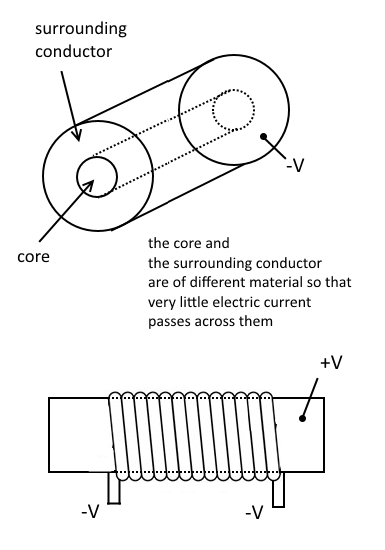
A similar way to separate positive and negative gravity particles is also shown in the bottom figure above, where spinning negative gravity particles are diverted away from the main particle stream by a negative electric potential surrounding the center core conductor.  The following is an illustrative diagram of two possible implementations.


Very little current should pass between the core and the surrounding conductor or coil.  In the case of separating  temperature particles, both conductors should be good conductor of heat, but at least one of them should be a bad conductor of electricity.

 Have a nice day.


Science And Disorder

Oh yes, science is otherwise schizophrenia; a closed, self-consistent system of deductions and derivations from a set of ''self-evident'' beliefs and axioms.  And you are equally crazy.  Science is an disorder only when you don't believe that you are crazy too.

I am better, I forget...

Does Electron Fall Under Gravity?

If the flight of a proton is a photon; a sustained flight that does not obey Lenz's Law (in effect the law of conservation of energy), then there can be two other positive particle radiations corresponding to positive temperature particles and positive gravitational particles.

Both are types of photons.  But, to accelerate positive particles to light speed would suggest that they are mass-less.  This is consistent with the derivation for force density, where a negative force density requires that the particle has some mass, and at the same time, positive particles have no mass.

Mass, \(m\), as the multiplicative constant to obtain weight, \(wt\), under gravity \(g\),

\(wt=mg\)

is fully determined and only determined by the presence of gravity particles.

At this point we extend our definition for mass to include charge mass, \(m_e\)  inertia of a particle accelerated under the electric force and temperature mass, \(m_{\small{T}}\) inertia of a particle accelerated under the temperature field.  Mass, \(m\) is redefined as \(m_{\small{G}}\), the gravitational mass/inertia in acceleration under gravity.

An electron then has \(m_e\) but not \(m_{\small{G}}\) nor \(m_{\small{T}}\).  Electrons do not fall under gravity!  Neither do temperature particles fall under gravity.


Tempero-gravitational Wave

For completeness sake,


We have from Maxwell,

\(\nabla.E=\cfrac{\rho}{\varepsilon_o}\)

\(\nabla.B=0\)

\(\nabla\times E+\cfrac{\partial B}{\partial t}=0\)

\(\nabla\times B-\cfrac{1}{c^2}\cfrac{\partial E}{\partial t}=\cfrac{1}{c^2}\cfrac{J}{\varepsilon_o}\)

and so, analogously,

\(\nabla.T=\cfrac{\rho_{\small{T}}}{\varepsilon_{\small{To}}}\)

where \(T\) is the temperature force field strength per unit temperature particle (defined later in this post).  \(\rho_{\small{T}}\), the negative temperature particle density enclosed inside the closed area for which \(\nabla.T\) is defined.

\(\nabla.G_W=0\)

where a gravitational field is produced by spinning negative temperature particles.

\(\nabla\times T+\cfrac{\partial G_W}{\partial t}=0\)

\(\nabla\times G_W-\cfrac{1}{c^2}\cfrac{\partial T}{\partial t}=\cfrac{1}{c^2}\cfrac{J_T}{\varepsilon_{\small{To}}}\)

where \(J_T\) is the negative temperature particle flow density.

Furthermore, \(\varepsilon_{\small{To}}\) is to be interpreted as the resistance to establishing a temperature force field in free space by a temperature particle, \(T_m\).   Such a force field, experienced by other temperature particles, is spherical, centered at \(T_m\),

\(T=F_{\small{/T_m}}=\cfrac{T_m}{4\pi \varepsilon_{\small{To}}r^2}\)

per unit temperature particle.  \(T\) is a Newtonian force per unit temperature particle \(T_m\), experienced by other temperature particle inside the temperature field.  \(T\) by itself is no longer temperature but a vector quantity.  It is possible to define a scalar potential field, \(T_s\), by defining zero potential at infinity (ie. \(r\rightarrow\infty\), \(T_s\rightarrow0\)); as just the derivations of electric and gravitational potentials.

We have a tempero-gravitational wave; a coupled pair of heat and gravitational energy; a wave oscillating between these two forms of energies; travelling at light speed \(c\).

Note:   宝莲灯; spinning negative temperature particles.


Saturday, February 20, 2016

Einstein's Gravitational Waves, Maxwell's ElectroMagnetic Waves And Me

By oscillating electrons in a conductor, we generate electromagnetic waves,

From Maxwell,

\(\nabla.E=\cfrac{\rho}{\varepsilon_o}\)

\(\nabla.B=0\)

\(\nabla\times E+\cfrac{\partial B}{\partial t}=0\)

\(\nabla\times B-\cfrac{1}{c^2}\cfrac{\partial E}{\partial t}=\cfrac{1}{c^2}\cfrac{J}{\varepsilon_o}\)

If negative gravity particle is as postulated,


In an analogous way, if we are able to oscillate negative gravity particles in an equivalent conductor, we will generate gravito-electric waves.

\(\nabla.G_W=\cfrac{\rho_g}{\varepsilon_{go}}\)

where \(G_W\) gravitational field, replaces \(E\) the electric field.  \(\rho_g\) is the total negative gravity particle enclosed (expressed as mass density).  And \(\varepsilon_{go}\) is equivalent to \(\varepsilon_{o}\) in free space.

\(\nabla.E=0\)

An \(E\) field due to the negative gravity particle spin replaces the \(B\) field due to electron spin.

\(\nabla\times G_W+\cfrac{\partial E}{\partial t}=0\)

\(\nabla\times E-\cfrac{1}{c^2}\cfrac{\partial G_W}{\partial t}=\cfrac{1}{c^2}\cfrac{J_g}{\varepsilon_{go}}\)

where \(J_g\) is the negative gravity particle flow density.

If we compare with Newton's expression for gravity, per unit mass,

\(F_{/m}=G\cfrac{m}{r^2}=4\pi G\cfrac{m}{4\pi r^2} \)

keeping in mind,

\(E=\cfrac{1}{\varepsilon_{o}}\cfrac{q}{4\pi r^2}\)

We can let,

\(\rho_g=\rho_m=\cfrac{m}{Volume\,\,enclosed}\)

\(4\pi G=\cfrac{1}{\varepsilon_{go}}\)

This is using the unmodified gravitational constant \(G\) for gravity.

Such gravito-electric waves can be detected by their varying electric component, just as EMW can also be detected by their varying magnetic field.

Have a nice day.

Tuesday, February 9, 2016

搵食難 初一春夜賣魚蛋
人情難 本钱未賺翻曬攤
世道難 磚頭警棍互相應
忍心難 一聲炮響震民驚
安平難 再聲炮響喧社定
進步難 火舌盤繞掩夜星
退步難 寒夜迫臉背窮境
不講難 年關風冷同赤身
再講難 當權緩法讓民生

《大吉利事!HK2016》

Sunday, February 7, 2016

夜雨送岁
一洗尘旧
炎热夏国
难得凉秋

冷风迎春
拥怀心暖
淡淡人生
喜聚佳节

《新春2016》

Saturday, February 6, 2016

The Likes Of Hall Effects

This is how a transient field as the result of spinning negative particles around a positive nucleus might align and be detectable. A negative particle spinning around a positive nucleus and together revolve around another nucleus (positive or negative) in an elliptical orbit.


A positive field will be required to push the positive nucleus towards a flat surface of the containing material.  This field can be along the direction of the transient field, perpendicular to the flat surface or be perpendicular to the transient field, parallel to the flat surface.

It is likely that the center particle about which the spinning pair revolves, is part of the solid lattice of the material.  This requires that the lattice be sufficiently sparse to accommodate the revolving pair of particles.

Happy Lunar New Year!  Go crazy.

Thursday, February 4, 2016

春引夜寒
冰冰晨曦
冬拖旧岁
姗姗不退
烈日当夏
尽洒光辉
冷流暖流
风和呈秋
赤道小国
半日春秋

《岛国风情》
春节咆战
不耻虚谦
兵凑几多?
老幼残凑!
再轰屯里
微毫即发
座年顾阵
亿夫当关
君便自游
瓮备年羹

《我狂》


雨歇密云开
且留七分凉
顽月无觅处
木兰携草芳

冬尽春意迫
先送三分暖
灌木齐望春
浓香报春早

《木兰 望春 》