Tuesday, January 31, 2023

推背圖

第四三象 丙午 巽下離上 鼎 

讖曰:

君非君 臣非臣

始艱危 終克定

頌曰:

黑兔走入青龍穴 欲盡不盡不可說

惟有外邊根樹上 三十年中子孫結

兔入穴‘冤’,

欲盡則‘洩’, 不盡,洩的反義‘補’ 不可說為‘噤’

外邊‘疆’,惟有外邊,‘疆’的邊旁是‘弓’

三十年為‘一世’,中,把‘世’拆開,‘一’,‘七’ 和 ‘廿’

子孫結為‘果’, ‘果’字的根樹上,加‘弓’,加‘穴’字的‘八’, 是‘弹’。

‘冤’,‘中子弹’。‘洩’,‘補’,‘噤’,應是諧音,名字或地名。

君非君 臣非臣, 都是戲子。

始艱危 終克定, 大同千千界,難道兒戲。


Friday, January 27, 2023

Not Counting Primes Afterall

 No, sum of the reciprocals of primes is not the count of primes,

\(\pi(x)\ne log(x)\)

but,

\(\sum^n_{i=1}\cfrac{1}{p_n}\rightarrow log(n)\)

more correctly, piecewise,

\(\sum^n_{i}\cfrac{1}{p_n}\rightarrow log(x)|^{n}_{i}\)

for \(n\) and \(i\) large, positive.  Which adds no information because, the sum of \(\cfrac{1}{x}\) is smaller than the integration of \(\cfrac{1}{x}\), ie \(log(x)\).  And rightfully,

\(p_n=n\)

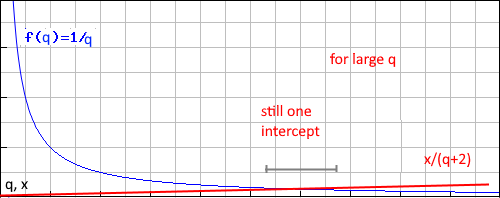
which means a log(x) factor is the result of possible intersections of \(\cfrac{1}{x}\) with \(\cfrac{x}{p_n+2}\).

Shifting \(\cfrac{x}{p_n+2}\) against \(\cfrac{1}{x}\) to find an integer intercept is,

\(\cfrac{x_1}{p_n+2}=y=\cfrac{1}{x_2}\)

\(x_1x_2=p_n+2\)

looking for a product of \(x_1\) and \(x_2\), that rules out \(p_n+2\) as prime.

There is still no new information that makes prime \(p_n\) different from any number \(x\).


Prime Panic

 If \(\pi(x)\lt log(x)\) that the number of primes up to \(x\) is bounded by \(log(x)\), and not \(x/log(x)\) there are way less primes available for anything and everything.


Primes are all under the \(\cfrac{1}{x}\) curve, except for non primes when \(\cfrac{x}{p_n}\) intercept \(\cfrac{1}{x}\) at integer values for \(x\), so

\(\pi(x)\lt log(x)\)

This is serious, Prime Scarce.


Prime Number Theorem And Intercepting The \(\frac{1}{x}\) Line

 It's \(\pi(x)=log(x)\) and not \(\cfrac{x}{log(x)}\) and \(p_n=n\) and not \(nlog(n)\),


Whether it is an intercept on the \(\cfrac{1}{p_n}\) curve by the \(\cfrac{x}{p_n+2}\) line for a factor, as such a non prime, or a non-intercept on the \(\cfrac{1}{p_n}\) curve by the \(\cfrac{x}{p_n+2}\) line for prime number, both ride along the \(\cfrac{1}{p_n}\) curve.

So, the number of primes, \(\pi(x)\) at \(x\) is less than \(\int^{x}_1{\cfrac{1}{x}}=log(x)\)

this however, does not give any information on the prime itself, \(p_n\)

\(p_n=n\)

Happy Lunar New Year.. reset system to spring and start over.

Thursday, January 26, 2023

Exactly Where?

 Earth is a dynamic system spinning and revolving,  a space elevator no matter how weightless,


will topple the system and end up spinning along the equator, albeit a new equator.  When that happens, there will be huge tidal waves, flooding and drastic climate changes.  So, don't build a space elevator anywhere else except exactly at the equator.


Saturday, January 14, 2023

\(\Large\pi\) is Eventually Rational

 From the previous post "Zero Error Small Piece Of Pi" dated 11 Jan 2023, that series for \(\pi\) has a zero correction at the infinite term, that means the infinite but one term represents \(\pi\) fully, and \(\pi\) is rational.  Eventually.

Neither \(e\) nor \(\sqrt{2}\) share this.  Both their descending series representations tend to zero at the infinite term but not quite zero.

A new kind of irrationality.


Wednesday, January 11, 2023

Zero Error Small Piece Of Pi

 The fact is,

\(\theta_0=\cfrac{\pi}{4}\)

\(S_{\theta_i}=\cfrac{\pi}{2^2}+\cfrac{\pi}{2^3}+...+\cfrac{\pi}{2^{i+1}}+\cfrac{\theta_0}{2^{i}}=\cfrac{\pi}{2^2}+\cfrac{\pi}{2^3}+...+\cfrac{\pi}{2^{i+2}}\)

\(S^{i\rightarrow\infty}_{\theta_i}=\cfrac{\pi}{2^2}(1+\cfrac{1}{2}+\cfrac{1}{2^2}+...+\cfrac{1}{2^{i}}...)\)

\(S^{i\rightarrow\infty}_{\theta_i}=\cfrac{\pi}{2^2}(2)\)

\(S^{i\rightarrow\infty}_{\theta_i}=\cfrac{\pi}{2}\)

So, the last correction is,

\(\epsilon_{i\rightarrow\infty}=M_{i\rightarrow\infty}(\cfrac{1}{sin\theta_{i\rightarrow\infty}}-1)^2tan\theta_{i\rightarrow\infty}\)

\(\epsilon_{i\rightarrow\infty}=M_{i\rightarrow\infty}(\cfrac{1}{sin(\frac{\pi}{2})}-1)^2tan(\frac{\pi}{2})=0\)

no matter what \(M_{i\rightarrow\infty}\) and \(tan(\frac{\pi}{2})\) are.  The smallest piece of \(\pi\) corrected is zero.


Finding Pi In A square Plate

 Consider again,


\(\theta_0=\cfrac{\pi}{4}\)

\(Area = r(\cfrac{1}{sin\theta_0}-1).r(\cfrac{1}{sin\theta_0}-1)tan\theta_0=r^2(\cfrac{1}{sin\theta_0}-1)^2tan\theta_0\)

For all four quadrant, multiply by \(M_0=4\).

Consider the next triangle for which there are two, 

\(\theta_1=\cfrac{1}{2}(\pi-(\cfrac{\pi}{2}-\theta_0))=\cfrac{\pi}{4}+\cfrac{\theta_0}{2}=\cfrac{3}{8}\pi\)

\(Area = r(\cfrac{1}{sin\theta_1}-1).r(\cfrac{1}{sin\theta_1}-1)tan\theta_1=r^2(\cfrac{1}{sin\theta_1}-1)^2tan\theta_1\)

\(M_1=4*2\)

And the next \(\theta_2\),

\(\theta_2=\cfrac{1}{2}(\pi-(\cfrac{\pi}{2}-\theta_1))=\cfrac{\pi}{4}+\cfrac{\theta_1}{2}=\cfrac{7}{16}\pi\)

We have,

\(S_{\theta_2}=\cfrac{\pi}{4}+\cfrac{1}{2}\left(\cfrac{\pi}{4}+\cfrac{\theta_0}{2}\right)=\cfrac{\pi}{4}+\cfrac{1}{2}*\cfrac{\pi}{4}+\cfrac{\theta_0}{2^2}\)

\(S_{\theta_3}=\cfrac{\pi}{4}+\cfrac{1}{2}\left(\cfrac{\pi}{4}+\cfrac{1}{2}\left(\cfrac{\pi}{4}+\cfrac{\theta_0}{2}\right)\right)=\cfrac{\pi}{4}+\cfrac{\pi}{2*4}+\cfrac{\pi}{2^2*4}+\cfrac{\theta_0}{2^3}\)

\(S_{\theta_4}=\cfrac{\pi}{4}+\cfrac{1}{2}\left(\cfrac{\pi}{4}+\cfrac{\pi}{2*4}+\cfrac{\pi}{2^2*4}+\cfrac{\theta_0}{2^3}\right)=\cfrac{\pi}{4}+\cfrac{\pi}{2*4}+\cfrac{\pi}{2^2*4}+\cfrac{\pi}{2^3*4}+\cfrac{\theta_0}{2^4}\)

In general, 

\(S_{\theta_i}=\cfrac{\pi}{2^2}+\cfrac{\pi}{2^3}+\cfrac{\pi}{2^4}+...+\cfrac{\pi}{2^{i+1}}+\cfrac{\theta_0}{2^{i}}\)

Multiplicative factor due to symmetry, \(M_2=4*2^2=16\), in general for \(\theta_i\),

\(M_i=4*2^{i}=2^{i+2}\)

We have a series \(E_i\) to estimate \(\pi\), with \(r=1\), area of square 4,

\(\epsilon_i=M_i(\cfrac{1}{sin\theta_i}-1)^2tan\theta_i\)

\(\theta_0=\cfrac{\pi}{4}\)

\(S_{\theta_i}=\cfrac{\pi}{2^2}+\cfrac{\pi}{2^3}+...+\cfrac{\pi}{2^{i+1}}+\cfrac{\theta_0}{2^{i}}=\cfrac{\pi}{2^2}+\cfrac{\pi}{2^3}+...+\cfrac{\pi}{2^{i+2}}\)

and \(M_i=2^{i+2}\)

\(E_i=4-\epsilon_0-\epsilon_1-\epsilon_2...-\epsilon_i\)

\(E_0=8(\sqrt{2}-1)=3.313708\)

\(\epsilon_1=8(\cfrac{1}{sin(\frac{\pi}{4}+\frac{\pi}{8})}-1)^2tan(\frac{\pi}{4}+\frac{\pi}{8})=0.131111\)

\(E_1=8(\sqrt{2}-1)-0.131111=3.182598\)

\(\epsilon_2=16(\cfrac{1}{sin(\frac{\pi}{4}+\frac{\pi}{8}+\frac{\pi}{16})}-1)^2tan(\frac{\pi}{4}+\frac{\pi}{8}+\frac{\pi}{16})=0.03087297\)

\(E_2=8(\sqrt{2}-1)-0.131111-0.03087297=3.151725\)

\(\epsilon_3=32(\cfrac{1}{sin(\frac{\pi}{4}+\frac{\pi}{8}+\frac{\pi}{16}+\frac{\pi}{32})}-1)^2tan(\frac{\pi}{4}+\frac{\pi}{8}+\frac{\pi}{16}+\frac{\pi}{32})\\=0.0076065\)

\(E_3=8(\sqrt{2}-1)-0.131111-0.03087297-0.0076065=3.144118\)

\(\epsilon_4 =64(\cfrac{1}{sin(\frac{\pi}{4}+\frac{\pi}{8}+\frac{\pi}{16}+\frac{\pi}{32}+\frac{\pi}{64})}-1)^2tan(\frac{\pi}{4}+\frac{\pi}{8}+\frac{\pi}{16}+\frac{\pi}{32}+\frac{\pi}{64})  \\=0.001894755\)

\(E_4=8(\sqrt{2}-1)-0.131111-0.03087297-0.0076065-0.001894755=3.1422236\)

\(\epsilon_5 =128(\cfrac{1}{sin(\frac{\pi}{4}+\frac{\pi}{8}+\frac{\pi}{16}+\frac{\pi}{32}+\frac{\pi}{64}+\cfrac{\pi}{128})}-1)^2tan(\frac{\pi}{4}+\frac{\pi}{8}+\frac{\pi}{16}+\frac{\pi}{32}+\frac{\pi}{64}+\cfrac{\pi}{128})  \\=0.000473261\)

\(E_5=8(\sqrt{2}-1)-0.131111-0.03087297-0.0076065-0.001894755-0.000473261\\=3.1417500\)

\(\epsilon_6 =256(\cfrac{1}{sin(\frac{\pi}{4}+\frac{\pi}{8}+\frac{\pi}{16}+\frac{\pi}{32}+\frac{\pi}{64}+\frac{\pi}{128}+\frac{\pi}{256})}-1)^2tan(\frac{\pi}{4}+\frac{\pi}{8}+\frac{\pi}{16}+\frac{\pi}{32}+\frac{\pi}{64}+\frac{\pi}{128}+\frac{\pi}{256})  \\=0.000118288\)

\(E_6=8(\sqrt{2}-1)-0.131111-0.03087297-0.0076065-0.001894755\\-0.000473261-0.000118288=3.1416317\)

Just for fun.  \(\pi\) as a simple series.


Gauss Circle, Square And Triangle

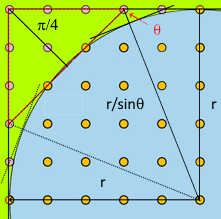
 Consider the circle,

and the estimate for the number of integer points in the circle is, square minus four triangles. 

\(e_z=(2r)^2-4(r(\sqrt{2}-1))^2\)

\(e_z=4r^2(1-(\sqrt{2}-1)^2)\)

\(e_z=4r^2(1-(2+1-2\sqrt{2})\)

\(e_z=8r^2(\sqrt{2}-1)\)

\(\pi\) need not get involved, but the estimation comes from a circle in a square.

Good night.


Fusobacterium Infection, Eyes

 These are frequencies for Fusobacterium infection including the eyes,

Fusobacterium Infection 470-12 377-91 115-7 Hz

Fusobacterium Infection 470-12 377-91 115-7 177-979 1779-79 Hz

Fusobacterium Infection 115-7 Hz

Fusobacterium Infection 377-91 Hz

Fusobacterium Infection 470-12 Hz

Good luck.


Monday, January 9, 2023

For Twins Large

 There is still just one intercept at a time, as the line is translated by odd steps (start on odd number plus 2 for every next step).


The two low gradients might guarantee an odd integer intercepts.  This suggests twin primes cease to exist beyond this point.

Twin prime conjecture is wrong.  Even if the twin prime returns and then start off again, some regions along the primes number will not have twin primes series.

If the target points on \(1/q\) were to straighten out, there is still no guarantee that there will be a intersect at an integer on \(1/q\).

So, when there is no integer intercept, twin primes occurs over long stretches where \(1/q\) levels off, then the \(1/q\) asymptote drops and factors appear, the twin prime disappears over a short period, afterwards, the asymptote levels off again and twin primes occur again over a relatively long period.  Over long plateau of the asymptote either no twin primes or consecutive twin primes can occur.  This is followed by a drop in the asymptote and once again a series of twin primes or not can occur.  The drop in asymptote usher a change but can change to the same.


Twins Hopping Odd

 More accurately,


which does not indicate the inevitability of \(q+2\) being prime.

No prove.


Prime Arrows and Targets

 From previously, "Going Around In Circle" dated 09 Jan 2023, \(3\) has been excluded as a factor of \(q+2\),

the total number of integer marks along arc \(q+2\) from \(1\) to \(\cfrac{q+2}{3}\) is about,

\(T=\cfrac{q+2}{3}-1+1\)

after removing \(1\) and \(2\) as possible intercepts,

\(T=\cfrac{q+2}{3}-3+1=\cfrac{q+2}{3}-2=\cfrac{q-4}{3}\)

and the number of possible 1st intercept lines from arc \(q\) and below is,

\(a=\cfrac{q-1}{2}-2=\cfrac{q-5}{2}\)

where arcs \(1\) and \(2\) are excluded.  There is more targets than arrows, and the numbers \(2\), \(3\), \(4\) and \(5\) are involved.

The targets are evenly spaced along arc \(q+2\) at equal angle intervals, \(\cfrac{\pi}{2}*\cfrac{1}{2}*\cfrac{1}{q+2}=\cfrac{\pi}{4(q+2)}\),

\(\cfrac{3\pi}{4(q+2)}\),\(\cfrac{4\pi}{4(q+2)}\), \(\cfrac{5\pi}{4(q+2)}\)...  \(\cfrac{(q+2)\pi}{3*4(q+2)}=\cfrac{\pi}{12}\) excluded. 

\(\cfrac{\pi}{4}\cfrac{3}{(q+2)}\),\(\cfrac{\pi}{4}\cfrac{4}{(q+2)}\), \(\cfrac{\pi}{4}\cfrac{5}{(q+2)}\)... \(\cfrac{\pi}{4}\cfrac{(q+1)}{3*(q+2)}\)

whereas the arrows are at,

\((\cfrac{\pi}{4}*\cfrac{1}{3})\) excluded, \((\cfrac{\pi}{4}*\cfrac{1}{5})\),  \((\cfrac{\pi}{4}*\cfrac{1}{7})\), \((\cfrac{\pi}{4}*\cfrac{1}{9})\)... \((\cfrac{\pi}{4}*\cfrac{1}{q-2})\)

Removing \(\cfrac{\pi}{4}\) the common factor,

\(\cfrac{3}{(q+2)}\),\(\cfrac{4}{(q+2)}\), \(\cfrac{5}{(q+2)}\)... \(\cfrac{(q+1)}{3}*\cfrac{1}{(q+2)}\)

\(\cfrac{1}{5}\),  \(\cfrac{1}{7}\), \(\cfrac{1}{9}\)... \(\cfrac{1}{q-2}\)

If these two series share a common member, then \(q+2\) is not prime.

This is nothing new, as  a prime candidate is often tested for all possible factors.  These members are on the delimited line,

\(\cfrac{1}{q+2} x\) 

and  \(3\le x\le \cfrac{q+1}{3}\) 

and the curve, 

\(\cfrac{1}{x}\) 

but for \(x\) odd, \(5\le x\le (q-2)\)

If the line and the curve intersect within the specified domains at integer points then \(q+2\) is not prime.

The target are on a line and the arrows on a reciprocal curve.  They will meet once, but do they meet in the restricted domains?  The line maybe translated along the \(x\) axis, as any coincidental member on the two series will fail \(q+2\) as a prime.


The line and curve will meet, but not necessarily on odd integer points, but always, no matter how large \(q\) is, as the curve is translated along the \(x\) axis within its domain in odd integer steps,\(5\le x\le (q-2)\).

Integers that are candidates for factors will be below the curve \(\cfrac{1}{x}\) when the line starts at the origin.  As the line translated along \(x\) in odd integer steps, candidates  that are not factors are moved above the curve.

Factors will meet on the curve exactly.

Good morning. 


Producing Negative Gravity Particles Nowhere

 Since a dodecahedron cannot be divided along its edges into two like a tetrahedron, it seem that only positive particles are possible.


Maybe a high current that drain away (right hand screw rule) from the dodecahedron inside, will produce negative gravity particles, and opens up a portal to nowhere.

Going somewhere.

Going Around In Circle

 The presence of \(q\) does not guarantee that \(q+2\) is prime.

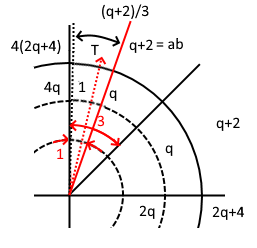
where the bisector of arc \(2(q+2)\) intersects arc \(2b\) at a integer marking.  A line through the 1st marking on arc \(2b\) intersect arc \(2(q+2)\) at the \(a^{th}\) mark.

\(q+2=a*b\)

if \(a\) is not an integer neither \(a\) nor \(b\) is a factor of \(q+2\).

\(q\) is prime means none of the 1st intercept lines (lines through the first mark and the center of the arc) below it, cross it at an integer marking.

The first mark intercept lines approaches the vertical as the arc value approach \(2q\).

The first mark intercept from arc \(2q\) will be very close to the first mark of \(2(q+2)\).

The widest 1st mark comes from \(q=3\) or an arc of length \(6\).  If this 1st intercept line crosses on \(R_a\) on arc \(2(q+2)\)then the integer marks between the first mark on arc \(2(q+2)\) and \(R_a\) will have no intercepts from all first mark intercept from arcs below it, when \(q+2\) is prime.

The arc \(2q=6\) divides the right angle in \(\cfrac{\pi}{12}\) this angle extends a width,

\(\cfrac{\pi}{12}*\cfrac{2}{\pi}2(q+2)=\cfrac{1}{3}(q+2)\)

on arc \(2(q+2)\).

So, \(q+2\) is prime only if there are no intercepts from its third mark to the \(\cfrac{1}{3}(q+2)\) mark due to all 1st mark intercept lines below it.

This narrows the range from which a factor of \(q+2\) can be found, to a number up to \(\cfrac{1}{3}(q+2)\) after considering the number \(3\).

All numbers above arc \(b=3\) will mark, with a 1st intercept line, to the left of the 1st intercept line from \(b=3\), and narrows the range from which a factor can be found.

Only \(b\) that are odd are considered.

The 1st intercept steps in decreasing step angle given by \(\cfrac{\pi}{4b}\).

The step angle size of \(q\) is \(\cfrac{\pi}{4q}\).  If, an integer marking at \(n\), intercepts with the first intercept line from arc \(b\).

\(n\cfrac{\pi}{4q}=\cfrac{\pi}{4b}\)

then     \(q=nb\)

then \(q\) has a factor \(n\), and \(b\).

There is no further information to indicate \(q+2\) to be prime.


Sunday, January 8, 2023

Deactivating Organophosphorus Compound

The length of phosphorus-oxygen double bonds is \(1.52\,\dot{A}\)  

\(f_{res}=0.122\cfrac{c}{BL}\)

\(f_{res}=0.122*\cfrac{299792458}{1.52}*10^{10}\)

\(\cfrac{f_{res}}{10^{15}}= 240.622\,\,Hz\)

This frequency will hopefully change the functional group to a tautomer P(OH)3 attached compound.  And render toxins like Sarin, Tabun and VX ineffective.

Other phosphorous bonds breakable,

Phosphorus-oxygen single bonds,

\(f_{res}=0.122*\cfrac{299792458}{1.66}*10^{10}\)

\(\cfrac{f_{res}}{10^{15}}= 220.329\,\,Hz\)

or with the involvement of d orbitals,

\(f_{res}=0.122*\cfrac{299792458}{1.62}*10^{10}\)

\(\cfrac{f_{res}}{10^{15}}= 225.769\,\,Hz\)

Dephosphorylation deactivates proteins and is very dangerous.

Saturday, January 7, 2023

Taking Time Positively and Negatively

 Take your time, 


positive or negative, take it.  It's a cube inside.


A New Force

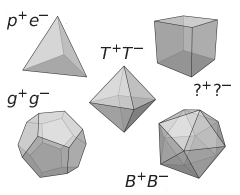
 Particle assignments and then Platonic Solids assignments,

Whatever the assignment one particle pair, force/energy type is missing. 

\(C^+\),  \(C^-\) for life force, Chi.  Chronos, actually.  Time particles/photons.


Amplify Negative Particles

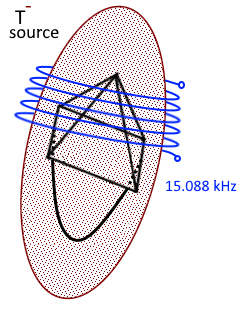
 Maybe to amplify the number of negative particles, a frequency of \(141.988\,kHz\) will drive more particles outwards.


and so, the number get amplified and not the size/energy of the particles.


Platonic Solids And Energy, Which Is Which?

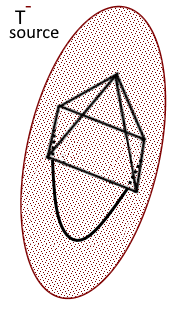
This is a \(T^{+}\) source, a complete encased octahedron,


it renders things more colorful and with enough strength, combusts them.

This is a \(T^{-}\) source, a half encased octahedron, shorted at the base,

it turns things invisible and at high strength crystalizes them.  Things made invisible can be illuminated by the encased tetrahedron shown above.  A beam of this nature is deflected by crystalline surfaces.

\(p^+\), \(e^-\), \(g^+\), \(g^-\), \(m^+\), \(m^-\) and space.  

Just enough Platonic Solids; but which is which.  Can a negative source be amplified without making them positive,

is there more negative particles or do the particles increase in size and turn positive.


Breaking Hydrogen Chloride Bonds

 Hydrogen Chloride bond length is, \(1.275\,\dot{A}\) 

\(f_{res}=0.122\cfrac{c}{BL}\)

\(f_{res}=0.122*\cfrac{299792458}{1.275}*10^{10}\)

\(\cfrac{f_{res}}{10^{15}}= 286.860\,\,Hz\)

Hydrogen Chloride 286-86 2868-60 Hz

Hydrogen Chloride 286-86 Hz

Hydrogen Chloride 2868-60 Hz

Just in case you have poison in your drinks.


Friday, January 6, 2023

大盘和掠舰

 Big craft,


tactical craft,


whatever two spinning discs can be made into.


Superimposed Dimensions

If superimposed dimension count as such higher dimensions and there can be three orthogonal axes in 3D space the last providing chirality.   

There are two other dimensions in space and then three in time, for a total of five possible  dimensions to superimpose on.  Including the mandate (un-imposed), that we exist in, five superimpose dimensions and six existing dimensions for a total of thirteen dimensions. 

One higher dimension is three space plus time superimposed on another one dimension.

Superposition will explain how particles are made to radiate photons. 

They started as a superposition of a photon and a particle in the first place.  Orthogonality restricts the types of superposition possible and so limits the types of photons emitted or not at all.


Higher Dimensions

 If this,

\(\cfrac{\partial^2\psi}{\partial\,t^2_c}=ic\cfrac{\partial^2\psi}{\partial\,x\partial\,t_c}\)

can accommodate another, \(\cfrac{\partial}{\partial\,t}\) or \(\cfrac{\partial}{\partial\,x}\), then that is higher dimension.

Nothing else.

Two Types Of Electrons

 Then again, there might be a new type of energy that can be drawn from the time dimension,


denoted here as \(t_m\).  It is magnetism or magnetic energy that establish a magnetic field; drives the magnetic field lines.

In which case, we have two types of electrons, both almost massless because of missing or oscillating \(t_g\).  An oscillating field can be subjected to a similar field and displays a bias that is observed as a small mass/inertia.  Without \(t_g\), massless, would mean a wave; a pure wave.

This might destroy wave-particle duality.  Wave and particles are separate entity with the similar field properties.

And there's a lot more types of particles.

If \(t_c\) is also oscillating then there are two wave/particle superimposed in a orthogonal direction.  And this beast,

\(\cfrac{\partial^2\psi}{\partial\,t^2_c}=ic\cfrac{\partial^2\psi}{\partial\,x\partial\,t_c}\)

 is sleeping with,

\(i\cfrac{\partial^2\psi}{\partial\,t^2_m}=-c\cfrac{\partial^2\psi}{\partial\,x\partial\,t_m}\)

in an orthogonal manner, \(i*i=-1\).

Four types of energy (Platonic Solids) can be drawn from the time dimension, (a believe, not science) in  different combinations of a wave creates different particles.  Particle may superimpose orthogonally and manifest as different distinctive particles with different (superimposed) properties.

Those with \(t_g\), gravitational energy are particles with mass, those with oscillating \(t_g\) display small mass under gravitational field.  The rest (absolutely no \(t_g\)) are photons for the time being.

Good night.


Two Opposing Spin Aluminum Discs

Remember this model of an electron,


where \(t_g\) in oscillation results in a particle without mass.  But this field is manifested/ produced in rotation.

This is magnetism. An electron in circular motion, produce magnetic field lines that is actually gravitational field lines.  This way temperature acts independently.  Magnetism does not exist, it is just gravity fields; magnetic monopoles do not exist.

This would explain,

where the spinning discs close together presses the fields in between to emphases the fields top and bottom of the discs.

This arrangement brings control upwards and downwards.  Slow the spin of the top disc and the contraption lifts; slow down the spin of the bottom disc and the contraption lowers.

Open the disc in the direction of intended travel and the contraption move forward in that direction. 

Or, bring the disc closer in the direction of intended travel and the contraption move forward in that direction.


Quiet, gravitational drive!


Kindergarten Math And Half Way Done

 A rational diagonal is easier to draw, \(c=\cfrac{a}{b}\) means a line \(b\) on the x axis and \(a\) up on the y axis; a line through cutting the both axes at these point is \(c\).  But what else?

The effect of not allowing other numbers for \(c\) is an incomplete set of spaced ellipses.

But what look like a ellipse is an ellipse.  Since every ellipse can be drawn on a pixelized computer screen, there are finite number of rational points on every ellipse.  Birch and Swinnerton-Dyer conjecture is half proven! 

The latter part of the Conjecture, "...and the first non-zero coefficient in the Taylor expansion of L(E, s) at s = 1 is given by more refined arithmetic data attached to E over K", suggests an irrational coefficient, possibly involving \(\sqrt{2}\) and \(\pi\).

Dithering is after the ellipse has been drawn.  A kind of fuzz to made the lines smooth.

A made-up question to plot ellipse on cartesian points.  Not fun.

Note:  \(c\) is used to general the ellipse; rational \(c\), plots rational points on the ellipse.  If  \(c\) not rational move diagonal to next rational points and start there.


Squares In A Square

 More correctly,


why the triangle, why insist on a rational diagonal?


Thursday, January 5, 2023

Kindergarten Again

 When the square full right angle triangle divided by the repeated factor, \(2\).  It seem an area of size \(1\) square unit does not count,


There are not considered squares there!  And apparently, a lot of unit squares are being cut up to fit into a right angle triangle.

What childhood memories.

Prime are not congruent, by their definition!  This is wrong.

When \(a=1\), for 

\(b=2n\)

Area of triangle\(=\cfrac{1}{2}a*b=\cfrac{1}{2}.2n=n\)

But side \(c\) must also be rational.

\(\sqrt{1^2+(2n)^2}=\sqrt{4n^2+1}\) 

which is the square of an odd number.  \(c\) is odd.  

\(\sqrt{4n^2+1}=2m+1\)

\(4n^2+1=(2m+1)^2\)

\(n=\cfrac{1}{4}\sqrt{(2m+1)^2-1}\)

So, maybe...

\(b=2n=\cfrac{1}{2}\sqrt{(2m+1)^2-1}\)

\(c=2m+1\)

\(a=1\)  

This unfortunately does not happen.  \(a=1\) only is wrong.  Both is possible, \(a=odd\), \(b=even\) and \(c=odd\).  Both sides \(a\) and \(b\) being even is not allow because they will generate a \(\sqrt{2}\) factor in \(c\) unless they form a perfect square.  A pair of \(a\) and \(b\) both odd will give even \(c\) s.  A pair of \(a\), \(b\), odd and even, will given odd \(c\) s.

But what about fractions?  odd, even fraction?  

In seem that this question is didactic, Kindergarten all over again.  Aliens teachers...

Thank you.


Integer Full Of Squares

 This is why they are squares in rational right angle triangle,

the squares fit exactly.

\(\cfrac{1}{2}*\cfrac{204}{3}*\cfrac{6}{3}=68=2*2*17\)

the squares comes from multiple factors, in this case \(2*2\).

Note:  \({\cfrac{204}{3},\,\cfrac{6}{3}}\) also work for an area of 51 which has no square and so squareless.


Finding Congruent Numbers

 This is why the elliptic,


and congruent numbers together.  Does any elliptic has a set of congruent numbers, \({a,\,b}\) that is the sides of a right angle triangle whose area is a whole number.  \(\cfrac{204}{3}*\cfrac{6}{4}*\cfrac{1}{2}=51\) is the integer, indicated by the area of the triangle.

More likely every curve has more than one, such set.


Wednesday, January 4, 2023

Where Opposites Take Off

 Because this can fly,


so, this can fly better,

two aluminum discs with flat surfaces very close and spinning in the opposite direction.

Don't play on the road now.


So, Not Going To Heaven

 $$y^{-i2ln(a)/\pi}=a^{\frac{1}{n}}$$

$$e^{i\theta-i2ln(a)/\pi}=a^{\frac{1}{n}}$$

This is wrong!  So have been,

$$\LARGE{e^{(i\theta)^{-i2ln(a)/\pi}=\,\LARGE{{a}^{\small\frac{1}{n}}}}}$$

Which is bad...

$$\LARGE{e^{{(i\theta)^{-i2ln(a)/\pi}}=\,\LARGE{{a}^{\small\frac{1}{n}}}}}$$

$$\LARGE{e^{{(ie)^{-i2ln(\theta)ln(a)/\pi}}=\,\LARGE{{a}^{\small\frac{1}{n}}}}}$$

$$\LARGE{e^{{(i^i)^{-2ln(\theta)ln(a)/\pi}.(e)^{-i2ln(\theta)ln(a)/\pi}}=\,\LARGE{{a}^{\small\frac{1}{n}}}}}$$

$$\LARGE{e^{{(i^i)^{-2ln(\theta)ln(a)/\pi}}.e^{-i2ln(\theta)ln(a)/\pi}=\,\LARGE{{a}^{\small\frac{1}{n}}}}}$$

\(\theta=\cfrac{\pi}{2n}\), and   \(i^i=0.20788\lt 1\)

What about,

$$\LARGE{e^{(i^i)^{-\frac{2}{\pi}ln(a+\frac{\pi}{2n})}}}$$

$$\LARGE{e^{e^{-i\frac{2}{\pi}ln(a+\frac{\pi}{2n})}}}$$

And what the f**k for?

$$\LARGE{|a^{\frac{1}{n}}|=e^{(i^i)^{-\frac{2}{\pi}ln(a+\frac{\pi}{2n})}}}.{e^{{cos\left(\frac{2}{\pi}ln(a+\frac{\pi}{2n})\right)}}}$$

Since the imaginary part has is a sine function,

$$-1 \le \angle arg\le 1$$

and as only positive values are considered, and the stated condition,

$$\cfrac{1}{m}+\cfrac{1}{n}+\cfrac{1}{k}\lt 1$$

$$|\angle arg |\lt 1$$

Still not going to heaven.


\(c\) Goes to Heaven

Looking at,

\(c^k= e^{-i\cfrac{\pi}{2k}}. c^{i\cfrac{\pi}{2}}\) This is wrong.

Consider,

\(y=c^{i\cfrac{\pi}{2}}\)

\(ln(y)=i\cfrac{\pi}{2}ln(c)\)

\(y=c.e^{i\cfrac{\pi}{2}}\)

\(c^k= c.e^{i\cfrac{\pi}{2}\left(1-\cfrac{1}{k}\right)}\)

Visually,


\(\cfrac{\pi}{2}\left(1-\cfrac{1}{k}\right) \longrightarrow \cfrac{\pi}{2}\)   as \(k\rightarrow \infty\)

With \(|c|\rightarrow \infty\),  \(c\) goes to heaven, upwards.


Tuesday, January 3, 2023

Turning Round And Round

And it seem that,

\(a^{\frac{1}{m}}+b^{\frac{1}{n}}=c^\frac{1}{k}\)

is just,

\(cos(\theta_m)+cos(\theta_n)=cos(\theta_k)\), where the radius of the circle has been normalized with a factor \(\cfrac{\pi}{2}\).

\(r\theta_n=arc_n\) , \(r=\cfrac{2}{\pi}\)

\(\theta_n=\cfrac{1}{n}\cfrac{\pi}{2}\)

\(\theta_m=\cfrac{1}{m}\cfrac{\pi}{2}\)

\(\theta_k=\cfrac{1}{k}\cfrac{\pi}{2}\)

\(cos(\cfrac{\pi}{2m})+cos(\cfrac{\pi}{2n})=cos(\cfrac{\pi}{2k})\)

What happened to \(a^{m}, b^{n}, c^{k}\)?

$${ln(y)nln(a)}=\frac{\pi}{2}ln(a)$$  

Consider, $$y=e^{i\theta}$$

$$ln(y)=i\cfrac{1}{n}\cfrac{\pi}{2}$$

$$\cfrac{2ln(y)ln(a)}{\pi}=i\frac{1}{n}ln(a)$$

$$ln(y)nln(a)=i\frac{\pi}{2}ln(a)$$

$$ln(y)=ln(a)(\frac{i\pi}{2}-n)$$

$$e^{i\theta}=a^{\cfrac{i\pi}{2}-n}$$

$$a^n=e^{-i\theta} a^{\cfrac{i\pi}{2}}$$

And so,

$$a^m=e^{-i\theta_m} a^{\cfrac{i\pi}{2}}$$

$$b^n=e^{-i\theta_n} a^{\cfrac{i\pi}{2}}$$

$$c^k=e^{-i\theta_k} a^{\cfrac{i\pi}{2}}$$

With \(\theta_n=\cfrac{\pi}{2n}\),  \(\theta_m=\cfrac{\pi}{2m}\),  \(\theta_k=\cfrac{\pi}{2k}\)

$$a^m+b^n=e^{-i\cfrac{\pi}{2n}}. a^{i\cfrac{\pi}{2}}+e^{-i\cfrac{\pi}{2m}} .b^{i\cfrac{\pi}{2}}=e^{-i\cfrac{\pi}{2k}}. c^{i\cfrac{\pi}{2}}=c^k$$

And they just keep turning.


Don't Any How Define A Cross Product

If we define a cross product as, \(a\otimes b=b^a\)

consider, 

\(\frac{1}{m}\otimes a = a^{\frac{1}{m}}\)

 \(\frac{1}{n}\otimes b = b^{\frac{1}{n}}\)

 \(\frac{1}{k}\otimes c = c^{\frac{1}{k}}\)

and

\(c^\frac{1}{k}=a^{\frac{1}{m}}+b^{\frac{1}{n}}\)

where \(\cfrac{1}{m}+\cfrac{1}{n}+\cfrac{1}{k}\lt 1\)


Don't panic, it's only maths.  

Are \(\frac{1}{m}\), \(\frac{1}{n}\) and \(\frac{1}{k}\) confined strictly within the space of a one eighth of a sphere of radius \(r=\frac{2}{\pi}\) (surface of sphere not included)? Yes. As required.

This will have finite numbers of triplets, \((a^m,\,b^n,\,c^k)\) but their values can be high.

Does \(a\), \(b\) and \(c\) being co-prime make them (their axes) orthogonal here?  As illustrated, positive and orthogonal.

\(\{\frac{1}{k},\,c\}\), is defined on the plane extended by \((\frac{1}{n}\otimes b)\) and \((\frac{1}{m}\otimes a)\).  The cross product \((\frac{1}{k}\otimes c)\) lift \(\{\frac{1}{k},\,c\}\) into a perpendicular plane.  \((\frac{1}{m}\otimes a)\), \((\frac{1}{n}\otimes b)\) and \((\frac{1}{k}\otimes c)\) forms a rectangular axis, right handed.

What happen to the angle in between with cross product?

It is in \(\cfrac{1}{n}\), etc in actual \(\cfrac{1}{n}\) should be represented by a vector,

\(\cfrac{2}{\pi}e^{i\theta}\), where \(\theta=\cfrac{1}{n}\cfrac{\pi}{2}\)   the arc length \(\cfrac{1}{n}\) divided by the radius, \(\cfrac{2}{\pi}\).  This radius constant is in all \(a\), \(b\) and \(c\) and cancels eventually in the equation,

\(a^m+b^n=c^k\)

Consider, $$y=e^{i\theta}$$

$$ln(y)=i\cfrac{1}{n}\cfrac{\pi}{2}$$

$$-i\cfrac{2ln(y)ln(a)}{\pi}=\frac{1}{n}ln(a)$$

$$y^{-i2ln(a)/\pi}=a^{\frac{1}{n}}$$

$$e^{i\theta-i2ln(a)/\pi}=a^{\frac{1}{n}}$$

$$e^{i\theta}a^{-i2/\pi}=a^{\frac{1}{n}}$$   This is wrong.

$$e^{i\theta}=a^{\frac{1}{n}+i2/\pi}$$

$$Re[e^{i\theta}]=cos(\theta)=a^{\frac{1}{n}}$$

This is where \(cos(\theta)\) for the cross product is hiding.

This means the illustration is consistent.  Fermat–Catalan Conjecture, on hold. 


Monday, January 2, 2023

No More Lower Arcs

 In the previous post "Looking For P4?" dated 02 Dec 2023, the arc \(P1+P2+2\) is not excluded from providing a \(q\).  This \(q=1\), and \(P3=P1+P2+2-2=P1+P2\).

And there is no need for full lower arcs, just long enough to provide the first integer marking.

This is how arc \(P1+P2-2\) provides a possible solution always,


as \(P1+P2+2\) is always even with \(P1\) and \(P2\) being prime and \(P1+P2-2\) is short by four integer lengths.  Therefore, two marking (one on each portion) on arc \(P1+P2-2\), will accommodate a line through it that intersect another integer marking on arc \(P1+P2+2\).

Possibly,

\(P4=P1-2\),     \(P3=P2+2\)

or

\(P4=P1+2\),     \(P3=P2-2\)

when the radial intersects arc \(P1+P2+2\) and recovers 4 integer units in total.


Looking For P4?

 Before, in the case of Beal Conjecture, \(q\), the scaling factor, is a factor of \(C^z\), in this case however \(q\) need not be a factor of \(P1+P2+2\).


Why do lines through two integer markings pass through the center?  They are radial lines of concentric circles.

\(q_1\) and \(q_2\) are selected when the line through the 1 mark on a lower arc meets the arc \(P1+P2+2\) on a integer mark.  These \(q_n\) are primes.  \(P4\) is then,

\(P4=1.q_1\) or

\(P4=1.q_2\)

Only on the first integer marking on arc \(n\) is the factor \(P4=1.q_n\), a possible  candidate for \(P4\).  All other distances along the lower arcs will not provide a prime factor. \(a.p_n\),  \(b.p_n\)... etc, are not prime.

\(P3\) is obtained by \(P3=P1+P2+2-P4\).  If it is not a prime number, find the next \(p_n\).

Where is the \(\cfrac{1}{\pi}\) factor often encountered?  It is hidden in the radius.

Thank you very much, for your Ps and Qs.

Note:  The first integer mark from the vertical is always available no matter what \(a\) introduced in the previous post "Missing The Mark Goldbach" dated 02 Jan 2023, is.

The bisector divides \(P1+P2-n\) into two odd numbers. \(q\) is odd.  Only odd number are considered in turn as factor/primes.


Missing The Mark Goldbach

Consider two primes, \(P1\) and \(P2\), we construct a quadrant with an arc ABC and another arc EFG.  These arcs are of length.

arc ABC\(=P1+P2\)    and

arc EFG\(=P1+P2+2\)

Both arcs are divided by its length to give integer points and provide markings, each of unit length \(1\),

Since there is symmetry about the bisector of the arcs, only one portion is discuss here.  Since, \(P1+P2\) is even, this portion is always odd.

Let \(m+n=P1+P2\)

and

\(j+k=P3+P4=P1+P2+2\)

Consider,

 \(\cfrac{P2}{P1+P2}=\cfrac{P3}{P1+P2+2}\)

\(P3=\cfrac{P1+P2+2}{P1+P2}P2=\cfrac{n}{n+m}(P1+P2+2)\)

\(\cfrac{k}{j+k}=\cfrac{P3}{(P1+P2+2)}=\cfrac{n}{n+m}\)

So,

\(\cfrac{1}{j+k}=\left(\cfrac{n}{k}\right)\cfrac{1}{n+m}\)

since \(n\lt k\)

the unit division along \((j+k)\) is a fraction of the unit division along \((n+m)\). \(P1\) is not a factor of \(P4\) and \(P2\) is not a factor of \(P3\).

In fact, given that the length of arc EFG is just one plus the length of arc ABC.  This gain in a unit division is spread over the length of EFG  There is no line through the origin that will meet both markings on ABC and EFG.  

If a line OF is drawn from an integer mark on EFG, this line will not intersect with any integer mark on ABC.  This is true for any marking on EFG, and so for all values of \(P4\).  A missed integer marking means the obtained value is not an integer; it is not a valid value.

Also since, arc EFG has length,

 arc EFG\(=P1+P2+2\) 

and the lower arcs have length \(P1+P2\), \(P1+P2-2\)...  ...\(6\),\(4\),\(2\)

There is a possible \(a\gt 1\), such that

\({P1+P2+2}=a\overset{ \frown}L\)

where \(\overset{ \frown}L\) is the length of a lower arcs.  

\(\cfrac{1}{\overset{ \frown}L}=a.\cfrac{1}{P1+P2+2}\)

The unit markings on arc L is of multiple unit width on arc EFG.  

A line OF through an integer point on this lower arc \(\overset{ \frown}L\) will cross another integer point along EFG.  This would mean \(P4\) has a factor (like P1) on \(\overset{ \frown}L\), given by this intersection.

Consecutive marking on this lower arc L will intersect EFG at \(a\) spacing apart.  That means there are \(a-2\) choices of \(P4\) for an \(a\) size aperture on EFG that do not have this factor.

\(a\) decreases with with longer arc length L.  The choice of \(P4\) to avoid an integer marking on L also decreases.  With a lower arc length of \(2\) that accommodates for the case \(P4=P3\), there are at most \((P1+P2-2)-2+1\),\(P1+P2-2\) (odd numbers discarded) possible values of \(a\) (every lower arc provides a factor and is avoided),  excluded are \(L=(P1+P2)\) that provides no factors and \(L=1\).  So, there is at least one choice on arc EFG that allows line OF to avoid all integer intersections on the lower arcs.  (The one choice on arc of length \(P1+P2-2\) when all lower arcs have factors).  

That means \(P4\) can have no factors.  \(P4\) can be prime.  The primes \(P1\) and \(P2\) guarantee that there is at least one choice of \(P4\) to be prime.  The arc ABC allows line OF to sweep for all integer on EFG, to obtain a value for \(P4\) that is prime.

When \(P4\) is prime, and by symmetry \(P3\) is also prime (swap \(P3\) with \(P4\)).  For \(P3\), start at the horizontal instead, line OF missing all markings on lower arcs.  It is the same line when \(P4\) was discussed.

So, given two primes, \(P1\) and \(P2\) the sum of which is \(P1+P2\), there are then \(P3\) and \(P4\), such that the next integer,

\(P1+P2+2=P3+P4\)

and both \(P3\) and \(P4\) are prime.  

So by induction, given that \((1+1=2)\), \((2+1=3)\), \((3,1=4)\) and \((3+2=5)\) all even numbers can be represented as the sum of two primes.

Goldbach's Conjecture is proven.

Note: 

Factors found using this graphical method divide \(P3\), \(P4\) and their sum \(P3+P4=P1+P2+2\).

If OF crosses with integer markings on EFG and any of the lower arcs L, then a factor is found on L.  That cannot happen.  \(P1+P2+2\) cannot be divided.  This derivation does not choose \(P4\) and \(P3\).  

Starting from an integer marking on arc L, but the line OF misses integer markings on arc EFG, means \(P4\) and \(P3\) are not integers.  Starting from an integer marking on EFG, but the line OF misses integer markings on L, means the lower arc does not provide a factor to both \(P4\) and \(P3\) and \(P1+P2+2\).  Not just \(P4\).  This graphical method find factors for \(P4\), \(P3\) and their sum \(P3+P4=P1+P2+2\).


Does 432.22 Hz Make you Invisible?

 Only experiment and persistent will tell.  A much safer way to turn invisible than stuffing olive into your navel.

Happy New Year.

Sunday, January 1, 2023

Composite Number? Grimm

 This does work because it seem that one \(q\) fits all, \(n_{j}\), \(n_{j+1}\)...


then again composite numbers are not consecutive integer.

There seems to be no simple math problem now.  But maybe all higher composite numbers share all factors, prime or otherwise, from lower composite numbers, as the graph above suggests.  

They do, but is just \(2\) for the series \(2n_{j}\), \(2n_{j+1}\)...


Grim Beal Grimm

To used the graphical method from (post "Beal And Integer Quadrant Arcs" dated 31 Dec 2022), we plot \(A^x=n_{j}\), \(B^y=1\) and \(C^z=n_{j}+1\).  Any irreducible factor wholly divides \(n_{j}\) and is a prime factor of \(n_{j}\).

 At first it seem, this graphical method to find factors that disallows other factors when a prime factor is plotted, would discontinue Grimm series of \(n_j\) immediately.


Arc \(n_j+1\) seem to be due to a factor of \(n_{j+1}+1\).  However, \(n_{j+1}+1\) is not on the same plot as \(n_j+1\).  A prime factor of \(n_{j+1}\) will exclude this line, OD`.  OD and OD` is not coincidental.

However, for the integer \(n_{j+k}=4n_{j}+3\) with arc \(4(4n_{j}+3+1)=16(n_{j}+1)\), the arc \(4(n_{j}+1)\) suggest a factor \(4\).

What?  Ignore this line when doing arc \(4n_{j}+3\)?

Happy New Year 2023.

No, the line OD is on a integer point, markings made by dividing the quadrant arc by \((n+1)\); the arc is part of a circle with circumference \(4(n+1)\). This point and the origin give OD. All quadrant arcs draw with integer length that intersects line OD on a integer marking contributes a factor to \(n\).  With OD line due to the prime factor, ono other lines are possible.

Any factor set up a series of marking on its arc that excludes all intersections with OD all other arcs not from factors, once OD is drawn.

There is only one unique OD.

Any arc of integer length, does not have markings that intersect OD drawn, except arcs from factors.

Maybe...

Saturday, December 31, 2022

Beal And Integer Quadrant Arcs

Consider a circle of circumference \(4C^z\),

The circumference along arc EDF is of length \(C^z\).

Let \(p\) be a factor of \(C^z\), we draw another smaller circle of circumference \(\cfrac{4C^z}{p}\).  The quadrant arc is of length \(\cfrac{C^z}{p}\).  This arc is of whole integer length as \(p\) is a factor of \(C^z\).  And this quadrant arc scales to \(C^z\) by \(p\).

A line OD is drawn to divide the smaller circle such that,

\(m+n=\cfrac{C^z}{p}\)

where both \(m\) and \(n\) and \(\cfrac{C^z}{p}\) are integers.  Markings on the longer arc EDF is of integer width being divided by \(C^z\).  Markings on arc GHI is also of integer width being divided by \(\frac{C^2}{p}\).  The shorter arc GHI is scaled by \(p\) to the longer EDF.  Line OD from O intersect a integer marking on arc GHI and then intersect another integer marking on the arc EDF.  The width of the markings on arc EDF is \(p\) times smaller than the width on  arc GHI. One marking on GHI scale to \(p\) markings on EDF.

This line divides \(C^z\) into two integers, \(K\) and \(J\).

As the circumference \(C^z\) was reduced by \(p\),  The arc \(K\) is, 

\(K=mp\) 

and arc \(J\) is,

\(J=np\)

Both K and J have a factor \(p\) and are integers.  So,

\(K+J=(m+n)p=\cfrac{C^z}{p}p=C^z\)

and all \(K\), \(J\) and \(C^z\) has a common factor \(p\).  

Suppose \(p=ab\) and we scale to \(a\) now,

arc \(G'H'I'=\cfrac{C^z}{a}=\cfrac{C^z}{p}b\).  When we divide arc G'H'I' into equally space markings, their width is, 

width of markings on arc G'H'I\(=\cfrac{p}{bC^z}=\cfrac{1}{b}\times\)width of markings on arc GHI.

The marking has scaled proportionately to accommodate line OD.  So, when there is a factor of \(C^z\), all other factors of \(C^z\) are also factors of \(K\) and \(J\).

If \(p\) is prime, that \(p=ab\), either \(a=1\) and \(b=p\), or \(a=p\) and \(b=1\), and \(pa=b\), either \(a=1\), \(p=b\) or \(b=1\) and there is no scaling, the arc remains on \(C^z\). In this case of prime \(p\), as the only (repeated) factor of \(C^z\), all markings along quadrant arcs above and below \(p\) will not accommodate line OD.  None of the markings generated above and below \(p\) will intersect the line OD, because arc GHI drawn are not of integer length.

Both \(K\) and \(J\) share this prime factor.

This does not prove Beal Conjecture, but if given a plot of actual \(A^x\), \(B^y\) on a quadrant arc of length \(C^z\),  and a line OD through center O dividing\(C^z\) into \(A^x\) and \(B^y\), any quadrant arc that intersects OD at integer markings along the arc are factors of both \(A^x\) and \(B^y\) and so, also a factor of \(C^z=A^x+B^y\).

As for the conjecture, if there is a factor of \(C^z\), then both \(A^x\) and \(B^y\) share this factor.  Other factors that divide \(C^z\) into integers are also possible on the same plot. These factor cannot be prime.  If \(C^z\) has one prime factor then no other factor are possible on the plot.  Both \(A^x\) and \(B^y\) also have this prime factor.


Friday, December 30, 2022

Average Proof Pigeon Can Do It,

 Divide a unit circle into \(n\) equal sector each of arc length \(\cfrac{1}{n}\), \(n\) runners occupy these \(n\) sections.  On average, one runner is in each section, and so, their average and possible consecutive distance for two consecutive runners along the path is \(\cfrac{1}{n}\).

This is true for all numbers of runners greater than \(3\), with constant distinct speeds.

And the lonely runner conjecture is proved.  No pigeonholes needed.

Phase Important? Not Specified

 What all runners start at a common origin, their phase are the same.  When the phase of the system is not considered then the runners simply pepper themselves on the path at various time and start at various phase.  

This is the situation that the proof is for, where a snapshot was taken, that given a initial least distance the next least distance requirement is also satisfied.

 What else is a common origin for?  Does it matter if one guy is late.  Does the system forgets.  Does the reference for which this analogue is based show concern for phase and starting point?


Drop And Start Running.

Maybe the initial conjecture is formulated without a start point.  That the situation is simply \(n\) runners running on a unit circle path each with distinct constant speeds.  It does not matter whether their paths trace back to a common start point.  They simply drop and start running.  

The need for such a common start point comes from computer simulation of the problem.


Rotational Invariant Path

With reference to the Post "Another Theorem By Changing The Question" dated 30 Dec 2022.  

Adding a reference runner with arbitrary speed is like rotating the path at that speed with all the runners on it.  As far as the runners are concern nothing changes.  But there is this strange guy by the track, seems to be going backwards.  Never seen before, must be new, a NPC!

Initiatively the proof is flawed.  It could be that this added \(n+1\) runner does not start at the origin, but does that matter when his relative speed is zero.

This added runner must be half way between the lonely runner and the runner closes to him.  That position may not be the starting point.  But he is stationary always.  Can the whole system be rotated, rotational invariant?  The situation can stop and every body runs nothing should change.

What gives?  Starting position.


Another Theorem By Changing The Question

 Suppose it is established that \(n\) runner running about a unit circle with arbitrary constant speeds, \(v_i\), one just experienced a moment of loneliness, and is at least \(\cfrac{1}{n}\) away from the closest runner.


We add the next \((n+1)\) runner, with relative speed zero, where all other runners take reference, right in between and achieve a least distance of \(\cfrac{1}{2n}\).  This \((n+1)\) runner is at the origin zero (starting point).  The added \((n+1)\) runner still has arbitrary speed, distinct and constant.

This is the trivial case of \(n=3\).

Since     \(\cfrac{1}{2n}\lt\cfrac{1}{(n+1)}\)

for \(n\gt 2\)

Adding the next \((n+1)\) runner becomes trivial, and with the trivial case of \(n=3\), by induction the conjecture is true.  The constraint is still a least distance of \(\cfrac{1}{n}\), it has not been changed to \(\cfrac{1}{2n}\).

What?  Using relative speeds is not suppose to change any aspect of the analogy.

 Happy? 

Note: All speeds changed by a constant, but the transition of time has no bearing here. The origin is rotated by a constant.  The circle is rotating at the reference speed, speed of the \((n+1)\) runner.  Starting time is later for all.


Futile And Mistaken Lonely Runner

Continuing from the last post "Lonely Runner Not Lovely", 

Runners having the same origin is important.  They start at the same place, same time.  With that in mind,

Can the next runner added to any point on the unit circle, with arbitrary speed provide a lonely opportunity in the future?

Immediately, this runner cannot land in arc \(\pm \cfrac{1}{n+1}\) around the \(n\) runner, that is,

\(v_{n+1}.t=m_{n+1}\pm\cfrac{1}{n+1}\)

This forbidden region is smaller with large \(n\).  

But can this runner, provide an lonely opportunity in the future?  The \(n\) runner is the stationary runner at the origin.


Not necessarily.  Only the point placement at exactly at \(\cfrac{1}{n+1}\), with making any other assumption.


Lonely Man Not Lovely

 The distance requirement is a distraction, because for all number \(n\), if it is found that, in an instance (t), that any one of the runners are at least \(\cfrac{1}{n}\) in front and back from other runners, then it is also true that in the distance from \(\cfrac{1}{n+1}\) to \(\cfrac{1}{n}\) taking reference from the same runner, that another runner be place there (either side of this reference runner) with any speed.   


Then the distance condition for \((n+1)\) runners is satisfied.  In fact for all \(m\ge n\) this snapshot is true.

However this \(n+1\) runner must be placed with speed \(v_{n+1}\) such that all runners has a common starting point in time and space (started together (same time) at the same place, with arbitrary speed).  

Can speed \(v_{n+1}\) be arbitrarily any speed, over a placement allowance of \(d_{\epsilon}=\cfrac{1}{n}-\cfrac{1}{n+1}\)? 

No, \(v_{n+1}\) can only varies in around \(\pm d_\epsilon+m_{n+1}\) circles.  Not the other way round.  \(v_{n+1}\) is restricted but can be infinitely many.

Let turn back the clock anyway, given time \(t\),  the duration that returns every runner to the starting point.

Consider, is it possible that,

\(v_{n+1}.t=m_{n+1}-\cfrac{1}{n+1}-\epsilon\)

where \(m_{n+1}\) is any integer greater than \(1\) (completing \(m_{n+1}\) full circles) less \(\cfrac{1}{n+1}+\epsilon\), \(\epsilon\) is up to the length \(d_{\epsilon}\) above.

\(m_{n+1}\) is unbounded and the expression \(\epsilon\) can be made proportionally infinitely, small but exact.


And we place the \(n+1\) runner at a distance \(\epsilon\) from the \(\cfrac{1}{n+1}\) boundary away from the \(n\) runner.

With this placement, \(n\) lonely runners implies \(n+1\) lonely runners and with an \(n=n_o\) to start (done computationally or be found in any discussion of this question), we would have proven the Lonely Runner Conjecture.  

Unfortunately, runner \(n+1\) added does not have arbitrary speed!  There's no proof.


Thursday, December 29, 2022

Thinking About Plasma Condensing

 Plasma liquefies at high temperature; remember how high pressure is the result of particles coalescing under heat resulting in higher momentum exchanges at the containment surface, because of higher masses involved, and not due to velocities increase. 


For this reason, lower temperature and pressure when plasma liquefies and sticks, to prevent local scalding.  Do not increase temperature.  


Going Half Wave Standing

 If plasma is more wave than particles,


it is better to contain it as a standing wave.  Assuming radio frequencies, half wavelength is at a few meters.  Would energy be tapped from the side or top and bottom?


Even Expectation

 Every proven \(n\) in Collatz Conjecture leads a path to \(1\).  So. there can be a number \(n_{max}\), below which all numbers have been proven true for Collatz Conjecture. (This can be created computationally).  The next immediate number after \(n_{max}\), \(n_{p}\) must be a odd integer, because an even integer will immediately be divided into \(2\) and be send into the pack of proven numbers, as the conjecture dictate. 

This odd number \(n_{p}\) will be move to bigger value to \(3n_{p}+1\).  This number being even is divided by \(2\), 

\(n_e=\cfrac{3n_{p}+1}{2}\)

this number can be odd or even.

Given that the probability of an even number by the operations in the Conjecture is \(P(even)=\cfrac{3}{4}\) and the probability of an odd number after any operation is \(P(odd)=\cfrac{1}{4}\).

The expected value for \(n_e\) is then

\(E(n_e)=\cfrac{3(3n_{p}+1)}{8}\)     when \(n_e\) is even

\(E(n_e)=\cfrac{3n_{p}+1}{8}\)     when \(n_e\) is odd

These are expected value of \((n_e)\) given large numbers where the probability provide good approximation.

The next value of \(n_e\) when it is even as we apply \(\cfrac{n}{2}\) is,

\(\cfrac{1}{2}\cfrac{3(3n_{p}+1}{8}=\cfrac{3(3n_{p}+1)}{16}=\cfrac{9n_p}{16}+\cfrac{3}{16}\lt n_p\)

for large value of \(n_{max}\), this number is below \(n_p\) and so a proven number.

The next value of \(n_e\) when it is odd, we apply \(3n+1\)

\(3\cfrac{3n_{p}+1}{8}+1=\cfrac{9n_p}{8}+\cfrac{11}{8}\)

as this is always s even number, we divide by \(2\),

\(\cfrac{1}{2}\left(\cfrac{9n_p}{8}+\cfrac{11}{8}\right)=\cfrac{9n_p}{16}+\cfrac{11}{16}\lt n_p\).

which is also in the pack below \(n_p\)

As such with a large continuous number of Collatz number, of maximum \(n_{max}\), as starting point, \(n_{max}\) implies the next integer \(n_p\) is also a Collatz number, then by induction all integer \(n\ge 2\) are Collatz numbers.

Happy?  Be Happy New Year.


Collatz Funnel

Given any number \(n\),

$$n_{next} =\begin{cases} E(n)=n/2,  & \text{if $n$ is even} \\ O(n)=3n+1, & \text{if $n$ is odd}\end{cases}$$

The proof needed was that all numbers are reduced to \(1\) using these mappings.

Given that a number, \(n\) is odd, the operation,

\(O(n)=3n+1\) 

will always provide a even number,

P(O(n)=even)=1

P(O(n)=odd)=0

Given that a number \(n\) is even, the operation,

\(E(n)=\cfrac{n}{2}\)

can given either a even or odd number.

P(E(n)=odd)=1/2

P(E(n)=even)=1/2

The probability of any operation, producing an odd number is P(odd)=\(\cfrac{1}{4}\) 

and the probability of any operation, producing an even number is P(even)=\(\cfrac{3}{4}\)

This system of equations is bias towards producing even number, and so tends to reduce \(n\).

Given that a large number of lower numbers have already been found to reach \(1\), this shows that the system has a tendency to reach \(1\). This is because when a large unproven number is reduced to a smaller number proven to reach \(1\) then this large number has just been proven to reach \(1\) also.

Consider this,


This graph is symmetric about \(tan(45^o)\) line through the origin.  The label 'odd' and 'even' show how any selected number enters into the 'funnel' and is reduced.  The red lines deflect all odd numbers to the black lines that divide the number.  At this point the resulting number can be odd or even.  If even, the number is further reduced by the other black line.  If odd, the number is deflected to the red lines.

Number caught between the black lines eventually reach \(1\).  The red lines increase the numbers deflected off them and are always even.  These lines do not produce the needed \(1\).

Does this prove the Collatz Conjecture.  No, just that, the more lower number proven, the more likely the conjecture is true.


Taking Out The Explosives First

 $$\sum^{\infty}_{n=1}{\cfrac{csc^2(\cfrac{n\pi}{5})}{n^3}}=\sum^\infty_{m=0}\sum^{10}_{n=1}{\cfrac{1}{(10m+n)^3}}csc^2(\cfrac{n\pi}{5})$$

As the sum at \(n=5\) and \(n=10\) are positive and negative infinite sum, they cancel and we are left with,

  $$\sum^{\infty}_{n=1}{\cfrac{csc^2(\cfrac{n\pi}{5})}{n^3}}=\sum^\infty_{m=0}\sum^{2,3,4,6,7,8,9}_{n=1}{\cfrac{1}{(10m+n)^3}}csc^2(\cfrac{n\pi}{5})$$

We have eventually,

$$\cfrac{\pi^2}{25}\left[\sum^{2,4,5}_{i=1}csc^2(\cfrac{(2i-1)\pi}{5})\sum^\infty_{m=1}\cfrac{1}{(10m+(2i-1))^3} +\\ \cfrac{1}{8}\sum^{4}_{i=1}csc^2(\cfrac{2i\pi}{5})\sum^\infty_{m=1}\cfrac{1}{(5m+i)^3}+\\ \sum^{2,3,4,6,7,8,9}_{n=1}{\cfrac{1}{n^3}}csc^2(\cfrac{n\pi}{5})\right]$$

This will converge and can be solved, numerically.


Wednesday, December 28, 2022

Changing Flint Miller Summation

 Consider a circle of perimeter,

\(2\pi r=10\)

a unit circle that has been scaled by 

\(r=\cfrac{10}{2\pi}\).  

A scaling factor of \(\cfrac{2\pi}{10}\) has to be applied to the results afterwards because of this scaling.

This way, as a integer \(n\) run along the circumference, integers overlap with a previous integer (the last digit being the same).  All integer falls into \(10\) points on the circumference.

The scaling factor is necessary because on a unit circle, one unit length along the circumference extends one radian (rad) at the center.  It is not true here.  Scaling the unit circle to radius \(\cfrac{10}{2\pi}\), to accommodate \(10\) points on the circumference, simplifies the analysis. 

Consider, 

$$(\cfrac{2\pi}{10})^2\sum^{\infty}_{n=1}{\cfrac{csc^2(n.\cfrac{2\pi}{10})}{n^3}}=\cfrac{\pi^2}{25}\sum^{\infty}_{n=1}{\cfrac{csc^2(\cfrac{n\pi}{5})}{n^3}}$$

where \((\cfrac{2\pi}{10})^2\) scales \((csc^2\,\,n)\) back to its length on a unit circle.

$$\sum^{\infty}_{n=1}{\cfrac{csc^2(\cfrac{n\pi}{5})}{n^3}}=\sum^\infty_{m=0}\sum^{10}_{n=1}{\cfrac{1}{(10m+n)^3}}csc^2(\cfrac{n\pi}{5})$$

because when \(n=10\),  \(\cfrac{n\pi}{5}=2\pi\) and the next \(10\) addends scaled by \(\cfrac{1}{n^3}\) repeats on the circle in the same position.  We extract the first \(10\) terms for \(m=0\),

$$\sum^{10}_{n=1}{\cfrac{1}{n^3}}csc^2(\cfrac{n\pi}{5})$$

We are then left with eq(1),

$$\sum^\infty_{m=1}\sum^{10}_{n=1}{\cfrac{1}{(10m+n)^3}}csc^2(\cfrac{n\pi}{5})$$

Consider, when \(n=1\),

$$csc^2(\cfrac{\pi}{5})\sum^\infty_{m=1}\cfrac{1}{(10m+1)^3}$$

Consider, when \(n=2\),

$$csc^2(\cfrac{2\pi}{5})\sum^\infty_{m=1}\cfrac{1}{(10m+2)^3}=csc^2(\cfrac{2\pi}{5})\sum^\infty_{m=1}\cfrac{1}{8}\cfrac{1}{(5m+1)^3}$$

which is for all even \(n\),

$$\cfrac{1}{8}\sum^{5}_{i=1}csc^2(\cfrac{2i\pi}{5})\sum^\infty_{m=1}\cfrac{1}{(5m+i)^3}$$

then (1) is then,

$$\sum^{5}_{i=1}csc^2(\cfrac{(2i-1)\pi}{5})\sum^\infty_{m=1}\cfrac{1}{(10m+(2i-1))^3} +\\ \cfrac{1}{8}\sum^{5}_{i=1}csc^2(\cfrac{2i\pi}{5})\sum^\infty_{m=1}\cfrac{1}{(5m+i)^3}$$

And the origin summation we started with is,

$$\cfrac{\pi^2}{25}\left[\sum^{5}_{i=1}csc^2(\cfrac{(2i-1)\pi}{5})\sum^\infty_{m=1}\cfrac{1}{(10m+(2i-1))^3} +\\ \cfrac{1}{8}\sum^{5}_{i=1}csc^2(\cfrac{2i\pi}{5})\sum^\infty_{m=1}\cfrac{1}{(5m+i)^3}+\\ \sum^{10}_{n=1}{\cfrac{1}{n^3}}csc^2(\cfrac{n\pi}{5})\right]$$

Convergent but...NOT Quite!

Addends at \(\pi\) and \(2\pi\) should cancels leaving \(8\) points on the circle, but it is not satisfying.

Note:

Flint Miller Series is $$\sum^{\infty}_{n=1}{\cfrac{csc^2(n)}{n^3}}$$


Stepping Out Odd And Stepping Out Even

 Stepping out odd steps and stepping out even steps are different,


Odd and even steps already have one common point at the origin.  They will not meet again unless they have at least one odd common factor in their divisors that created those step sizes.  Since only even numbers can have a odd factor (and at least one other even factor), and a odd number has only odd factors (an even factor changes it to a even number).  This common odd factors are in the even number divisor that creates a even step.

A new step everyday.