Cont'd from the post "Stable Eight" dated 08 Jul 2016...
In fact all distances \(\Delta a\) that results in a \(\pi\) phase shift, ie.
\(\Delta a=m.2\pi a_{\psi}\)
where \(m=1,3,5..\) is odd, will also result in field confinement.
Given \(n\), the number of complete wavelength(s) along \(2\pi a_{\psi}\) the perimeter of \(\psi\), if \(n\ne\cfrac{1}{2}\), but \(n=1\) minimum we have,
\(2\pi a_{\psi}=\lambda_{\psi}\)
then
\(\pi a_{\psi}=\cfrac{1}{2}\lambda_{\psi}\)
However, if the minimum is \(n=2\),
\(\cfrac{\pi}{2} a_{\psi}=\cfrac{1}{2}\lambda_{\psi}\)
which is impossible given \(m=1\) as,
\(\cfrac{\pi}{2} a_{\psi}\lt 2a_{\psi}\)
as the minimum distance for \(\Delta a\) is \(2a_{\psi}\) in order for \(\psi\) of the particles not to touch.
Since, stable nuclei of eight exist, \(n\le 1\) for \(m=1\); at least for the particles in the stable group of eight. \(m\) on the other hand can be large.
Which points to disassociating/reducing a confined field by increasing the frequency of the particles in the stable group.
When \(m\) is large, \(n\) can be large, increasing the frequency of \(\psi\) will visibly shrink the nuclei and the body as a whole.
Is this how UFOs do their disappearance act? "UFO Over Vasquez Rocks " https://www.youtube.com/watch?v=h0TpWceUZnQ
Good night.
Friday, July 8, 2016
Stable Eight
\(F_{\rho}.c\) is sinusoidal and travels outwards with velocity \(c\). It is possible that a combination of different \(F_{\rho}.c\) with different phases relative to each other be bounded in space. Instead of its resultant field reaching to infinity in space, this group of particles has significant field only within a distinct boundary.
This might explain the relative stability of certain nuclei and elements.
With this in mind, consider,
\(f\lambda_{\psi}=c\)
\(2\pi a_{\psi}=\cfrac{1}{2}\lambda_{\psi}\)
\(\small{n=\cfrac{1}{2}}\). \(\psi\) is a half wave that spends half its time in the time dimension and half its time in the space dimension from the posts "Not All Integer But Half Has A Place" dated 12 Dec 2014 and "Half A Wave Really? Exicting! Illuminated!" dated 12 Dec 2014.
For a \(\pi\) phase difference or a length of \(\small{\cfrac{1}{2}\lambda}\) such that the fields from two particles cancel, the two particles will have to be \(\Delta a\) apart,
\(\Delta a = 2\pi a_{\psi}\)
center to center. In this arrangement, the resultant field cancels along the line joining the two particles, beyond the two particles. Their resultant field is concentrated in a plain perpendicular to and bisecting the line joining the two centers of the particles.

Two such pair of particles, where their field planes intersect and are \(\Delta a\) apart line to line. The resultant fields are then restricted to between the parallel lines that bisect the lines joining the particle pair center to center.
Then, when we have another group of four particles where their resultant fields are similarly restricted, and aligned where their field strips overlap at \(\Delta a\) apart, the field strips cancels beyond the two groups. The resultant field is essentially within the square between the two groups of four particles.
When the field is so confined, the particles as a group of eight does not interact with particles outside of its field. They are relatively stable.
Inert elements are stable; eight big particles orbiting as such a group in a nuclei are stable.
Group of two and four are also relatively stable given their restricted fields.
Yet it is a sad day to have reach this far...

Free Lunch
If both basic particles and big particles have the same inertia to a change in energy in the time dimension, big particles are just as easy to move along the energy number line as basic particles.
There is an opportunity here for gain without effort.
Free lunch is being served big.
There is an opportunity here for gain without effort.
Free lunch is being served big.
And \(G\) Came Last
From previously, "Pinch, Pull And Let Go" dated 08 Jul 2016,
\(F.c=\cfrac{dKE}{dt}\)
\(KE\) is as defined in the space dimension \(\cfrac{1}{2}mv^2\)
\(F.c=\cfrac{1}{2}m\cfrac{dv^2}{dt}\)
with \(v=c\)
\(F.c=m.c\)
with \(m=\cfrac{1}{c}\)
\(F.c=\cfrac{1}{c}.c=1\)
However, force density \(F\) was derived as,
\(F=i\sqrt{2mc^2}.G.tanh\left(\cfrac{G}{\sqrt{2mc^2}}(x-x_z)\right)\)
where we make \(x_z=0\). When \(m=\cfrac{1}{c}\),
\(F=i\sqrt{2c}.G.tanh\left(\cfrac{G}{\sqrt{2c}}(x)\right)\)
Is it possible logically that,
\(F.c=\sqrt{2c}.G.tanh(\theta_{\psi}).c=1\)
from which,
\(G=\left(\cfrac{1}{c}\right)^{3/2}.\cfrac{1}{\sqrt{2}.tanh(\theta_{\psi})}\)
where \(\theta_{\psi}=\cfrac{G}{\sqrt{2c}}(a_{\psi})\)
\(\cfrac{1}{c}\) is the inertia of a particle in the time dimension.
Is \(\cfrac{1}{c}\) the inertia of a basic particle or a big particle of \(n\) constituent basic particles?
\(\cfrac{1}{c}\) was derived with the consideration of \(F_{\rho}\), both basic particles and big particles with \(n\) constituent basic particle shares the same \(F_{\rho}\) expression. Both basic particles and big particles have the same inertia \(\cfrac{1}{c}\). When \(F_{\rho}\) is scaled by \(m\),
\(F_{\rho}\to m.F_{\rho}\)
then inertia,
\(F.c=\cfrac{dKE}{dt}\)
\(KE\) is as defined in the space dimension \(\cfrac{1}{2}mv^2\)
\(F.c=\cfrac{1}{2}m\cfrac{dv^2}{dt}\)
with \(v=c\)
\(F.c=m.c\)
with \(m=\cfrac{1}{c}\)
\(F.c=\cfrac{1}{c}.c=1\)
However, force density \(F\) was derived as,
\(F=i\sqrt{2mc^2}.G.tanh\left(\cfrac{G}{\sqrt{2mc^2}}(x-x_z)\right)\)
where we make \(x_z=0\). When \(m=\cfrac{1}{c}\),
\(F=i\sqrt{2c}.G.tanh\left(\cfrac{G}{\sqrt{2c}}(x)\right)\)
Is it possible logically that,
\(F.c=\sqrt{2c}.G.tanh(\theta_{\psi}).c=1\)
from which,
\(G=\left(\cfrac{1}{c}\right)^{3/2}.\cfrac{1}{\sqrt{2}.tanh(\theta_{\psi})}\)
where \(\theta_{\psi}=\cfrac{G}{\sqrt{2c}}(a_{\psi})\)
\(\cfrac{1}{c}\) is the inertia of a particle in the time dimension.
\(G\) is not the gravitational constant, but the constant of proportionality in the derivation for \(F_{\rho}\).
\(\cfrac{1}{c}\) was derived with the consideration of \(F_{\rho}\), both basic particles and big particles with \(n\) constituent basic particle shares the same \(F_{\rho}\) expression. Both basic particles and big particles have the same inertia \(\cfrac{1}{c}\). When \(F_{\rho}\) is scaled by \(m\),
\(F_{\rho}\to m.F_{\rho}\)
then inertia,
\(\cfrac{1}{c}\to \cfrac{m}{c}\)
\(m.F_{\rho}\) is due to \(m\) distinct basic particles or \(m\) distinct big particles.
\(\psi\) is energy density without material mass. Inertia in the time dimension is the resistance to change in energy as expressed as,
\(\Delta E=\cfrac{d\,KE}{dt}\)
Both basic particles and big particles although with different \(a_{\psi}\) are made of the same \(\psi\). They both have the same resistance to a change in energy in the time dimension, as such they both have the same inertia. With \(m\) distinct particles, each will present the same resistance, as such there is \(m\,\,\,times\) the individual inertia to a change in energy.
Good night.
Pinch, Pull And Let Go
How to make a hollow particle? When \(a_{\psi}\lt a_{\psi\,\pi}\) set off a perturbation in \(\psi\) towards the center of the particle. Pinch, pull and let go.
When is \(a_{\psi}\lt a_{\psi\,\pi}\)? When \(n\lt 77\), when the particle is smaller.
We can direct \(\psi\) only if \(\dot{x}\) retains its direction when the particle returns from the time dimension. We point ourselves in space at Jupiter, travel to light speed in space and exit into the time dimension, travel in time by the comparative age of Earth and Jupiter (Jupiter is older by 50000 years; a guess); travel back in time by 50000 years and pops back into the space dimension, in the same direction. The gain is in the higher speed limit in the time dimension of \(\small{4\sqrt{}2.\pi^2c}\) and possibly a short travel distance of 50000 years in time.
If these details are true, only places of about the same age as the starting point is worth travelling to this way.
But this enunciation does bring out a point; the need to travel through the distance in time between the starting and destination points.
Which lead us to "time particles".
Not only do the entangled particles in space be hollow, they have to exist in the time dimension as one big particle. One big time particle. Only then, there is entanglement.
Which bring us back to the Durian constant...
If applying the Durian constant is correct, then this big time particle contains \(\cfrac{4}{3}\pi(2c)^3\) number of basic particles. One big lump of entanglement.
Why? My guess is it takes an equivalent distance of \(2c\) to reach light speed under the action of the field in the time dimension. At \(2c\) from the center of a particle, a test particle \(\small{\cfrac{1}{c}}\) returns to the space dimension.
Unfortunately,
Mass \(m\) is the proportional constant in the space dimension \(x\). If a point of unit mass move through \(x\). A point mass of \(m=2\) moves through by \(\cfrac{1}{2}\). In a very strained but analogous way, in the time dimension at light speed \(c\) (\(F.c\),energy is flowing out of the particle at light speed), a time particle moves through time by,
\(n_c=\cfrac{c}{\left(\cfrac{1}{c}\right)}\)
number of time particle of inertia \(\cfrac{1}{c}\) per second. But since we are in the time dimension,
\(n_{c\,t}=\cfrac{d}{dt}\left\{n_c\right\}\)
we differentiate \(n_c\) in time again to obtain \(n_{c,t}\) the number of particles per unit time in the time dimension.
\(n_{c\,t}=2c\)
And so in the time dimension a sphere of entangled particle is,
\(A_D=\cfrac{4}{3}\pi (2c)^3\)
Why do we consider a windows of "per second" over a distance of \(c\) in time? It is for the same reason we differentiate \(n_c\) in time again to obtain \(n_{c,t}\). In the post "A Mass In Time And In Mind" dated 04 Jul 2016, the expression
\(F.c=\cfrac{dKE}{dt}\)
was differentiated with respective to time to arrive at,
\(\cfrac{dF}{dt}=\cfrac{1}{c}\cfrac{d^2KE}{dt^2}\)
the force in time.
In the time dimension displacement is measured in time, in order to obtain a dimensionless count in number, we differentiate once with time. In order to obtain a per unit time count, (count per second), we differentiate again with respective to time. So a dimensionless count is consider over a per second window. The time dimension is the equivalent of the frequency domain where relevant parameters are in per unit time.
Intuitively speaking...
Thursday, July 7, 2016
Hollow Particle, Driving Miss \(\psi\)
A perturbation in \(\psi\) will normally oscillate through the center of the particle,

when it does not gain light speed along its trip to the center of the particle.
When \(\psi\) does gain light speed at \(x=a_{\psi\,ex}\), the particle is hollow in the inside.

\(\psi=0\) for \(x\lt a_{\psi\,ex}\).
At the limiting case, when \(a_{\psi\,ex}=0\), \(a_{\psi\,\pi}=a_{\psi\,c}\).
For a particle to start entangling, it is either hollow or made hollow, or is a basic particle.
And a hollow vessel makes noise.
If Earth is hollow, travelling at light speed towards the center bring us up to the surface, or to another planet. The problem is when is where? A leg on Mars, an arm on Venus...
How to direct \(\psi\) through the time dimension?
Particle \(FM\) Radio
It was proposed in the post "Sticky Particles..." dated 23 Jun 2016, that at \(a_{\psi\,c}\) \(\psi\) returns to the time dimension. It exits from time dimension and return to the space dimension on the outer surface of the particle where \(\dot{x}=c\)...
If \(\psi\) carries information then entanglement as understood, can occur if \(\psi\) is returned to the surface of another particle in close proximity in time.
This however is non specific, not two particles are specifically entangled.
Since we are dealing with \(a_{\psi}\lt a_{\psi\,\pi}\),
\(q|_{a_\psi}=2\dot{x}F_{\rho}|_{a_\psi}\)
and the exit point \(a_{\psi\,ex}\) at the interior of the particle,
\(\cfrac{1}{4\pi a_{\psi\,ex}^2}\cfrac{q|_{a_\psi\,ex}}{\varepsilon_o}=-F_{\rho}|_{a_{\psi\,ex}}.\dot{x}\)
where \(F_{\rho}|_{a_{\psi\,ex}}\) explicitly points in the negative \(x\) direction.
And the rate of change of \(F_{\rho}\), \(\cfrac{d F_{\rho}}{dt}\),
\(\cfrac{d F_{\rho}}{dt}=-\cfrac{dF_{\rho}}{dt}.\dot{x}+\cfrac{d\dot{x}}{dt}F_{\rho}\)
For the time being,
\(F_{\rho}=F_{\rho}|_{a_{\psi\,ex}}\)
\(\cfrac{dF_{\rho}}{dt}=0\)
\(\cfrac{d F_{\rho}}{dt}=-\cfrac{d\dot{x}}{dt}F_{\rho}|_{a_{\psi\,ex}}\)
We can change \(\dot{x}\) through the spin of the particle. \(\dot{x}\) is always relative to space around the particle.
\(\cfrac{d F_{\rho}}{dt}\) acts to counter the spin at the surface of the particle and if and when \(\psi\) returns to the space dimension on the surface of another particle, induces a opposite spin on that particle.
From the post "A Mass In Time And In Mind" dated 04 Jul 2016,
\(\cfrac{dF_{\rho}}{dt}=\cfrac{1}{c}\cfrac{d^2KE}{dt^2}\)
\(\cfrac{dF_{\rho}}{dt}\) is a force on a mass \(\cfrac{1}{c}\) in the time dimension (equivalent to \(m\) in the space dimension).
Entanglement here is made specific by creating two or more particles at the same time and thus be in close proximity in time.
If we modulate \(\dot{x}\) then we have a particle \(FM\) radio, because changing \(\dot{x}\) changes the frequency of \(\psi\). If spin is difficult to detect then,
\(-\cfrac{d\dot{x}}{dt}F_{\rho}|_{a_{\psi\,ex}}=\cfrac{1}{c}\cfrac{d^2KE}{dt^2}\)
offers a direct way for detection as the second order time derivative of kinetic energy, \(KE\).
Note: Claude E. Shannon, Information is "entropy". Information is energy need to wait...
Wednesday, July 6, 2016
Magic Booted Off The Bang Wagon
From the posts "Sticky Particles Too...Many" dated 24 Jun 2016, etc,
\(ln(cosh(\cfrac { G }{ \sqrt { 2{ mc^{ 2 } } } }a_{\psi\,c}))=\cfrac{1}{4}\)
\(\cfrac { G }{ \sqrt { 2{ mc^{ 2 } } } }a_{\psi\,c}=0.7369\)
When \(n=77\),
\(\theta_{\psi}=\cfrac{G}{\sqrt{2mc^2}}a_{\psi\,\pi}\lt\pi\)
The pinch force in the post "Big Particle Exists" dated 28 Jun 2016 holds the particles with \(a_{\psi}=a_{\psi\,77}\) with greater magnitude when they are slightly displaced further apart center to center.
When \(n=76\), this pinch force is even higher as the particles are displaced slightly, as \(F_{\rho}\) increases monotonously with radial distance \(r\).
Does this contribute to a macroscopic view that when the number of nucleons is \(2\), \(8\), \(20\) or \(28\) the nucleus is strongly bounded?
Not directly. There is no reason why \(2\) nucleons in composite would make the constituent basic particles prefer a group of \(n=77\). But, \(n=77\) would make all number of nucleons of this number of constituent basic particles more strongly bounded. Furthermore, \(n=77\) being less than \(n=78\) would make such isotopes lighter in all magnitudes of charge, \(q|_{a_\psi}\), (gravitational mass, electric charge and temperature).
Do the quantum fractions, \(\cfrac{1}{77}\) and \(\cfrac{1}{78}\) exist? For that matter, \(\cfrac{1}{38}\) and \(\cfrac{1}{39}\) when we consider the interaction of only the exposed number of the constituent basic particles in each direction on half the surface of the big particle, \(a_{\psi\,\pi}\) together with the matter of attractive or repulsive interactions.
And kicked off the bang wagon I was.
Note: The least repulsive force and the maximum attractive force that result from the constituent basic particle redistributing or the big particle \(a_{\psi\,\pi}\) rotating away from a repulsive force and rotating towards an attractive force, do not result in an integer effective number of \(n=39\), or \(n=38\) either.
These numbers are guides not absolute truth.
Tuesday, July 5, 2016
Vectoring DragonBall
Only if there is a determined and fixed direction of spin \(\omega\) along the top containment half sphere does orientating the half sphere produce a vectoring effect.

Vectoring points the rate of change in kinetic energy, \(\cfrac{d\,KE}{dt}\) in a specific direction.
Now where are you going?

Vectoring points the rate of change in kinetic energy, \(\cfrac{d\,KE}{dt}\) in a specific direction.
Now where are you going?
An UFO With Seven Dragon Balls...
If you ever seen an UFO with a plasma propulsion supporting it,

it is likely that the plasma ball is spinning in a up-down direction instead of horizontally. This direction creates lifts that provide for anti-gravity.
In a similar way, a missile that proposes to generate lift and velocity with a ball of fire, is best also spinning the ball of fire in a plane parallel to its direction of travel. Changing the axis of this plane of spin, changes the direction of travel. Vectoring.
It is the velocity along a circular path of the plasma in the interior of the containment of the fire ball that is \(v_s\), the spin velocity developed in the previous posts "Spinning Plasma" and "Spinning Plasma" dated 05 and 04 Jul 2016, respectively.
Unlike a jet engine, the spinning dragon ball is contained not open ended. No hot material is lost from the fire ball.
KO!
Spinning Plasma
When the dragon ball is spinning at circular velocity \(c\), the power output from the particle is,
\(v_s=\dot{x}=c\)
\((\dot{x}-v_s).F=0\)

zero. This is the limiting case, when the power output from the particle is tangential to the surface of the sphere, perpendicular to a radial line. It is as if power is being shaved from the surface of the sphere by an observer standing in relative speed \(\dot{x}-v_s\) just above the surface.
Power output slows and remains around the particle could explain the increase in energy detected around spinning plasma. Such power is directly proportional to the spin velocity \(v_s\) of the plasma, on the equatorial plane of the particle,
\(P_{rad}=(\dot{x}-v_s).F\)
By conservation of energy,
\(P_{\bot}=v_sF\)
which is consistent with the limiting case of \(v_s\to c\),
\(P_{bot}\to P=c.F\)
with \(\dot{x}=c\)
where the power output is tangential to a radial line. Furthermore,
\(\overset {\rightarrow }{ \cfrac{ P_{\bot} }{v_s}}+\overset {\rightarrow}{\cfrac{P_{rad}}{(c-v_s)}}=\overset{\rightarrow }{\cfrac{P}{c}}\)
where the power vector \(\overset{\rightarrow }{\cfrac{P}{\dot{x}}}\) takes the direction of \(\dot{x}\), in view of the fact that,
\(F.\dot{x}=\cfrac{d\,KE}{dt}\)
\(F=\cfrac{1}{\dot{x}}\cfrac{d\,KE}{dt}\)
\(F\) is not a force, but a power vector.
But,
\(\overset {\rightarrow }{ \cfrac{ P_{\bot} }{v_s}}=\overset {\rightarrow}{\cfrac{P_{rad}}{(c-v_s)}}=\overset{\rightarrow }{\cfrac{P}{c}}=F\)
\(\left|\overset {\rightarrow }{ F}\right|+\left|\overset {\rightarrow }{ F}\right|=\sqrt{2}\left|\overset {\rightarrow }{ F}\right|\)
since the total output power is a constant, we have instead,
\(\cfrac{1}{\sqrt{2}}\left|\overset {\rightarrow }{ F}\right|+\cfrac{1}{\sqrt{2}}\left|\overset {\rightarrow }{ F}\right|=\left|\overset {\rightarrow }{ F}\right|\)
both expressions suggest that there can be a reduction by a factor of \(\frac{1}{\sqrt{2}}\) as the power vectors sum vectorially, in the time dimension. Where did this lost energy go? Into the space dimension from which we harness. So, as we manipulate mass in the time dimension \(\frac{1}{c}\), by manipulating light speed \(\dot{x}=c\) in the space dimension, we can gain energy in the space dimension. However, \(c\) is a constant, as the example illustrates, \(c\) is manipulated by adding an orthogonal component to \(c\). In this case the spin velocity \(v_s\).
The maximum lost of power in the time dimension is at \(\cfrac{1}{\sqrt{2}}P\) when \(v_s=\cfrac{c}{2}\), and so the maximum power available to the space dimension is \(\left(1-\frac{1}{\sqrt{2}}\right)P\) when \(v_s=\cfrac{c}{2}\).

If there is ever a bullshit alert this will surely sets it off loudly.
Good night.
Monday, July 4, 2016
Light Speed Spin And Other Tales
The way to harness energy from a dragon ball is to slow it down in a vortex of the appropriate field,

This way the energy remains around the particle for long enough time to be put to good use. Since the energy from the particle is the same as the vortex containment field, the system is self-sustaining.
All that is needed is a little spin, near light speed.

This way the energy remains around the particle for long enough time to be put to good use. Since the energy from the particle is the same as the vortex containment field, the system is self-sustaining.
All that is needed is a little spin, near light speed.
Singularity Is A Question
\(F_{\rho}\) points inwards and accelerate \(\psi\). \(\psi\) returns to the time dimension at \(c\), so it is possible to create a thin shell of \(\psi\), very dense that is at light speed a very short distance from the surface of the spherical shell.
\(\psi\) is the equivalent of \(B\) or \(E\) per unit volume.
\(\psi\) was derived with the assumption, \(c\) is the terminal speed limit and a constant. When we derive an expression for \(c\) in the post "Just When You Think \(c\) Is The Last Constant" dated 26 Jun 2016 and find that it is a constant for a given \(n\). That is just consistent with the stated assumption.
A manufactured coincident.
Why should \(\dot{x}=c\) in \(q|_{a_\psi}=2\dot{x}F_{\rho}|_{a_{\psi}}\)? Why should changes on the surface of the sun travel to Earth at the speed of light \(c\)?
Is light perception the way we detect the force field (temperature field) around a temperature particle?
When,
\(F.\dot{x}=\cfrac{d\,KE}{dt}\)
is it possible that \(\psi\) be at \(\dot{x}\lt c\) such that the power from a big particle of many \(n\) is reduced and harnessed?
A Mass In Time And In Mind
From the post "Into A Pile Of Deep Shit" dated 09 Jun 2016,
\(\left( 1-\cfrac { 1 }{ \gamma ^{ 2 } } \right) \cfrac { \partial \, \psi }{ \partial \, t_{ c } } =2\cfrac { \partial \, T }{ \partial \, t_{ c } }\)
For \(\cfrac { \partial \, x }{ \partial \, t_{ c } } \ne 0\), multiply both sides by \(\cfrac{ \partial \, t_{ c } } { \partial \, x }\)
\(\left( 1-\cfrac { 1 }{ \gamma ^{ 2 } } \right) \cfrac { \partial \, \psi }{ \partial \, t_{ c } } \cfrac { \partial \, t_{ c } }{ \partial \, x } =2\cfrac { \partial \, T }{ \partial \, t_{ c } } \cfrac { \partial \, t_{ c } }{ \partial \, x }\) -- (*)
The reason (*) is still possible is because, the wave \(\psi\) is stationary in space, that \(\cfrac{\partial\,\psi}{\partial\,t}|_{x=x_o}=0\).
A wave \(\psi\) in circular motion, radiating energy is analogous to circular motion in mechanics. In circular motion,

in turning \(v\) into a circular path a centripetal force directed to the center the circle acts on the body. As \(\Delta \theta\to0\) in the diagram, \(F_{m}\) is directed at the center of the circle. If the body encounters resistance along its circular path but remains in circular motion, a resistance force pointing away from the center of the circle acts on the body. Work done against this resistance force is the energy needed to overcome the resistance along the circular path. This force acts on the mass of the body, \(m\) and is a Newtonian force.
In the case of \(\psi\), in circular motion around the center of a particle, a similar "force" develops as \(\psi\) encounters resistance along its path. "Work done" against this resistance is radiated outward away from the center of the particle along a radial line. This force acts on \(\psi\) (not on mass \(m\) but on energy density, \(\psi\)) and results in a rate of change of kinetic energy,
\(F.c=\cfrac{dKE}{dt}\)
where \(\dot{x}=c\).
\(F=\cfrac{1}{c}\cfrac{dKE}{dt}\)
Image \(\psi\) along an energy number line mark consecutively with increasing energy magnitude. \(\cfrac{dKE}{dt}\) is the equivalent of velocity along the energy number line. \(\cfrac{1}{c}\) is the equivalent of mass. \(F\) is then the momentum of energy density, \(\psi\). \(\psi\) is a point of energy denoted as \(\cfrac{1}{c}\) just as a point mass is notated as mass density, \(m\).
We can have,
\(F.c=ma.c=mc.a=\cfrac{dKE}{dt}\)
but \(F\) does not act on \(m\) but on \(\psi\). If the equivalent mass is \(mc\) then \(mc.a=\cfrac{dKE}{dt}\) would make \(a\), a velocity. However, \(m\) is a space concept of inertia and does not exist in time. However we can view the time dimension from the perspective of space and obtain,
\(E=mc^2\)
where \(c\) is the speed limit in the time dimension or
\(E=32\pi^4c^2\)
where \(c\) is the speed limit defined in the space dimension.
\(32\pi^4v_x^2+v_t^2=32\pi^2c^2\)
both of which deals with the time dimension at the terminal speed \(c\) in the time dimension from the perspective of the space dimension.
\(m\) marks a point in space, \(x\) along a space number line. \(\psi\) marks a point of energy in time along a time number line. In the time dimension, the first rate of change is the second rate of change in space; Acceleration (in space) is the analogue of velocity (in time) and the change of energy, not over time and stationary in space is the analogue of the change of time (position) along the time number line.
Energy \(\cfrac{1}{c}\) in the time dimension is the equivalent of mass \(m\) in the space dimension. In the space dimension,
\(F=ma\)
\(m\) is the inertia, resistance along a space number line.
In the time dimension,
\(F.c=\cfrac{dKE}{dt}\)
\(\cfrac{dF}{dt}.c=\cfrac{d^2KE}{dt^2}\)
assuming \(c\) is a constant.
\(\cfrac{dF}{dt}=\cfrac{1}{c}\cfrac{d^2KE}{dt^2}\)
A force in the time dimension is the rate of change of \(F\) acting on \(\psi\).
The first rate of change in time is the second rate of change in space; the change of position in time is the first rate of change in space (change in velocity; change in \(KE\)). Inertia in the time dimension is \(\cfrac{1}{c}\).
This is just consistent coincident.
Friday, July 1, 2016
Why \(\mu_o\)?
If we have mistaken,
\(\cfrac{1}{4\pi r^2}\cfrac{q|_{a_\psi}}{\varepsilon_o}=F_{newton}\)
then effectively
\(\cfrac{1}{4\pi r^2}\cfrac{q|_{a_\psi}}{\varepsilon_o.c}=F_{newton}\)
that
\(\varepsilon_o\rightarrow \varepsilon_o^{*}.c\)
in which case,
\({\varepsilon_o^{*}.c}=\cfrac{1}{2c^2ln(cosh(\theta_{\psi}))}\)
Multiplied by \(\mu_o\),
if this were to be
\(\mu_o\varepsilon_o=\cfrac{1}{c^2}\)
\(\mu_o.\cfrac{1}{2c^2ln(cosh(\theta_{\psi}))}.c=\cfrac{1}{c^2}\)
\(\mu_o=\left(\cfrac{1}{c\sqrt{2ln(cosh(\theta_{\psi}))}}\right)^{2/3}\)
when \(\theta_{\psi}=3.135009\),
\(\cfrac{1}{4\pi r^2}\cfrac{q|_{a_\psi}}{\varepsilon_o}=F_{newton}\)
then effectively
\(\cfrac{1}{4\pi r^2}\cfrac{q|_{a_\psi}}{\varepsilon_o.c}=F_{newton}\)
that
\(\varepsilon_o\rightarrow \varepsilon_o^{*}.c\)
in which case,
\({\varepsilon_o^{*}.c}=\cfrac{1}{2c^2ln(cosh(\theta_{\psi}))}\)
\({\varepsilon_o^{*}}=\cfrac{1}{2c^3ln(cosh(\theta_{\psi}))}\)
\(c=\cfrac{1}{\sqrt[3]{2ln(cosh(\theta_{\psi})).\varepsilon_o^{*}}}=\cfrac{1}{\sqrt{\mu_o\varepsilon_o^{*}}}=\cfrac{1}{\sqrt{\varepsilon_o2ln(cosh(\theta_{\psi}))}}\) --- (*)
\(\mu_o\) in the denominator is first cube rooted then squared then divided by \(2ln(cosh(\theta_{\psi}))\). The far right hand side, is the actual measured term, and has the factor \(2ln(cosh(\theta_{\psi}))\). The mistaken theoretical term involving \(\varepsilon_o^{*}\) does not, so \(\mu_o\) inserted into the expression is divided by \(2ln(cosh(\theta_{\psi}))\).
With the result,
\({\varepsilon_o}=\cfrac{1}{2c^2ln(cosh(\theta_{\psi}))}\)
when \(\varepsilon_o\rightarrow \varepsilon_o^{*}.c\), we have
\({\varepsilon_o^{*}.c}=\cfrac{1}{2c^2ln(cosh(\theta_{\psi}))}\)
\({\varepsilon_o^{*}.c}=\cfrac{1}{2c^2ln(cosh(\theta_{\psi}))}\)
Multiplied by \(\mu_o\),
\({\mu_o\varepsilon_o^{*}.c}=\mu_o.\cfrac{1}{2c^2ln(cosh(\theta_{\psi}))}.c\)
if this were to be
\(\mu_o\varepsilon_o=\cfrac{1}{c^2}\)
\(\mu_o.\cfrac{1}{2c^2ln(cosh(\theta_{\psi}))}.c=\cfrac{1}{c^2}\)
\(\mu_o=\cfrac{2ln(cosh(\theta_{\psi}))}{c}\)
such that we move the measured results to the mistaken theoretical expression of \(\cfrac{1}{c^2}\).
such that we move the measured results to the mistaken theoretical expression of \(\cfrac{1}{c^2}\).
So when we apply information in (*) to the \(\mu_o\) above,
\(\mu_o=\cfrac{1}{2ln(cosh(\theta_{\psi}))}\left(\sqrt[3]{\cfrac{2ln(cosh(\theta_{\psi}))}{c}}\right)^2\)
\(\mu_o=\left(\cfrac{1}{c\sqrt{2ln(cosh(\theta_{\psi}))}}\right)^{2/3}\)
when \(\theta_{\psi}=3.135009\),
\(\mu_o=1.315500e-6\)
The defined value of \(\mu_o\) is \(\mu_o=1.256637e-6\)
Which is interesting. \(\mu_o\) may have originated in the mistake in \(c\) in,
\(\cfrac{1}{4\pi r^2}\cfrac{q|_{a_\psi}}{\varepsilon_o}=F.c\ne F_{newton}\)
Thursday, June 30, 2016
Correcting The Correction
Maybe,
\(\cfrac{q^2}{4\pi \varepsilon_o r^2}=\cfrac{q}{4\pi \sqrt{\varepsilon_o} r^2}.\cfrac{q}{\sqrt{\varepsilon_o}}\)
that, the change in \(KE\) per unit test charge is,
\(\cfrac{q}{4\pi \sqrt{\varepsilon_o} r^2}\)
This would change the definition of \(\varepsilon_o\) in this model, and the symbol \(\sqrt{\varepsilon}\) replaces \(\varepsilon_o\). The correction factor to \(c\) considering \(\sqrt{\varepsilon}\) remains,
\(\cfrac {2ln(cosh(\theta_{\psi})) }{ \mu _{ o } }\)
the same.
What Change \(KE\)?
From the post "Equating To A Indefinite Integral" dated 10 Jun 2016,
\(q|_{a_\psi}=2\dot{x}F_{\rho}|_{a_\psi}\)
and at a distance \(r\), \(r\gt a_{\psi}\) from the center of the field,
\(\cfrac{1}{4\pi r^2}\cfrac{q|_{a_\psi}}{\varepsilon_o}=\dot{x}F_{\rho}|_{r}\) defined this way
where \(\dot{x}=v\).
This was Coulomb's inverse square law, as a constant power is divided over the surface area of a sphere at radial distance, \(r\) from the center of the field.
So, with
\(\cfrac{1}{\varepsilon_o}=2c^2ln(cosh(\theta_{\psi}))\) and,
\(F_{\rho}|_{r}=\cfrac{F_{\rho}|_{a_\psi}}{4\pi r^2}.\cfrac{2}{\varepsilon_o}\)
here the factor \(\cfrac{2}{\varepsilon_o}\) behaves like surface area,
\({F_{\rho}|_{a_\psi}}.\cfrac{2}{\varepsilon_o}=\Psi_c\)
is the total flux emanating from a sphere of surface area of \(4\pi a_{\psi}\), at a distance \(a_{\psi}\) from the center of the field. So that, \(F_{\rho}|_{r}\) is simply,
\(F_{\rho}|_{r}=\cfrac{\Psi_c}{4\pi r^2}\)
And when \(\dot{x}=v=c\), we have,
\(\cfrac{1}{4\pi r^2}\cfrac{q|_{a_\psi}}{\varepsilon_o}=F_{\rho}|_{r}.c\)
This is different from Coulomb's
\(\cfrac{1}{4\pi r^2}\cfrac{q}{\varepsilon_o}=F\)
the force in a field per unit charge.
From Newton force,
\(F=ma=m\cfrac{dv}{dt}\)
An incremental work done by this force,
\(F.\Delta x=m\cfrac{dv}{dt}\Delta x\)
If we allow \(m\) to change with velocity, ie to associate the factor \(32\pi^4\) in the expression,
\(32\pi^4v^2_x+v^2_t=32\pi^4c^2\)
that originated from considering the different in speed limits in the time dimension and the space dimension and that energy is conserved across the two dimensions. At the speed limit, a particle passes over to the orthogonal dimension; in space, light speed brings a particle to the time dimension at \(v_t=0\). So, we have,
\(F.{ \Delta x }=\left\{ m(v_{ p })+\Delta m(v_{ p }) \right\} \cfrac { dv_{ p } }{ dt } { \Delta x_{ p } }\)
where \(m=m(v_p)\), the particle mass is a function of its velocity, and the particle is displaced by \(\Delta x_p\) instead. \(\Delta m(v_p)\) is due to a change \(v_p\), \(\Delta v_p\) with \(\Delta x_p\),
\(F.{ \Delta x }=m(v_{ p })\cfrac { dv_{ p } }{ dt } { \Delta x_{ p } }+\Delta m(v_{ p })\cfrac { dv_{ p } }{ dt } { \Delta x_{ p } }\)
\( F.{ \Delta x }=m(v_{ p })\cfrac { dv_{ p } }{ dt } { \Delta x_{ p } }+\cfrac { dm(v_{ p }) }{ dv_{ p } } \Delta v_{ p }.\cfrac { dv_{ p } }{ dt } { \Delta x_{ p } }\)
\( F.{ \Delta x }=m(v_{ p })\cfrac { dv_{ p } }{ dt } { \Delta x_{ p } }+\cfrac { dm(v_{ p }) }{ dt } \Delta v_{ p }.{ \Delta x_{ p } }\)
Over time \(\Delta t\),
\(F.{ \cfrac { \Delta x }{ \Delta t } }=m(v_{ p })\cfrac { dv_{ p } }{ dt } { \cfrac { \Delta x_{ p } }{ \Delta t } }+\cfrac { dm(v_{ p }) }{ dt } \cfrac { \Delta v_{ p } }{ \Delta t } .{ \Delta x_{ p } }\)
as \(\Delta t\rightarrow 0\)
\(\cfrac{\Delta x_p}{\Delta t}=v_p\), \(\cfrac{\Delta v_p}{\Delta t}=a\)
\(F.{ \cfrac { \Delta x }{ \Delta t } }=m(v_{ p })v_p\cfrac { dv_{ p } }{ dt } +\cfrac { dm(v_{ p }) }{ dt } a.{ \Delta x_{ p } }\)
since \(\Delta t\) is small and \(\Delta x\) is small, \(a\) is a constant, basically,
\( v=u+at\)
\( \Delta x=ut+\cfrac { 1 }{ 2 } at^{ 2 }\)
\( \Delta x=u\cfrac { (v-u) }{ a } +\cfrac { 1 }{ 2 } \cfrac { (v-u)^{ 2 } }{ a } \)
\( 2a\Delta x=2(uv-u^{ 2 })+(v-u)^{ 2 }=v^{ 2 }-u^{ 2 }\)
when \( u=0\), the particle is subjected to the field from rest,
\( 2a\Delta x=v^{ 2 }\)
\( a\Delta x=\cfrac { 1 }{ 2 } v^{ 2 }\)
So,
\(F.{ v }=m(v_{ p }).v_{ p }\cfrac { dv_{ p } }{ dt } +\cfrac { 1 }{ 2 } v^{ 2 }_{ p }\cfrac { dm(v_{ p }) }{ dt } \)
\(F.{ v }=m(v_{ p })\cfrac{1}{2}\cfrac { dv_{ p }^2 }{ dt } +\cfrac { 1 }{ 2 } v^{ 2 }_{ p }\cfrac { dm(v_{ p }) }{ dt }=\cfrac { d }{ dt }\left\{\cfrac{1}{2}m(v_p).v_P^2\right\}=\cfrac { dKE }{ dt } \)
\(v\) is independent of \(v_p\), it is a parameter associated with the field only.
From previously,
\(c=n\sqrt { \cfrac {(32\pi ^{ 4 }-1) }{ 128\pi\theta_{\psi}ln(cosh(\theta_{\psi}))tanh(\theta_{\psi}) } }\)
\(n=\left(\cfrac{\theta_{\psi}}{0.7369}\right)^3\)
\(c\) is the flow of energy from the center of the field, irrespective of the velocity of a test charge in the field. \(c\) is a constant between all interacting particles with the same \(n\) number of constituent basic particle.
When \(v=c\), the idea of \(F\) changing \(KE\) directly and \(F.c\) changing \(KE\) directly differ by a constant.
\(F.c=\cfrac { dKE }{ dt }\)
\(F.c\) is decreasing with distance \(r\) from the center of the field because the fixed total amount of energy from the field passes through a bigger surface area \(4\pi r^2\) at \(r\).
...
This is still prelude to an expression for mass \(m\), but correct for \(F.c\) that change \(KE\) directly.
\(\cfrac{1}{4\pi r^2}\cfrac{q|_{a_\psi}}{\varepsilon_o}=F_{\rho}|_{r}.c\ne F_{newton}\)
Two things have changed, a field is quantifies by its power output \(F.c\) and the force in a field is different from the Newtonian force.
\(q|_{a_\psi}=2\dot{x}F_{\rho}|_{a_\psi}\)
and at a distance \(r\), \(r\gt a_{\psi}\) from the center of the field,
\(\cfrac{1}{4\pi r^2}\cfrac{q|_{a_\psi}}{\varepsilon_o}=\dot{x}F_{\rho}|_{r}\) defined this way
where \(\dot{x}=v\).
This was Coulomb's inverse square law, as a constant power is divided over the surface area of a sphere at radial distance, \(r\) from the center of the field.
So, with
\(\cfrac{1}{\varepsilon_o}=2c^2ln(cosh(\theta_{\psi}))\) and,
\(F_{\rho}|_{r}=\cfrac{F_{\rho}|_{a_\psi}}{4\pi r^2}.\cfrac{2}{\varepsilon_o}\)
here the factor \(\cfrac{2}{\varepsilon_o}\) behaves like surface area,
\({F_{\rho}|_{a_\psi}}.\cfrac{2}{\varepsilon_o}=\Psi_c\)
is the total flux emanating from a sphere of surface area of \(4\pi a_{\psi}\), at a distance \(a_{\psi}\) from the center of the field. So that, \(F_{\rho}|_{r}\) is simply,
\(F_{\rho}|_{r}=\cfrac{\Psi_c}{4\pi r^2}\)
And when \(\dot{x}=v=c\), we have,
\(\cfrac{1}{4\pi r^2}\cfrac{q|_{a_\psi}}{\varepsilon_o}=F_{\rho}|_{r}.c\)
This is different from Coulomb's
\(\cfrac{1}{4\pi r^2}\cfrac{q}{\varepsilon_o}=F\)
From Newton force,
\(F=ma=m\cfrac{dv}{dt}\)
An incremental work done by this force,
\(F.\Delta x=m\cfrac{dv}{dt}\Delta x\)
\(32\pi^4v^2_x+v^2_t=32\pi^4c^2\)
that originated from considering the different in speed limits in the time dimension and the space dimension and that energy is conserved across the two dimensions. At the speed limit, a particle passes over to the orthogonal dimension; in space, light speed brings a particle to the time dimension at \(v_t=0\). So, we have,
\(F.{ \Delta x }=\left\{ m(v_{ p })+\Delta m(v_{ p }) \right\} \cfrac { dv_{ p } }{ dt } { \Delta x_{ p } }\)
where \(m=m(v_p)\), the particle mass is a function of its velocity, and the particle is displaced by \(\Delta x_p\) instead. \(\Delta m(v_p)\) is due to a change \(v_p\), \(\Delta v_p\) with \(\Delta x_p\),
\(F.{ \Delta x }=m(v_{ p })\cfrac { dv_{ p } }{ dt } { \Delta x_{ p } }+\Delta m(v_{ p })\cfrac { dv_{ p } }{ dt } { \Delta x_{ p } }\)
\( F.{ \Delta x }=m(v_{ p })\cfrac { dv_{ p } }{ dt } { \Delta x_{ p } }+\cfrac { dm(v_{ p }) }{ dv_{ p } } \Delta v_{ p }.\cfrac { dv_{ p } }{ dt } { \Delta x_{ p } }\)
\( F.{ \Delta x }=m(v_{ p })\cfrac { dv_{ p } }{ dt } { \Delta x_{ p } }+\cfrac { dm(v_{ p }) }{ dt } \Delta v_{ p }.{ \Delta x_{ p } }\)
Over time \(\Delta t\),
\(F.{ \cfrac { \Delta x }{ \Delta t } }=m(v_{ p })\cfrac { dv_{ p } }{ dt } { \cfrac { \Delta x_{ p } }{ \Delta t } }+\cfrac { dm(v_{ p }) }{ dt } \cfrac { \Delta v_{ p } }{ \Delta t } .{ \Delta x_{ p } }\)
as \(\Delta t\rightarrow 0\)
\(\cfrac{\Delta x_p}{\Delta t}=v_p\), \(\cfrac{\Delta v_p}{\Delta t}=a\)
\(F.{ \cfrac { \Delta x }{ \Delta t } }=m(v_{ p })v_p\cfrac { dv_{ p } }{ dt } +\cfrac { dm(v_{ p }) }{ dt } a.{ \Delta x_{ p } }\)
since \(\Delta t\) is small and \(\Delta x\) is small, \(a\) is a constant, basically,
\( v=u+at\)
\( \Delta x=ut+\cfrac { 1 }{ 2 } at^{ 2 }\)
\( \Delta x=u\cfrac { (v-u) }{ a } +\cfrac { 1 }{ 2 } \cfrac { (v-u)^{ 2 } }{ a } \)
\( 2a\Delta x=2(uv-u^{ 2 })+(v-u)^{ 2 }=v^{ 2 }-u^{ 2 }\)
when \( u=0\), the particle is subjected to the field from rest,
\( 2a\Delta x=v^{ 2 }\)
\( a\Delta x=\cfrac { 1 }{ 2 } v^{ 2 }\)
\(F.{ v }=m(v_{ p }).v_{ p }\cfrac { dv_{ p } }{ dt } +\cfrac { 1 }{ 2 } v^{ 2 }_{ p }\cfrac { dm(v_{ p }) }{ dt } \)
\(F.{ v }=m(v_{ p })\cfrac{1}{2}\cfrac { dv_{ p }^2 }{ dt } +\cfrac { 1 }{ 2 } v^{ 2 }_{ p }\cfrac { dm(v_{ p }) }{ dt }=\cfrac { d }{ dt }\left\{\cfrac{1}{2}m(v_p).v_P^2\right\}=\cfrac { dKE }{ dt } \)
\(v\) is independent of \(v_p\), it is a parameter associated with the field only.
From previously,
\(c=n\sqrt { \cfrac {(32\pi ^{ 4 }-1) }{ 128\pi\theta_{\psi}ln(cosh(\theta_{\psi}))tanh(\theta_{\psi}) } }\)
\(n=\left(\cfrac{\theta_{\psi}}{0.7369}\right)^3\)
\(c\) is the flow of energy from the center of the field, irrespective of the velocity of a test charge in the field. \(c\) is a constant between all interacting particles with the same \(n\) number of constituent basic particle.
When \(v=c\), the idea of \(F\) changing \(KE\) directly and \(F.c\) changing \(KE\) directly differ by a constant.
\(F.c=\cfrac { dKE }{ dt }\)
\(F.c\) is decreasing with distance \(r\) from the center of the field because the fixed total amount of energy from the field passes through a bigger surface area \(4\pi r^2\) at \(r\).
...
This is still prelude to an expression for mass \(m\), but correct for \(F.c\) that change \(KE\) directly.
\(\cfrac{1}{4\pi r^2}\cfrac{q|_{a_\psi}}{\varepsilon_o}=F_{\rho}|_{r}.c\ne F_{newton}\)
Two things have changed, a field is quantifies by its power output \(F.c\) and the force in a field is different from the Newtonian force.
Prelude To "What Is Inerita?"
From the previous post "Entanglement Made It So" dated 29 Jun 2016,
\(v^2_x+v^2_t=c^2\)
\(v_x\) is in the space dimension, \(v_t\) is in the time dimension, both are of different reference frame. In the time dimension the unit of measure for velocity, displacement per unit time, changes with the unit of time that lengthens with increasing velocity in time. We can, however, compare the maximum points in each of the dimension and expresses both in the space dimension. From the post "Just When You Think c Is The Last Constant" dated 26 Jun 2016, for example, the maximum kinetic energy of a particle in the time dimension, with reference to the space dimension was,
\(E_t=32\pi^4.\cfrac { 1 }{ 2 } mc^{ 2 }\) --- (**)
compared to
\(E_{x}=\cfrac { 1 }{ 2 } mc^{ 2 }\)
in the space dimension.
So, (*) above with reference to the space dimension only, could be,
\(32\pi^4v^2_x+v^2_t=32\pi^4c^2\) --- (*)
that would satisfy the two extremema, \(v_x=0\,\,\,v^2_t=32\pi^4c^2\) and \(v_t=0\,\,\,v^2_x=c^2\)
But in between these extremema, the transition of \(v_x\) to \(v_t\) is not in linear proportion.
If we associate the factor \(32\pi^4\) with the mass of the particle, then as the velocity \(v_x\) of a particle of mass \(m\), increases towards light speed \(c\), its mass increases to \(32\pi^4m\) and its \(KE\) is given by (**) with the understanding that the particle is now in the time dimension.
The point of this is prelude to find the particle's mass, \(m\) from \(\psi\) and light speed \(c\).
For the sake of...
\(\cfrac{v^2_t}{c^2}=\gamma^2=32\pi^4\left(1-\cfrac{v_x^2}{c^2}\right)\)
\(\gamma=4\sqrt{2}.\pi^2\sqrt{\left(1-\cfrac{v_x^2}{c^2}\right)}\)
Einstein, or if you travel through time.
\(F=m_ia=m_i\cfrac{dv}{dt}\)
An incremental work done by this force,
\(F.\Delta x=m_i\cfrac{dv}{dt}\Delta x\)
over time \(\Delta t\),
\(F.\cfrac{\Delta x}{\Delta t}=m_i\cfrac{dv}{dt}\cfrac{\Delta x}{\Delta t}\)
as \(\Delta t\rightarrow 0\)
\(F.v=m_iv\cfrac{dv}{dt}=\cfrac { 1 }{ 2 } m_{ i }\cfrac { dv^{ 2 } }{ dt } =\cfrac { dKE }{ dt }\)
where \(F\) changes along the distance between the particle and the center of the field.
\(F.v =\cfrac { dKE }{ dt }\)
is consistent, where the input power (rate of change in energy) results in a change in kinetic energy. From,
\(F.v=\cfrac { 1 }{ 2 } m_{ i }\cfrac { dv^{ 2 } }{ dt } \)
\(m_{ i }=\cfrac { 2F.c }{ \cfrac { dv^{ 2 } }{ dt } } \)
From (*),
\(32\pi ^{ 4 }\cfrac { dv^{ 2 }_{ x } }{ dt } +\cfrac { dv^{ 2 }_{ t } }{ dt } =0\)
since \(c^2\) is a constant.
\(\cfrac { dv^{ 2 }_{ x } }{ dt }=-\cfrac{c^2}{32\pi^4}\cfrac { d\gamma^{ 2 } }{ dt }= \cfrac { dv^{ 2 } }{ dt }\)
and we are not getting anywhere.
\(m_i=-\cfrac{64\pi^4}{c}F.\left(\cfrac { d\gamma^{ 2 } }{ dt }\right)^{-1}\)
This particle is not at rest in the field so, \(\cfrac { dv^{ 2 } }{ dt }\ne0\) and \(\cfrac { d\gamma^{ 2 } }{ dt }\ne0\). As the particle speed increases in the field \(F\), time speed decreases and so \(\left(\cfrac { d\gamma^{ 2 } }{ dt }\right)\lt 0\).
At light speed,
\(\lim\limits_{v\to c}{F.\left(\cfrac { d\gamma^{ 2 } }{ dt }\right)^{-1}}\rightarrow-1 \)
as both \(F\) and \(\cfrac{d\gamma^2}{dt}\) is \(\cfrac{dv^2}{dt}\) dependent.
\(\lim\limits_{v\to c}m_i=\cfrac{64\pi^4}{c}\)
This is the mass of the particle at light speed, \(c\).
And boldly we are at where no rational man has gone before, because
\(\lim\limits_{v\to c}{F.\left(\cfrac { d\gamma^{ 2 } }{ dt }\right)^{-1}}\rightarrow-\cfrac{c}{64\pi^2}m_i \)
and
\(\lim\limits_{v\to c}m_i=m_i\)
It seems that rest mass is the mass at light speed. The speed limits in the space dimension and the time dimension are different; \(c\) and \(4\pi^2\sqrt{2}\) respectively.
Still, how to obtain \(m_i\) from
\(c=n\sqrt { \cfrac {(32\pi ^{ 4 }-1) }{ 128\pi\theta_{\psi}ln(cosh(\theta_{\psi}))tanh(\theta_{\psi}) } }\)
\(n=\left(\cfrac{\theta_{\psi}}{0.7369}\right)^3\)
???
Once \(c\) is defined and given a unit, \(ms^{-1}\), \(kg\) is also defined.
Wednesday, June 29, 2016
Entanglement Made It So
We know that because of entanglement,
\(max(v_x)=c\)
Entanglement shares energy and acts like a drag force proportional to \(v_x^2\), that give rise to a terminal velocity, \(max(v_x)\). And
\(max(v_t)=c\)
since all dimensions are equivalent, swapping \(x\) for \(t\) is arbitrary.
Since, \(v_t\) and \(v_x\) are oscillating and orthogonal,
\(v_x=max(v_x)sin(\omega t)=c.sin(\omega t)\)
\(v_t=max(v_t)cos(\omega t)=c.cos(\omega t)\)
With the trigonometrical identity,
\(sin^2(\omega t)+cos^2(\omega t)=1\)
\(c^2sin^2(\omega t)+c^2cos^2(\omega t)=c^2\)
So,
\(v^2_x+v^2_t=c^2\) --- (*)
where \(c\) is the speed limit in both dimensions.
We have conservation of energy across two dimensions for a single particle. As \(v_x\) increases in a field, \(v_t\) decreases and we have time dilation.
Good night.
\(c\) Is For Circle
Is light speed still a constant for all particles without the adjustments?
\(c=n\sqrt { \cfrac {(32\pi ^{ 4 }-1) }{ 128\pi\theta_{\psi}ln(cosh(\theta_{\psi}))tanh(\theta_{\psi}) } }\)
\(n=\left(\cfrac{\theta_{\psi}}{0.7369}\right)^3\)
so, given \(n\), \(\theta_{\psi}\) is determined and \(c\) is fixed. \(c\) is the same for all particles with \(n\) number of basic particles.
\(c_{n=i}\ne c_{n=j}\)
for \(i\ne j\)
But this does not proof that \(c\) is a constant even for particles with the same \(n\). \(c\) was assumed to be a speed limit when \(\theta_{\psi\,c}=0.7369\) was obtained from
\(ln(cosh(\cfrac { G }{ \sqrt { 2{ mc^{ 2 } } } }a_{\psi\,c}))=\cfrac{1}{4}\)
in the post "New Discrepancies And Hollow Earth" dated 23 Jun 2016.
We are going in circles otherwise...
Adjustments And Light Speed...
But does it make sense to apply the correction,
\(c_{ adj }=c.\cfrac {2ln(cosh(\theta_{\psi})) }{ \mu _{ o } }\)??
If we generalize,
\(16*3.135009*{ \cfrac { \dot { x } }{ a_{ \psi } } }{ c^{ 2 }ln(cosh(3.135009 )) }tanh(3.135009)\cfrac { 1 }{ 4\pi a_{ \psi }^{ 2 } }=\\\cfrac{1}{2}.(32\pi ^{ 4 }-1).\cfrac { c }{ 2\pi a_{ \psi \, c } } \cfrac { 1 }{ 4\pi a_{ \psi \, c }^{ 2 } } *\cfrac{77}{2}\)
to
\(16.\theta _{ \psi }{ \cfrac { \dot { x } }{ a_{ \psi } } }{ c^{ 2 }ln(cosh(\theta _{ \psi })) }tanh(\theta _{ \psi })\cfrac { 1 }{ 4\pi a_{ \psi }^{ 2 } } =\cfrac { 1 }{ 2 } .(32\pi ^{ 4 }-1)\cfrac { c }{ 2\pi a_{ \psi \, c } } \cfrac { 1 }{ 4\pi a_{ \psi \, c }^{ 2 } } \cfrac { n }{ 2 } \)
\({ \dot { x } c }.\theta _{ \psi }{ ln(cosh(\theta _{ \psi })) }tanh(\theta _{ \psi })=n\cfrac { (32\pi ^{ 4 }-1) }{ 128\pi } \left( \cfrac { a_{ \psi } }{ a_{ \psi \, c } } \right) ^{ 3 }\)
since,
\(\left( \cfrac { a_{ \psi } }{ a_{ \psi \, c } } \right) ^{ 3 }=n\)
and \(\dot{x}=c\)
\(c^2 .\theta _{ \psi }{ ln(cosh(\theta _{ \psi })) }tanh(\theta _{ \psi })=n^2\cfrac { (32\pi ^{ 4 }-1) }{ 128\pi }\)
does it make sense to multiply \(\left(\cfrac {2ln(cosh(\theta_{\psi})) }{ \mu _{ o } }\right)^2\) to the right hand side?
Nooooooooooooooo!
Or, why should \(\left(\cfrac {2ln(cosh(\theta_{\psi})) }{ \mu _{ o } }\right)^2\) be divided from the left hand side?
Simple, there is a mistake, the actual force due to Coulomb and Newton was,
\(F_e=\cfrac{q_1q_2}{4\pi\varepsilon_o r^2}\) and
\(F_g=G\cfrac{m_1m_2}{ r^2}\)
but neither \(\varepsilon_o\) nor \(G\) were necessary in this formulation for \(c\), that consider the flow of energy from the basic particles through the surface of the manifested particle. Both constants should not be involved in the final expression for \(c\) explicitly.
However, if we define,
\(\varepsilon_{d}=\cfrac{1}{2c^2ln(cosh(\theta_{\psi}))}\)
\(c^2=\cfrac{1}{\varepsilon_{d}.2ln(cosh(\theta_{\psi}))}\)
then
\(c^2.\cfrac{2ln(cosh(\theta_{\psi}))}{\mu_o}=\cfrac{1}{\mu_o\varepsilon_{d}}=c^2_1\) --- (*)
But we defined,
\(c^2=\cfrac{1}{\mu_o\varepsilon_o}\)
which leads to,
\(\varepsilon_o=\cfrac{1}{\mu_oc^2}\)
However, the definition,
\(c^2=\cfrac{1}{\mu_o\varepsilon_o}\)
\(c_{ adj }=c.\cfrac {2ln(cosh(\theta_{\psi})) }{ \mu _{ o } }\)??
If we generalize,
\(16*3.135009*{ \cfrac { \dot { x } }{ a_{ \psi } } }{ c^{ 2 }ln(cosh(3.135009 )) }tanh(3.135009)\cfrac { 1 }{ 4\pi a_{ \psi }^{ 2 } }=\\\cfrac{1}{2}.(32\pi ^{ 4 }-1).\cfrac { c }{ 2\pi a_{ \psi \, c } } \cfrac { 1 }{ 4\pi a_{ \psi \, c }^{ 2 } } *\cfrac{77}{2}\)
to
\(16.\theta _{ \psi }{ \cfrac { \dot { x } }{ a_{ \psi } } }{ c^{ 2 }ln(cosh(\theta _{ \psi })) }tanh(\theta _{ \psi })\cfrac { 1 }{ 4\pi a_{ \psi }^{ 2 } } =\cfrac { 1 }{ 2 } .(32\pi ^{ 4 }-1)\cfrac { c }{ 2\pi a_{ \psi \, c } } \cfrac { 1 }{ 4\pi a_{ \psi \, c }^{ 2 } } \cfrac { n }{ 2 } \)
\({ \dot { x } c }.\theta _{ \psi }{ ln(cosh(\theta _{ \psi })) }tanh(\theta _{ \psi })=n\cfrac { (32\pi ^{ 4 }-1) }{ 128\pi } \left( \cfrac { a_{ \psi } }{ a_{ \psi \, c } } \right) ^{ 3 }\)
since,
\(\left( \cfrac { a_{ \psi } }{ a_{ \psi \, c } } \right) ^{ 3 }=n\)
and \(\dot{x}=c\)
\(c^2 .\theta _{ \psi }{ ln(cosh(\theta _{ \psi })) }tanh(\theta _{ \psi })=n^2\cfrac { (32\pi ^{ 4 }-1) }{ 128\pi }\)
does it make sense to multiply \(\left(\cfrac {2ln(cosh(\theta_{\psi})) }{ \mu _{ o } }\right)^2\) to the right hand side?
Nooooooooooooooo!
Or, why should \(\left(\cfrac {2ln(cosh(\theta_{\psi})) }{ \mu _{ o } }\right)^2\) be divided from the left hand side?
Simple, there is a mistake, the actual force due to Coulomb and Newton was,
\(F_e=\cfrac{q_1q_2}{4\pi\varepsilon_o r^2}\) and
\(F_g=G\cfrac{m_1m_2}{ r^2}\)
but neither \(\varepsilon_o\) nor \(G\) were necessary in this formulation for \(c\), that consider the flow of energy from the basic particles through the surface of the manifested particle. Both constants should not be involved in the final expression for \(c\) explicitly.
However, if we define,
\(\varepsilon_{d}=\cfrac{1}{2c^2ln(cosh(\theta_{\psi}))}\)
\(c^2=\cfrac{1}{\varepsilon_{d}.2ln(cosh(\theta_{\psi}))}\)
then
\(c^2.\cfrac{2ln(cosh(\theta_{\psi}))}{\mu_o}=\cfrac{1}{\mu_o\varepsilon_{d}}=c^2_1\) --- (*)
But we defined,
\(c^2=\cfrac{1}{\mu_o\varepsilon_o}\)
which leads to,
\(\varepsilon_o=\cfrac{1}{\mu_oc^2}\)
\(\varepsilon_o=\varepsilon_d.\cfrac{2ln(cosh(\theta_{\psi}))}{\mu_o}\)
the model \(\varepsilon_d\) defer from the definition \(\varepsilon_o\), by a factor of
\(\cfrac{2ln(cosh(\theta_{\psi}))}{\mu_o}\)
So,
\(\cfrac{1}{\mu_o\varepsilon_d}=\cfrac{1}{\mu_o\varepsilon_d\cfrac{2ln(cosh(\theta_{\psi}))}{\mu_o}}\cfrac{2ln(cosh(\theta_{\psi}))}{\mu_o}=\cfrac{1}{\mu_o\varepsilon_o}\cfrac{2ln(cosh(\theta_{\psi}))}{\mu_o}\)
and from (*),
\(c^2_1=\cfrac{1}{\mu_o\varepsilon_o}\cfrac{2ln(cosh(\theta_{\psi}))}{\mu_o}\)
\(c^2=\cfrac{1}{\mu_o\varepsilon_o}\)
is a mistake, but if this model is correct then when we measure \(\varepsilon_o\), denoted by \(\varepsilon_m\), we are actually measuring \(\varepsilon_d\) ie,
measuring \(\varepsilon_o\) obtain \(\varepsilon_m\) but \(\varepsilon_m=\varepsilon_d\)
so,
\(\varepsilon_o\rightarrow \varepsilon_d\)
and the expression for \(c^2_1\) becomes,
\(c^2_{adj}=\cfrac{1}{\mu_o\varepsilon_d}\cfrac{2ln(cosh(\theta_{\psi}))}{\mu_o}\)
but from (*),
\(c^2.\cfrac{2ln(cosh(\theta_{\psi}))}{\mu_o}=\cfrac{1}{\mu_o\varepsilon_{d}}\)
\(c^2_{adj}=c^2.\cfrac{2ln(cosh(\theta_{\psi}))}{\mu_o}.\cfrac{2ln(cosh(\theta_{\psi}))}{\mu_o}\)
\(c_{adj}=c.\cfrac{2ln(cosh(\theta_{\psi}))}{\mu_o}\)
The adjustment made to the calculated \(c\) in the post "Just When You Think c Is The Last Constant" dated 26 Jun 2016 was for the fact that the measured \(\varepsilon_o\) is \(\varepsilon_d\).
Note: This post is for those who keep substituting
\(c^2=\cfrac{1}{\mu_o\varepsilon_o}\)
back into (*) and obtain,
\(c^2=c^2\)
Enjoyed yourselves?
Note: This post is for those who keep substituting
\(c^2=\cfrac{1}{\mu_o\varepsilon_o}\)
back into (*) and obtain,
\(c^2=c^2\)
Enjoyed yourselves?
Tuesday, June 28, 2016
All For One...Flow Rate
Two manifested particles of \(n\) constituent basic particles does not interact at the total \(c_{adj,\,n}\) energy flow rate level. This is because the total energy flow is divided among \(n\) basic particles. Thus two manifested particles of \(n\) constituent basic particles interact at,
\(\cfrac{c_{adj,\,n}}{n}\)
which is a constant. For this reason, the maximum attained velocity is also a constant, in a field of constant flow rate. Given sufficiently large \(n\), this limit is the same constant for all \(n\).
One For All.
\(\cfrac{c_{adj,\,n}}{n}\)
which is a constant. For this reason, the maximum attained velocity is also a constant, in a field of constant flow rate. Given sufficiently large \(n\), this limit is the same constant for all \(n\).
One For All.
Big Particle Exists
The following plot shows the change in \(\psi\) along a radial line from the center of a particle,

A force \(F_r\) on \(\psi\) along a radial line, derived from the force density, \(F_{\rho}\)
\(F_{\rho}=-\cfrac{\partial\,\psi}{\partial x}\)
\(F_r=\int{F_{\rho}}dx\)
act opposite to the direction of increasing \(\psi\). If \(\psi\) moves to higher value than a positive force is required in the positive radial direction to perform work on \(\psi\), for \(\psi\) to gain energy. This force \(F_{pinch}\) in the positive direction is countered by \(F_r\) above in the negative direction, as \(\cfrac{\partial\,\psi}{\partial x}\) is positive.
Work is done against \(F_r\). This work done increases the potential of \(\psi\).
\(F_r\) is subjected to the inverse square law. When \cfrac{\partial\,\psi}{\partial x}\) at \(a_{\psi}\) and beyond, is a constant or does not increase enough,
\(\cfrac{\partial\,\psi}{\partial x}|_{x\gt a_{\psi}}\lt\cfrac{2}{r^3}\)
where
\(-\left(\cfrac{1}{r^2}\right)^{'}_r=\cfrac{2}{r^3}\)
then \(F_r\) decreases with distance from the center of the particle. Any non zero force \(F_{pinch}\) that displaces \(\Delta \psi\) away from the center of the particle, pulls \(\Delta\psi\) away to infinity with greater and greater acceleration.
\(\Delta\psi\) is removed from the particle.
In this way, \(a_{\psi}\) the probable size of a particle was arbitrarily set at,
\(\theta_{\psi}=\pi=\cfrac{G}{\sqrt{2mc^2}}a_{\psi}\)
where \(tanh(\pi)\approx1\), for \(F_r|_{a_{\psi}}\) to increase at greater distance from the particle center, that the particle remain intact with application of small \(F_{pinch}\). \(\psi\) has minimum resistance from being pinched apart.
This does not mean that big particles of higher values of \(a_{\psi}\) beyond the \(\theta_{\psi}=\pi\) limit do not exist.
Such big particles will still interact at a constant (slightly higher) light speed limit.
Speed Limited For A Different Reason
Obviously,
\(\left( \cfrac { c_{ adj\,n } }{ n=77 } \right) ^{ 2 }\ne\left( \cfrac { c_{ adj\,n } }{ n=78 } \right) ^{ 2 }\)
but all particles with \(77\) basic particles interact at the same light speed limit, and all particles with 78 basic particles interact at a different but constant light speed limit. Only for,
\(\theta_{\psi}\gt40\)
\(n\gt159939\)
using \(n=\left(\cfrac{\theta_{\psi}}{0.7369}\right)^3\)
is the light speed limit about the same for values of \(n\) greater than \(159939\).
That's a big particle!
Further more, with the Durian constant in mind, is \(n=A_D\)? (The particle size limit, \(a_{\psi\,\pi}\) is still an assumption only based on the need for an inverse square relation of the force in the field over distant, and so a decreasing or constant \(F_{\rho}\).) That entangled particles sharing energy in the time dimension is also in close proximity in space, so much so that a manifested particle is made up of \(n=A_D\) number of basic particles as far as elementary charges are concerned.
An electron is a basic particle, but free charges are much bigger; maybe a coalesce of \(n=A_D\) number of basic particles.
In this way, entanglement is not observed at the macro level of manifested particles, but only at the basic particle level. Manifested particles are entangled within themselves. Basic particles entangled as part of a manifested particle, pried from the manifested particle will display entanglement, and are entangled to each other.
Gas molecules cannot be entangled to each other, but as big manifested particles, they are subjected to a common light speed limit irrespective of their size, \(n\gt\gt159939\).
Gas molecules and the like are subjected to the light speed limit not because of entanglement but for \(\cfrac{c_{adj,\,n}}{n}=constant\) in a field.
May light speed be with you.
Light Speed As Flow Of Energy Per Basic Particle
We have attempted to generalize the expression for \(c\),
\(c=n\sqrt { \cfrac {(32\pi ^{ 4 }-1) }{ 128\pi\theta_{\psi}ln(cosh(\theta_{\psi}))tanh(\theta_{\psi}) } }\)
\(\theta_{\psi}=\cfrac{a_{\psi\,c} G}{\sqrt{2mc^2}}\sqrt [ 3]{n }\)
A more useful expression for \(n\) and \(\theta_{\psi}\) is,
\(n.a^3_{\psi\,c}=a^3_{\psi}\)
by consider \(n\) particles of radius \(a_{\psi\,c}\) forming into one particle of radius \(a_{\psi}\).
\(\theta_{\psi\,c}=\cfrac{G}{\sqrt{2mc^2}}a_{\psi\,c}=0.7369\)
\(\theta_{\psi}=\cfrac{G}{\sqrt{2mc^2}}a_{\psi}\)
\(\cfrac{\theta_{\psi}}{0.7369}=\cfrac{a_{\psi}}{a_{\psi\,c}}\)
\(n=\left(\cfrac{\theta_{\psi}}{0.7369}\right)^3\)
we will do it again with,
\(c_{ adj }=c.\cfrac {2ln(cosh(3.135009)) }{ \mu _{ o } }\)
that in general,
\(c_{ adj }=c.\cfrac {2ln(cosh(\theta_{\psi})) }{ \mu _{ o } }\)
\( c_{ adj\,n }=n\sqrt { \cfrac { (32\pi ^{ 4 }-1).ln(cosh(\theta _{ \psi })) }{ 32\pi .\theta _{ \psi }tanh(\theta _{ \psi }) } } .\cfrac { 1 }{ \mu _{ o } } \) --- (*)
where \(\mu _{ o }=4\pi \times 10^{ -7 }\).
So,
\(\left( \cfrac { c_{ adj\,n } }{ n } \right) ^{ 2 }=\cfrac { (32\pi ^{ 4 }-1).ln(cosh(\theta _{ \psi })) }{ 32\pi .\theta _{ \psi }tanh(\theta _{ \psi }) } .\cfrac { 1 }{ \mu _{ o }^{ 2 } } \)
A plot of ln(cosh(x))/(xtanh(x)),

and \(c_{adj\,n}\) can be a constant with changing \(n\), provided that,

\(\theta_{\psi}\) is large and so \(n\) is large.
\(c\) was the rate at which energy leaves the boundary of the particle at \(a_{\psi}\). This boundary was made up of \(n\) number of basic particles (each of radius \(a_{\psi\,c}\)), reformed into a sphere of radius \(a{\psi}\)
After \(c\) is adjusted by expression (*), \(c\rightarrow c_{adj\,n}\) we find the rate of flow of energy \(E_{excess}\) out of its boundary \(a_{\psi}\) increase proportionally with \(n^2\), irrespective of the final boundary \(a_{\psi}\) as denoted by a changing \(\theta_{\psi}\).
\(c_{adj\,n}=n.D\)
\(c_{adj\,n}\) is the flow of energy from the particle made up of \(n\) basic particles and,
\(D=\sqrt { \cfrac { (32\pi ^{ 4 }-1).ln(cosh(\theta _{ \psi })) }{ 32\pi .\theta _{ \psi }tanh(\theta _{ \psi }) } } .\cfrac { 1 }{ \mu _{ o } }\)
is a constant.
\(c_{adj\,n}\) per basic particle,
\(\cfrac{c_{adj\,n}}{n}=constant\)
Irrespective of increasing \(a_{\psi}\) and increasing total excess energy \(E_{excess}\). So, the total excess energy of \(n\) basic particles is,
\(E_{excess,\,n}=n.E_{excess,\,1}\)
and the total energy flow (times per sec) out of the manifested particle boundary at \(a_{\psi}\),
\(c_{adj\,n}.E_{excess,\,n}=c_{adj\,n}.nE_{excess,\,1}=n^2\cfrac{c_{adj\,n}}{n}.E_{excess,\,1}\)
the total energy flow out of the manifested particle boundary at \(a_{\psi}\) is proportional to its number of basic particles squared, \(n^2\).

In this case, the light speed limit is interpreted as the flow of energy in a field. Energy is imparted upon a particle until it achieve the same speed as this flow of energy. When the particle is at less than light speed, energy flows into the particle increasing its kinetic energy. The particle speed increases. When its speed is at the energy flow rate, energy does not enter into the particle and its speed is constant at light speed.
No matter what the manifested particle size is (in terms of \(n\), \(a_{\psi}\) or \(E_{excess}\)), this flow rate (flow per \(n\)) is the same. In other words, interactions between pairs of manifested particles of equal \(n\) will produce the same light speed limit, irrespective of \(n\).
But interactions between manifested particles of unequal \(n\) results in different rate of transfer of energy, corresponding to particles of different charge experiencing different force in a field. These interacting particles will still be at same constant flow rate per basic particle relative to each other when the transfer of energy between them stops.
So, an alternate view of the light speed limit is the constant flow of energy per basic particle provided the number of basic particles in the manifested particle is large.
Eventually this flow rate traces back to the flow of \(\psi\) at light speed back to the time dimension at the center of each basic particle. What is surprising is that after \(n\) number of basic particles reform into a sphere of radius \(a_{\psi}\) as they coalesce, the resulting energy flow rate out of the new boundary at \(a_{\psi}\), is a constant per basic particle.
Light speed is mine!
Note: Since energy flow per basic particle traces back to the flow of \(\psi\) at the center of each basic particle back to the time dimension, the presentation here does not answer the question why is there a speed limit. That was answered by entanglement as energy sharing in the time dimension, which manifests as a drag force proportional to speed squared in the space dimension. Here, we see how manifested particles might share the same speed limit as energy flows through them at a constant flow rate per basic particle.
A manifested particle is made up of \(n\) basic particles
In the starting equation equating energy emanated and excess kinetic energy, \(E_{excess}\) from the post "Just When You Think c Is The Last Constant" dated 26 Jun 2016, in expression (*) repeated,
\(16\pi { \cfrac { \dot { x } }{ a_{ \psi } } }{ c^{ 2 }ln(cosh(\pi ))tanh(\pi) }=\cfrac{1}{2}(32\pi ^{ 4 }-1).\cfrac { 1 }{ T }\)
flow rate was given by the term \(\cfrac{\dot{x}}{a_{\psi}}=\cfrac{c}{a_{\psi}}\) in per sec. In the discussion above flow rate is \(c\) and \(c_{adj\,n}\) in times per sec. To fully define light speed would require the definition of a meter. That happens when adjustments was made to \(c\),
\(c\rightarrow c_{adj\,n}\)
by the factor
\(c_{ adj,\,n=77 }=c.\cfrac {2ln(cosh(3.135009)) }{ \mu _{ o } }\)
\(c=n\sqrt { \cfrac {(32\pi ^{ 4 }-1) }{ 128\pi\theta_{\psi}ln(cosh(\theta_{\psi}))tanh(\theta_{\psi}) } }\)
\(\theta_{\psi}=\cfrac{a_{\psi\,c} G}{\sqrt{2mc^2}}\sqrt [ 3]{n }\)
A more useful expression for \(n\) and \(\theta_{\psi}\) is,
\(n.a^3_{\psi\,c}=a^3_{\psi}\)
by consider \(n\) particles of radius \(a_{\psi\,c}\) forming into one particle of radius \(a_{\psi}\).
\(\theta_{\psi\,c}=\cfrac{G}{\sqrt{2mc^2}}a_{\psi\,c}=0.7369\)
\(\theta_{\psi}=\cfrac{G}{\sqrt{2mc^2}}a_{\psi}\)
\(\cfrac{\theta_{\psi}}{0.7369}=\cfrac{a_{\psi}}{a_{\psi\,c}}\)
\(n=\left(\cfrac{\theta_{\psi}}{0.7369}\right)^3\)
we will do it again with,
\(c_{ adj }=c.\cfrac {2ln(cosh(3.135009)) }{ \mu _{ o } }\)
that in general,
\(c_{ adj }=c.\cfrac {2ln(cosh(\theta_{\psi})) }{ \mu _{ o } }\)
where \(\mu _{ o }=4\pi \times 10^{ -7 }\).
So,
\(\left( \cfrac { c_{ adj\,n } }{ n } \right) ^{ 2 }=\cfrac { (32\pi ^{ 4 }-1).ln(cosh(\theta _{ \psi })) }{ 32\pi .\theta _{ \psi }tanh(\theta _{ \psi }) } .\cfrac { 1 }{ \mu _{ o }^{ 2 } } \)
A plot of ln(cosh(x))/(xtanh(x)),

and \(c_{adj\,n}\) can be a constant with changing \(n\), provided that,

\(\theta_{\psi}\) is large and so \(n\) is large.
\(c\) was the rate at which energy leaves the boundary of the particle at \(a_{\psi}\). This boundary was made up of \(n\) number of basic particles (each of radius \(a_{\psi\,c}\)), reformed into a sphere of radius \(a{\psi}\)
After \(c\) is adjusted by expression (*), \(c\rightarrow c_{adj\,n}\) we find the rate of flow of energy \(E_{excess}\) out of its boundary \(a_{\psi}\) increase proportionally with \(n^2\), irrespective of the final boundary \(a_{\psi}\) as denoted by a changing \(\theta_{\psi}\).
\(c_{adj\,n}=n.D\)
\(c_{adj\,n}\) is the flow of energy from the particle made up of \(n\) basic particles and,
\(D=\sqrt { \cfrac { (32\pi ^{ 4 }-1).ln(cosh(\theta _{ \psi })) }{ 32\pi .\theta _{ \psi }tanh(\theta _{ \psi }) } } .\cfrac { 1 }{ \mu _{ o } }\)
is a constant.
\(c_{adj\,n}\) per basic particle,
\(\cfrac{c_{adj\,n}}{n}=constant\)
Irrespective of increasing \(a_{\psi}\) and increasing total excess energy \(E_{excess}\). So, the total excess energy of \(n\) basic particles is,
\(E_{excess,\,n}=n.E_{excess,\,1}\)
and the total energy flow (times per sec) out of the manifested particle boundary at \(a_{\psi}\),
\(c_{adj\,n}.E_{excess,\,n}=c_{adj\,n}.nE_{excess,\,1}=n^2\cfrac{c_{adj\,n}}{n}.E_{excess,\,1}\)
\(\because\) \(E_{excess\,1}\) is a constant, \(\cfrac{c_{adj\,n}}{n}\) is a constant.
\(c_{adj\,n}E_{excess\,n}\propto n^2\)
the total energy flow out of the manifested particle boundary at \(a_{\psi}\) is proportional to its number of basic particles squared, \(n^2\).

In this case, the light speed limit is interpreted as the flow of energy in a field. Energy is imparted upon a particle until it achieve the same speed as this flow of energy. When the particle is at less than light speed, energy flows into the particle increasing its kinetic energy. The particle speed increases. When its speed is at the energy flow rate, energy does not enter into the particle and its speed is constant at light speed.
No matter what the manifested particle size is (in terms of \(n\), \(a_{\psi}\) or \(E_{excess}\)), this flow rate (flow per \(n\)) is the same. In other words, interactions between pairs of manifested particles of equal \(n\) will produce the same light speed limit, irrespective of \(n\).
But interactions between manifested particles of unequal \(n\) results in different rate of transfer of energy, corresponding to particles of different charge experiencing different force in a field. These interacting particles will still be at same constant flow rate per basic particle relative to each other when the transfer of energy between them stops.
So, an alternate view of the light speed limit is the constant flow of energy per basic particle provided the number of basic particles in the manifested particle is large.
Eventually this flow rate traces back to the flow of \(\psi\) at light speed back to the time dimension at the center of each basic particle. What is surprising is that after \(n\) number of basic particles reform into a sphere of radius \(a_{\psi}\) as they coalesce, the resulting energy flow rate out of the new boundary at \(a_{\psi}\), is a constant per basic particle.
Light speed is mine!
Note: Since energy flow per basic particle traces back to the flow of \(\psi\) at the center of each basic particle back to the time dimension, the presentation here does not answer the question why is there a speed limit. That was answered by entanglement as energy sharing in the time dimension, which manifests as a drag force proportional to speed squared in the space dimension. Here, we see how manifested particles might share the same speed limit as energy flows through them at a constant flow rate per basic particle.
A manifested particle is made up of \(n\) basic particles
In the starting equation equating energy emanated and excess kinetic energy, \(E_{excess}\) from the post "Just When You Think c Is The Last Constant" dated 26 Jun 2016, in expression (*) repeated,
\(16\pi { \cfrac { \dot { x } }{ a_{ \psi } } }{ c^{ 2 }ln(cosh(\pi ))tanh(\pi) }=\cfrac{1}{2}(32\pi ^{ 4 }-1).\cfrac { 1 }{ T }\)
flow rate was given by the term \(\cfrac{\dot{x}}{a_{\psi}}=\cfrac{c}{a_{\psi}}\) in per sec. In the discussion above flow rate is \(c\) and \(c_{adj\,n}\) in times per sec. To fully define light speed would require the definition of a meter. That happens when adjustments was made to \(c\),
\(c\rightarrow c_{adj\,n}\)
by the factor
\(c_{ adj,\,n=77 }=c.\cfrac {2ln(cosh(3.135009)) }{ \mu _{ o } }\)
specifically when \(n=77\).
Have a nice day.
Monday, June 27, 2016
And Light Speed Has A Pulse...
From the post "Just When You Think c Is The Last Constant" dated 26 Jun 2016,
\(c=\sqrt { \cfrac { 38.5*(32\pi ^{ 4 }-1) }{ 64*3.135009*\pi .ln(cosh(3.135009))tanh(3.135009) } *\left( \cfrac {3.135009}{ 0.7369 } \right) ^{ 3 }}\)
Since,
\(\left( \cfrac { 3.135009 }{ 0.7369 } \right) ^{ 3 }=77\)
\(c=\sqrt { \cfrac { \frac { 77^{ 2 } }{ 2 } *(32\pi ^{ 4 }-1) }{ 64*3.135009*\pi .ln(cosh(3.135009))tanh(3.135009) } } \)
where given \(n\), \(\theta_{\psi}\) is fixed.
\(n.a^3_{\psi\,c}=a^3_{\psi}\)
as \(n\) basic particles reform into one particle, a sphere of radius \(a_{\psi}\).
\(a_{\psi}=\sqrt [ 3]{n }.a_{\psi\,c} \)
and
\(\theta_{\psi}=\cfrac{G}{\sqrt{2mc^2}}a_{\psi}=\cfrac{a_{\psi\,c} G}{\sqrt{2mc^2}}\sqrt [ 3]{n }\)
\(G\) is not the gravitational constant, it is still unknown.
We have,
\(\left(\cfrac{c}{n}\right)^2=\cfrac {(32\pi ^{ 4 }-1) }{ 128\pi\theta_{\psi}ln(cosh(\theta_{\psi}))tanh(\theta_{\psi}) }\)
where \(\theta_{\psi}\) is proportional to \(\sqrt [ 3]{n }\)
A plot of xln(cosh(x))tanh(x) gives,


\(c=\sqrt { \cfrac { 38.5*(32\pi ^{ 4 }-1) }{ 64*3.135009*\pi .ln(cosh(3.135009))tanh(3.135009) } *\left( \cfrac {3.135009}{ 0.7369 } \right) ^{ 3 }}\)
Since,
\(\left( \cfrac { 3.135009 }{ 0.7369 } \right) ^{ 3 }=77\)
\(c=\sqrt { \cfrac { \frac { 77^{ 2 } }{ 2 } *(32\pi ^{ 4 }-1) }{ 64*3.135009*\pi .ln(cosh(3.135009))tanh(3.135009) } } \)
We generalize the above expression,
\(c=n\sqrt { \cfrac {(32\pi ^{ 4 }-1) }{ 128\pi\theta_{\psi}ln(cosh(\theta_{\psi}))tanh(\theta_{\psi}) } } \)
\(n.a^3_{\psi\,c}=a^3_{\psi}\)
as \(n\) basic particles reform into one particle, a sphere of radius \(a_{\psi}\).
\(a_{\psi}=\sqrt [ 3]{n }.a_{\psi\,c} \)
and
\(\theta_{\psi}=\cfrac{G}{\sqrt{2mc^2}}a_{\psi}=\cfrac{a_{\psi\,c} G}{\sqrt{2mc^2}}\sqrt [ 3]{n }\)
\(G\) is not the gravitational constant, it is still unknown.
We have,
\(\left(\cfrac{c}{n}\right)^2=\cfrac {(32\pi ^{ 4 }-1) }{ 128\pi\theta_{\psi}ln(cosh(\theta_{\psi}))tanh(\theta_{\psi}) }\)
where \(\theta_{\psi}\) is proportional to \(\sqrt [ 3]{n }\)
A plot of xln(cosh(x))tanh(x) gives,

and a plot of 1/(xln(cosh(x))tanh(x)) and 3/x^2 gives,

Both curves coincide only at \(x=1\). In the expression for \(c\), \(c\) is not a constant but changes with \(n\). It is an expression for \(c\) that is valid only at the point \(n=77\) with the assumption that,
\(\theta_{\psi}=\cfrac{G}{\sqrt{2mc^2}}a_{\psi}\approx\pi\)
which delimits the particle size to be less than or equal to,
\(\theta_{\psi}=\cfrac{G}{\sqrt{2mc^2}}a_{\psi}=\pi\)
\(\theta_{\psi}=\cfrac{G}{\sqrt{2mc^2}}a_{\psi}=\pi\)
\(n=77\) is not a more fundamental constant, changing \(n\) does not change \(c\) in reality, but changes the magnitude of the charge.
And light speed has a pulse...
Still No Free Lunch
The truth of the matter is,
\(n=77\)
and
\(c_o=77*\cfrac { 2ln(cosh(3.135009)) }{ 4\pi\times10^{-7} }\)
\(c_o=300283934\)
where \(n\) is the number of fundamental/basic particles that coalesce into one manifested particle.
However, when \(n\gt77\), \(c \ngtr c_o\) but the force field around the manifested particle is greater, the flux from the charge is greater and the magnitude of the charge associated with the field is greater; all of which are equivalent. \(c_o\) remains the speed limit of the wave.
If,
\(KE_{t}=32\pi^4.\cfrac { 1 }{ 2 } mc^{ 2 }\)
where \(c\) is time speed,
is the peak value of kinetic energy in the time dimension, where did the energy come from?
Such energy must eventually return to the time dimension by attaining light speed in space.
From the perspective of the time dimension,
\(KE_{x}=32\pi^4.\cfrac { 1 }{ 2 } mc^{ 2 }\)
where \(c\) is "space" speed.
In the time dimension, a similar force field surrounds a particle suspended in time. The energy that flows in the field will also eventually return to the space dimension when it attains light speed in the time dimension.
\(KE_{t}\) and \(KE_{x}\) are like two equal scoops of energy being passed in the opposite direction between time and space. A doorway opens to the orthogonal dimension at light speed. The passage through this doorway is a wave at the speed limit.
Between time and space, energy is conserved.
Sunday, June 26, 2016
Just When You Think \(c\) Is The Last Constant
The kinetic energy of a particle at speed \(c\) in time is given by,
\(E=mc^2\)
it is doubled the KE in space because as speed in time increases, the time unit increases and speed tends to decrease. The post "No Poetry for Einstein" dated 6 Apr 2016, shows that energy required to accelerate to light speed in time is twice the normal expression for KE in space.
Since, the time dimension wrap around the space dimension, the kinetic energy of the particle in time is adjusted for by \(4\pi^2\) as shown by the previous post "May The Issue Rest" dated 25 Jun 2016,
\(E=4\pi^2.mc_{t}^2=8\pi ^{ 2 }.\cfrac { 1 }{ 2 } mc_{t}^{ 2 }\)
In the dimension space,
\(KE=\cfrac { 1 }{ 2 } mc_{ x }^{ 2 }\)
Since, in circular motion,
\(v\rightarrow 2\pi v\)
time and space do not share the same speed limit,
\(c_{t}=2\pi c_{x}=2\pi c\)
The kinetic energy in the time dimension is,
\(E=8\pi ^{ 2 }.\cfrac { 1 }{ 2 } mc_{t}^{ 2 }=8\pi ^{ 2 }.\cfrac { 1 }{ 2 } m(2\pi c)^{ 2 }\)
\(E=32\pi^4.\cfrac { 1 }{ 2 } mc^{ 2 }\)
Are we double counting here? No, in the first instance at time speed \(v_t\) in time because of circular motion we have an factor of \(4\pi^2\). In the second instance, compared to speed in space \(v_x\), \(v_t\) in time has a higher speed limit also because of circular motion in time, that introduced another factor \(4\pi^2\). Together with the fact that acceleration to \(v_t\) in the time dimension requires twice (\(\times2\)) the amount of energy compared to acceleration to the same speed in the space dimension, there is a combined factor of \(32\pi^4\) greater than the energy required in the space dimension.
\(\psi\) is oscillating, \(E\) is sinusoidal squared. When \(E\) is averaged over one period of oscillation,
\(E_{ave\,t}=\cfrac{1}{2}E_t=\cfrac{1}{2}.32\pi^4.\cfrac { 1 }{ 2 } mc^{ 2 }\)
in the time dimension and
\(E_{ave\,x}=\cfrac{1}{2}E_x=\cfrac{1}{2}.\cfrac { 1 }{ 2 } mc^{ 2 }\)
in the space dimension.
Where did the excess energy go as \(\psi\) oscillates between time and space?
\(E_{excess}=E_{ave\,t}-E_{ave\,x}=\cfrac{1}{2}.(32\pi ^{ 4 }-1).\cfrac { 1 }{ 2 } mc^{ 2 }\)
From the post "Equating To A Indefinite Integral" dated 10 Jun 2016,
\({ q_{a_{\psi}} } =2\dot { x }F_{\rho}|_{a_{\psi}}\)
\(F_{ \rho }=i\sqrt { 2{ mc^{ 2 } } } \, G.tanh\left( \cfrac { G }{ \sqrt { 2{ mc^{ 2 } } } } (x-x_{ z }) \right)\)
when, \(x_z=0\) and
\(\cfrac { G }{ \sqrt { 2{ mc^{ 2 } } } } (a_{\psi})=\pi\)
\(q_{ a_{ \psi } }=4\pi { \cfrac { \dot { x } }{ a_{ \psi } } mc^{ 2 } }tanh(\pi)\)
In this model,
\( \varepsilon _{ o }=\cfrac { 1 }{ 2c^{ 2 }ln(cosh(\pi )) } \)
So,
\( \cfrac { q_{ a_{ \psi } } }{ \varepsilon _{ o } } =4\pi { \cfrac { \dot { x } }{ a_{ \psi } } mc^{ 2 } }.{ 2c^{ 2 }ln(cosh(\pi )) }tanh(\pi)=16\pi { \cfrac { \dot { x } }{ a_{ \psi } } }{ c^{ 2 }ln(cosh(\pi )) }tanh(\pi).\cfrac { 1 }{ 2 } mc^{ 2 }\)
\( \cfrac { q_{ a_{ \psi } } }{ \varepsilon _{ o } } \) is the power emanating from the particle at the boundary \(x=a_{\psi}\)
If the energy discrepancy between the time and space dimension is emanated, over one period as \(\psi\) oscillates between time and space,
\( 16\pi { \cfrac { \dot { x } }{ a_{ \psi } } }{ c^{ 2 }ln(cosh(\pi ))tanh(\pi) }=\cfrac{1}{2}(32\pi ^{ 4 }-1).\cfrac { 1 }{ T } \)
\(T=\cfrac{2\pi a_{ \psi }}{c}\)
as the factor \(2\pi\) to \(c\) is applied per revolution.
\( 16\pi { \cfrac { \dot { x } }{ a_{ \psi } } }{ c^{ 2 }ln(cosh(\pi ))tanh(\pi) }=\cfrac{1}{2}(32\pi ^{ 4 }-1).\cfrac { c }{ 2\pi a_{ \psi } } \) ---(*)
\( \dot{x}c=\cfrac { 32\pi ^{ 4 }-1 }{ 64\pi ^{ 2 }ln(cosh(\pi ))tanh(\pi) } \)
as \(\dot{x}=c\)
\(c=\sqrt{\cfrac { 32\pi ^{ 4 }-1 }{ 64\pi ^{ 2 }ln(cosh(\pi )) tanh(\pi)}}\)
\(c=1.42156133\)
This value for \(c\) is too far off to be considered further.
If instead \(77\) particles made up the big particle, from the post "New Discrepancies And Hollow Earth" dated 23 Jun 2016,
\(ln(cosh(\cfrac { G }{ \sqrt { 2{ mc^{ 2 } } } }a_{\psi}))=\cfrac{1}{4}\)
and
\(\varepsilon _{ o }=\cfrac { 2 }{ c^{ 2 }}\)
for one particle. After the \(77\) particles coalesce into one big particle however,
\(\varepsilon _{ o }=\cfrac { 1 }{ 2c^{ 2 }ln(cosh(\cfrac { G }{ \sqrt { 2{ mc^{ 2 } } } }a_{\psi}))}\)
where,
\(\cfrac { G }{ \sqrt { 2{ mc^{ 2 } } } }a_{\psi}=3.135009\)
So,
\(\pi\rightarrow 3.135009\)
\(tanh(\pi)\rightarrow tanh(3.135009)\)
\(\cfrac { q_{ a_{ \psi } } }{ \varepsilon _{ o } } =16*3.135009*{ \cfrac { \dot { x } }{ a_{ \psi } } }{ c^{ 2 }ln(cosh(3.135009 )) }tanh(3.135009).\cfrac { 1 }{ 2 } mc^{ 2 }\)
on the particle side of the expression (*) not the \(KE\) discrepancy and so from (*),
\( 16*3.135009*{ \cfrac { \dot { x } }{ a_{ \psi } } }{ c^{ 2 }ln(cosh(3.135009 )) }tanh(3.135009)\cfrac { 1 }{ 4\pi a_{ \psi }^{ 2 } }=\\\cfrac{1}{2}.(32\pi ^{ 4 }-1).\cfrac { c }{ 2\pi a_{ \psi \, c } } \cfrac { 1 }{ 4\pi a_{ \psi \, c }^{ 2 } } *\cfrac{77}{2}\)
--- (**)
As \(\dot{x}=c\),
\(c=\sqrt { \cfrac { 38.5*(32\pi ^{ 4 }-1) }{ 64*3.135009*\pi .ln(cosh(3.135009))tanh(3.135009) } *\left( \cfrac { a_{ \psi } }{ a_{ \psi \, c } } \right) ^{ 3 } } \)
but,
\(\cfrac { G }{ \sqrt { 2{ mc^{ 2 } } } }a_{\psi}=3.135009\) and \(\cfrac { G }{ \sqrt { 2{ mc^{ 2 } } } }a_{\psi\,c}=0.7369\)
\(\cfrac{a_{\psi}}{a_{\psi\,c}}=\cfrac{3.135009}{0.7369}\)
\(c=\sqrt { \cfrac { 38.5*(32\pi ^{ 4 }-1) }{ 64*3.135009*\pi .ln(cosh(3.135009))tanh(3.135009) } *\left( \cfrac {3.135009}{ 0.7369 } \right) ^{ 3 }} \)
\(c=77.5871223\)
In this model, however,
\(\varepsilon_o=\cfrac{1}{2c^2ln(cosh(3.135009))}\)
\(c^2=\cfrac{1}{\varepsilon_o.2ln(cosh(3.135009))}\)
By definition,
\(c^2_{defined}=\cfrac{1}{\mu_o\varepsilon_{old}}\)
So,
\(c^2*\cfrac { 2ln(cosh(3.135009)) }{ \mu _{ o } } =\cfrac{1}{\mu_o\varepsilon_{o}} \)
This is with \(\varepsilon_o\) derived in this model. In the conventional definition,
\(\varepsilon_{old}=\cfrac{1}{\mu_o c^2}\)
And we adjust for this definition of \(\varepsilon_{old}\),
\(\cfrac{1}{c^2.2ln(cosh(3.135009))}\rightarrow\cfrac{1}{\mu_oc^2}=\cfrac{1}{4\pi\times10^{-7}c^2}\)
applying the factor,
\(\cfrac{2ln(cosh(3.135009))}{\mu_o}\)
to \(\varepsilon_o\). So,
\(c_{ adj }^{ 2 }=\cfrac { 1 }{ \mu_o\varepsilon _{ o }.\cfrac { 2ln(cosh(3.135009))}{ \mu _{ o } } } .\cfrac { 2ln(cosh(3.135009)) }{ \mu _{ o } } .\cfrac { 2ln(cosh(3.135009)) }{ \mu _{ o } } \)
the first \(\cfrac { 2ln(cosh(3.135009)) }{ \mu _{ o } } \) factor adjust for the absence of \(\mu_o\). The second \(\cfrac {2ln(cosh(3.135009))}{ \mu _{ o } } \) factor adjust for \(\varepsilon_o\rightarrow \varepsilon_{old}\)
Therefore,
\(c_{ adj }^{ 2 }=c^2.\left(\cfrac { 2ln(cosh(3.135009))}{ \mu _{ o } } \right)^2\)
\( c_{ adj }=c.\cfrac {2ln(cosh(3.135009)) }{ \mu _{ o } } \)
\( c_{ adj }=c.\cfrac { 2ln(cosh(3.135009)) }{ 4\pi\times10^{-7} } \)
\(c_{ adj }=301763665\)
Compare this with the definition for \(c=2.99792458e8\), we are off by a factor of \(1.0066\).
And I killed light speed.
Note: If we use \(\left\lceil\cfrac{77}{2}\right\rceil=38\)
\(c=\sqrt { \cfrac { 38*(32\pi ^{ 4 }-1) }{ 64*3.135009*\pi .ln(cosh(3.135009))tanh(3.135009) } *\left( \cfrac {3.135009}{ 0.7369 } \right) ^{ 3 }} .\cfrac { 2ln(cosh(3.135009)) }{ 4\pi\times10^{-7} } \)
\(c=299797757\)
Jackpot! More than half the emanated energy is returned to the center.
\(G\) here is not the gravitational constant.
\(E=mc^2\)
it is doubled the KE in space because as speed in time increases, the time unit increases and speed tends to decrease. The post "No Poetry for Einstein" dated 6 Apr 2016, shows that energy required to accelerate to light speed in time is twice the normal expression for KE in space.
Since, the time dimension wrap around the space dimension, the kinetic energy of the particle in time is adjusted for by \(4\pi^2\) as shown by the previous post "May The Issue Rest" dated 25 Jun 2016,
\(E=4\pi^2.mc_{t}^2=8\pi ^{ 2 }.\cfrac { 1 }{ 2 } mc_{t}^{ 2 }\)
In the dimension space,
\(KE=\cfrac { 1 }{ 2 } mc_{ x }^{ 2 }\)
Since, in circular motion,
\(v\rightarrow 2\pi v\)
time and space do not share the same speed limit,
\(c_{t}=2\pi c_{x}=2\pi c\)
The kinetic energy in the time dimension is,
\(E=8\pi ^{ 2 }.\cfrac { 1 }{ 2 } mc_{t}^{ 2 }=8\pi ^{ 2 }.\cfrac { 1 }{ 2 } m(2\pi c)^{ 2 }\)
\(E=32\pi^4.\cfrac { 1 }{ 2 } mc^{ 2 }\)
Are we double counting here? No, in the first instance at time speed \(v_t\) in time because of circular motion we have an factor of \(4\pi^2\). In the second instance, compared to speed in space \(v_x\), \(v_t\) in time has a higher speed limit also because of circular motion in time, that introduced another factor \(4\pi^2\). Together with the fact that acceleration to \(v_t\) in the time dimension requires twice (\(\times2\)) the amount of energy compared to acceleration to the same speed in the space dimension, there is a combined factor of \(32\pi^4\) greater than the energy required in the space dimension.
\(\psi\) is oscillating, \(E\) is sinusoidal squared. When \(E\) is averaged over one period of oscillation,
\(E_{ave\,t}=\cfrac{1}{2}E_t=\cfrac{1}{2}.32\pi^4.\cfrac { 1 }{ 2 } mc^{ 2 }\)
in the time dimension and
\(E_{ave\,x}=\cfrac{1}{2}E_x=\cfrac{1}{2}.\cfrac { 1 }{ 2 } mc^{ 2 }\)
in the space dimension.
Where did the excess energy go as \(\psi\) oscillates between time and space?
\(E_{excess}=E_{ave\,t}-E_{ave\,x}=\cfrac{1}{2}.(32\pi ^{ 4 }-1).\cfrac { 1 }{ 2 } mc^{ 2 }\)
From the post "Equating To A Indefinite Integral" dated 10 Jun 2016,
\({ q_{a_{\psi}} } =2\dot { x }F_{\rho}|_{a_{\psi}}\)
\(F_{ \rho }=i\sqrt { 2{ mc^{ 2 } } } \, G.tanh\left( \cfrac { G }{ \sqrt { 2{ mc^{ 2 } } } } (x-x_{ z }) \right)\)
when, \(x_z=0\) and
\(\cfrac { G }{ \sqrt { 2{ mc^{ 2 } } } } (a_{\psi})=\pi\)
\(q_{ a_{ \psi } }=4\pi { \cfrac { \dot { x } }{ a_{ \psi } } mc^{ 2 } }tanh(\pi)\)
In this model,
\( \varepsilon _{ o }=\cfrac { 1 }{ 2c^{ 2 }ln(cosh(\pi )) } \)
So,
\( \cfrac { q_{ a_{ \psi } } }{ \varepsilon _{ o } } =4\pi { \cfrac { \dot { x } }{ a_{ \psi } } mc^{ 2 } }.{ 2c^{ 2 }ln(cosh(\pi )) }tanh(\pi)=16\pi { \cfrac { \dot { x } }{ a_{ \psi } } }{ c^{ 2 }ln(cosh(\pi )) }tanh(\pi).\cfrac { 1 }{ 2 } mc^{ 2 }\)
\( \cfrac { q_{ a_{ \psi } } }{ \varepsilon _{ o } } \) is the power emanating from the particle at the boundary \(x=a_{\psi}\)
If the energy discrepancy between the time and space dimension is emanated, over one period as \(\psi\) oscillates between time and space,
\( 16\pi { \cfrac { \dot { x } }{ a_{ \psi } } }{ c^{ 2 }ln(cosh(\pi ))tanh(\pi) }=\cfrac{1}{2}(32\pi ^{ 4 }-1).\cfrac { 1 }{ T } \)
\(T=\cfrac{2\pi a_{ \psi }}{c}\)
as the factor \(2\pi\) to \(c\) is applied per revolution.
\( 16\pi { \cfrac { \dot { x } }{ a_{ \psi } } }{ c^{ 2 }ln(cosh(\pi ))tanh(\pi) }=\cfrac{1}{2}(32\pi ^{ 4 }-1).\cfrac { c }{ 2\pi a_{ \psi } } \) ---(*)
\( \dot{x}c=\cfrac { 32\pi ^{ 4 }-1 }{ 64\pi ^{ 2 }ln(cosh(\pi ))tanh(\pi) } \)
as \(\dot{x}=c\)
\(c=\sqrt{\cfrac { 32\pi ^{ 4 }-1 }{ 64\pi ^{ 2 }ln(cosh(\pi )) tanh(\pi)}}\)
\(c=1.42156133\)
This value for \(c\) is too far off to be considered further.
If instead \(77\) particles made up the big particle, from the post "New Discrepancies And Hollow Earth" dated 23 Jun 2016,
\(ln(cosh(\cfrac { G }{ \sqrt { 2{ mc^{ 2 } } } }a_{\psi}))=\cfrac{1}{4}\)
and
\(\varepsilon _{ o }=\cfrac { 2 }{ c^{ 2 }}\)
for one particle. After the \(77\) particles coalesce into one big particle however,
\(\varepsilon _{ o }=\cfrac { 1 }{ 2c^{ 2 }ln(cosh(\cfrac { G }{ \sqrt { 2{ mc^{ 2 } } } }a_{\psi}))}\)
where,
\(\cfrac { G }{ \sqrt { 2{ mc^{ 2 } } } }a_{\psi}=3.135009\)
So,
\(\pi\rightarrow 3.135009\)
\(tanh(\pi)\rightarrow tanh(3.135009)\)
on the particle side of the expression (*) not the \(KE\) discrepancy and so from (*),
\( 16*3.135009*{ \cfrac { \dot { x } }{ a_{ \psi } } }{ c^{ 2 }ln(cosh(3.135009 )) }tanh(3.135009)\cfrac { 1 }{ 4\pi a_{ \psi }^{ 2 } }=\\\cfrac{1}{2}.(32\pi ^{ 4 }-1).\cfrac { c }{ 2\pi a_{ \psi \, c } } \cfrac { 1 }{ 4\pi a_{ \psi \, c }^{ 2 } } *\cfrac{77}{2}\)
--- (**)
Only half the power is radiated outwards.

At the center, \(\psi\) is at light speed and is returned to the time dimension.
Since, the surface area of the big particle and its constituent \(77\) particles are different, we equate power per unit area, ie intensity instead. This is done by dividing both sides of the expression (**) by the spherical areas of radii \(4\pi a_{ \psi }^2\) and \(4\pi a_{ \psi \,c }^2\), respectively.
As \(\dot{x}=c\),
\(c=\sqrt { \cfrac { 38.5*(32\pi ^{ 4 }-1) }{ 64*3.135009*\pi .ln(cosh(3.135009))tanh(3.135009) } *\left( \cfrac { a_{ \psi } }{ a_{ \psi \, c } } \right) ^{ 3 } } \)
but,
\(\cfrac { G }{ \sqrt { 2{ mc^{ 2 } } } }a_{\psi}=3.135009\) and \(\cfrac { G }{ \sqrt { 2{ mc^{ 2 } } } }a_{\psi\,c}=0.7369\)
\(\cfrac{a_{\psi}}{a_{\psi\,c}}=\cfrac{3.135009}{0.7369}\)
\(c=\sqrt { \cfrac { 38.5*(32\pi ^{ 4 }-1) }{ 64*3.135009*\pi .ln(cosh(3.135009))tanh(3.135009) } *\left( \cfrac {3.135009}{ 0.7369 } \right) ^{ 3 }} \)
\(c=77.5871223\)
In this model, however,
\(\varepsilon_o=\cfrac{1}{2c^2ln(cosh(3.135009))}\)
\(c^2=\cfrac{1}{\varepsilon_o.2ln(cosh(3.135009))}\)
By definition,
\(c^2_{defined}=\cfrac{1}{\mu_o\varepsilon_{old}}\)
So,
\(c^2*\cfrac { 2ln(cosh(3.135009)) }{ \mu _{ o } } =\cfrac{1}{\mu_o\varepsilon_{o}} \)
This is with \(\varepsilon_o\) derived in this model. In the conventional definition,
\(\varepsilon_{old}=\cfrac{1}{\mu_o c^2}\)
And we adjust for this definition of \(\varepsilon_{old}\),
\(\cfrac{1}{c^2.2ln(cosh(3.135009))}\rightarrow\cfrac{1}{\mu_oc^2}=\cfrac{1}{4\pi\times10^{-7}c^2}\)
applying the factor,
\(\cfrac{2ln(cosh(3.135009))}{\mu_o}\)
to \(\varepsilon_o\). So,
\(c_{ adj }^{ 2 }=\cfrac { 1 }{ \mu_o\varepsilon _{ o }.\cfrac { 2ln(cosh(3.135009))}{ \mu _{ o } } } .\cfrac { 2ln(cosh(3.135009)) }{ \mu _{ o } } .\cfrac { 2ln(cosh(3.135009)) }{ \mu _{ o } } \)
the first \(\cfrac { 2ln(cosh(3.135009)) }{ \mu _{ o } } \) factor adjust for the absence of \(\mu_o\). The second \(\cfrac {2ln(cosh(3.135009))}{ \mu _{ o } } \) factor adjust for \(\varepsilon_o\rightarrow \varepsilon_{old}\)
Therefore,
\(c_{ adj }^{ 2 }=c^2.\left(\cfrac { 2ln(cosh(3.135009))}{ \mu _{ o } } \right)^2\)
\( c_{ adj }=c.\cfrac {2ln(cosh(3.135009)) }{ \mu _{ o } } \)
\( c_{ adj }=c.\cfrac { 2ln(cosh(3.135009)) }{ 4\pi\times10^{-7} } \)
\(c_{ adj }=301763665\)
Compare this with the definition for \(c=2.99792458e8\), we are off by a factor of \(1.0066\).
And I killed light speed.
Note: If we use \(\left\lceil\cfrac{77}{2}\right\rceil=38\)
\(c=\sqrt { \cfrac { 38*(32\pi ^{ 4 }-1) }{ 64*3.135009*\pi .ln(cosh(3.135009))tanh(3.135009) } *\left( \cfrac {3.135009}{ 0.7369 } \right) ^{ 3 }} .\cfrac { 2ln(cosh(3.135009)) }{ 4\pi\times10^{-7} } \)
\(c=299797757\)
Jackpot! More than half the emanated energy is returned to the center.
\(G\) here is not the gravitational constant.
Saturday, June 25, 2016
May The Issue Rest
If in circular motion the momentum of a particle is adjusted by \(2\pi\),
\(mv\rightarrow 2\pi mv\)
then the kinetic energy of the particle,
\(\cfrac{1}{2}mv^2\rightarrow \cfrac{1}{2}m(2\pi v)^2\)
\(KE\rightarrow 4\pi^2KE\)
is adjusted by a factor \(4\pi^2\approx 39.478\), and
\(\cfrac{1}{2}mv^2\rightarrow \cfrac{1}{2}(4\pi^2m)v^2\)
\(m\rightarrow4\pi^2m \)
\(m_{or}=4\pi^2m_r\)
This could account for the difference between "rest" mass, \(m_r\) and the mass of a particle in orbit around another, \(m_{or}\).
A Small Point Missed...
When mass measurement are apart from the gravitational constant \(G_o\),
\(q_e=\cfrac{1}{9.029022e26}=1.107540e-27=m_e\)
is also the elementary gravitational mass, \(m_e\).
\(m_e*77=\cfrac{1}{9.029022e26}*77=8.5281e-26\)
\(m_e*38=\cfrac{1}{9.029022e26}*38=4.2087e-26\)
and with the maximum attractive force, considering shielding,
\(\left\lfloor\cfrac{77}{2}\right\rfloor=\left\lfloor38.5\right\rfloor=39\)
\(m_e*39=\cfrac{1}{9.029022e26}*39=4.3194e-26\)
We could be talking about the atomic mass constant or the neutron rest mass. A proton as an elementary charge particle does not experience a force in a gravitational field and have no gravitational mass. But it has inertia under an electric field.
\(q_e=\cfrac{1}{9.029022e26}=1.107540e-27=m_e\)
is also the elementary gravitational mass, \(m_e\).
\(m_e*77=\cfrac{1}{9.029022e26}*77=8.5281e-26\)
and with the maximum attractive force, considering shielding,
\(\left\lfloor\cfrac{77}{2}\right\rfloor=\left\lfloor38.5\right\rfloor=39\)
\(m_e*39=\cfrac{1}{9.029022e26}*39=4.3194e-26\)
We could be talking about the atomic mass constant or the neutron rest mass. A proton as an elementary charge particle does not experience a force in a gravitational field and have no gravitational mass. But it has inertia under an electric field.
Genius And Creative Bullshit
Cont'd from the previous post "The Elementary Electron Charge" dated 25 Jun 2016.
It is possible that we do not have to account for 3D space using the factor \(\sqrt{3}\), but must account for the fact that the single charge is a lump of \(77\) particles. In any one direction half of these particles on one side shield the other half of the particles on the other side. In effect, a test charge only faces half of the total number of particles in a single charge. The effective number of particles, \(n_e\) is,
\(n_e=\cfrac{n}{2}=\cfrac{77}{2}\)
half the total number of particles in a charge, \(n\).

So,
\(q_{adj}=\cfrac{1}{9.029022e26}*\cfrac{2ln(cosh(3.135009))}{4\pi\times10^{-7}}*\cfrac{77}{2}=1.658431e−19 \)
in any one direction.
Good night...
If we really fuss about it,
\(\left\lceil\cfrac{77}{2}\right\rceil=\left\lceil38.5\right\rceil=38\)
when the experiment to find the elementary charge \(e\) is using repulsive force and the situation is presented with the least repulsive force.
\(q_{adj}=\cfrac{1}{9.029022e26}*\cfrac{2ln(cosh(3.135009))}{4\pi\times10^{-7}}*\left\lceil\cfrac{77}{2}\right\rceil=1.636893e-19 \)
and we edge closer to the quoted value of \(e=1.602 176 565e-19 \)
Good morning!
It is possible that we do not have to account for 3D space using the factor \(\sqrt{3}\), but must account for the fact that the single charge is a lump of \(77\) particles. In any one direction half of these particles on one side shield the other half of the particles on the other side. In effect, a test charge only faces half of the total number of particles in a single charge. The effective number of particles, \(n_e\) is,
\(n_e=\cfrac{n}{2}=\cfrac{77}{2}\)
half the total number of particles in a charge, \(n\).

So,
\(q_{adj}=\cfrac{1}{9.029022e26}*\cfrac{2ln(cosh(3.135009))}{4\pi\times10^{-7}}*\cfrac{77}{2}=1.658431e−19 \)
in any one direction.
Good night...
If we really fuss about it,
\(\left\lceil\cfrac{77}{2}\right\rceil=\left\lceil38.5\right\rceil=38\)
when the experiment to find the elementary charge \(e\) is using repulsive force and the situation is presented with the least repulsive force.
\(q_{adj}=\cfrac{1}{9.029022e26}*\cfrac{2ln(cosh(3.135009))}{4\pi\times10^{-7}}*\left\lceil\cfrac{77}{2}\right\rceil=1.636893e-19 \)
Good morning!
The Elementary Electron Charge
From the post "Pound To Rescue Permittivity" dated 30 May 2016,
\(\varepsilon_o=\cfrac{1}{2c^2ln(cosh(\pi))}\)
after applying the \(\sqrt{3}\) factor to account for 3D space,
\(\varepsilon_o=\cfrac{1}{2c^2ln(cosh(\pi))}*\sqrt{3}\)
\(\varepsilon_o=\cfrac{1}{2*299792458^2*ln(cosh(\pi))}*\sqrt{3}=3.9325e(-18)\)
Why was it not necessary to divide by the Durian constant \(A_D=\cfrac{4}{3}\pi(2c)^3=9.029022e26\)?
Because the elementary charge \(q_e\) has absorbed the constant,
\(q_e\rightarrow \cfrac{q}{A_D}\)
Given one particle, \(q=1\)
\(q_e=\cfrac{1}{9.029022e26}=1.107540e-27\)
since by definition,
\(\varepsilon_o=\cfrac{1}{\mu_oc^2}=\cfrac{1}{4\pi\times10^{-7}c^2}\)
If we adjust \(q_e\) by the factor,
\(\cfrac{2ln(cosh(\pi))}{4\pi\times10^{-7}*\sqrt{3}}\)
to return to the definition of \(\varepsilon_o\). ie,
\(\cfrac{1}{2c^2ln(cosh(\pi))}*\sqrt{3}\rightarrow\cfrac{1}{\mu_oc^2}=\cfrac{1}{4\pi\times10^{-7}c^2} \)
As both denominator and numerator of \(\cfrac{q}{\varepsilon_o}\)are multiplied by the same factor, we have,
\(q_{adj}=q_e*\cfrac{2ln(cosh(\pi))}{4\pi\times10^{-7}*\sqrt{3}}\)
\(q_{adj}=\cfrac{1}{9.029022e26}*\cfrac{2ln(cosh(\pi))}{4\pi\times10^{-7}*\sqrt{3}}=2.493676e-21\)
and we further account for the fact that \(77\) particles coalesce up to the limit \(tanh(\cfrac{G}{\sqrt{2mc^2}}a_{\psi\,\pi})=1\)
\(\pi\rightarrow 3.135009 \)
\(ln(cosh(\pi))\rightarrow ln(cosh(3.135009))\)
that is,
\(\varepsilon_o=\cfrac{1}{2c^2ln(cosh(3.135009))}\)
and so,
\(q_{adj}=\cfrac{1}{9.029022e26}*\cfrac{2ln(cosh(3.135009))}{4\pi\times10^{-7}*\sqrt{3}}*77=1.914991e-19\)
we compare this with the quoted value of \(e=1.602 176 565e-19\), we are about \(1.195\) times off.
If we do not adjust for the factor \(\sqrt{3}\),
\(q_{adj}=\cfrac{1}{9.029022e26}*\cfrac{2ln(cosh(3.135009))}{4\pi\times10^{-7}}*77=3.316861e-19\)
we are about twice off the quoted value,
\(\cfrac{q_{adj}}{2}=\cfrac{3.316861e-19}{2}=1.658431e-19\)
What happened? If the experiment to obtain \(e\) is with point charges then we may not have to factor in \(\sqrt{3}\) for charged bodies in 3D space, but this results in a calculated elementary charge of twice the quoted value.
When we do factor in \(\sqrt{3}\), the discrepancy seems to reflect the ratio between the Durian constant and Avogadro constant,
\(\cfrac{A_D}{A_v}=\cfrac{9.029022e26}{6.02214e26}=1.49930\)
there is however no reason to adjust the Durian constant here. Furthermore, swapping Durian for Avogadro increases the calculated charge, \(q_e\) that is already too high.
Otherwise, another constant hangs on my wall!
Note: Dividing by the Durian constant was necessary to account for entanglement.
\(\varepsilon_o=\cfrac{1}{2c^2ln(cosh(\pi))}\)
after applying the \(\sqrt{3}\) factor to account for 3D space,
\(\varepsilon_o=\cfrac{1}{2c^2ln(cosh(\pi))}*\sqrt{3}\)
\(\varepsilon_o=\cfrac{1}{2*299792458^2*ln(cosh(\pi))}*\sqrt{3}=3.9325e(-18)\)
Why was it not necessary to divide by the Durian constant \(A_D=\cfrac{4}{3}\pi(2c)^3=9.029022e26\)?
Because the elementary charge \(q_e\) has absorbed the constant,
\(q_e\rightarrow \cfrac{q}{A_D}\)
Given one particle, \(q=1\)
\(q_e=\cfrac{1}{9.029022e26}=1.107540e-27\)
since by definition,
\(\varepsilon_o=\cfrac{1}{\mu_oc^2}=\cfrac{1}{4\pi\times10^{-7}c^2}\)
If we adjust \(q_e\) by the factor,
\(\cfrac{2ln(cosh(\pi))}{4\pi\times10^{-7}*\sqrt{3}}\)
to return to the definition of \(\varepsilon_o\). ie,
\(\cfrac{1}{2c^2ln(cosh(\pi))}*\sqrt{3}\rightarrow\cfrac{1}{\mu_oc^2}=\cfrac{1}{4\pi\times10^{-7}c^2} \)
As both denominator and numerator of \(\cfrac{q}{\varepsilon_o}\)are multiplied by the same factor, we have,
\(q_{adj}=q_e*\cfrac{2ln(cosh(\pi))}{4\pi\times10^{-7}*\sqrt{3}}\)
\(q_{adj}=\cfrac{1}{9.029022e26}*\cfrac{2ln(cosh(\pi))}{4\pi\times10^{-7}*\sqrt{3}}=2.493676e-21\)
and we further account for the fact that \(77\) particles coalesce up to the limit \(tanh(\cfrac{G}{\sqrt{2mc^2}}a_{\psi\,\pi})=1\)
\(\pi\rightarrow 3.135009 \)
\(ln(cosh(\pi))\rightarrow ln(cosh(3.135009))\)
that is,
\(\varepsilon_o=\cfrac{1}{2c^2ln(cosh(3.135009))}\)
\(q_{adj}=\cfrac{1}{9.029022e26}*\cfrac{2ln(cosh(3.135009))}{4\pi\times10^{-7}*\sqrt{3}}*77=1.914991e-19\)
we compare this with the quoted value of \(e=1.602 176 565e-19\), we are about \(1.195\) times off.
If we do not adjust for the factor \(\sqrt{3}\),
\(q_{adj}=\cfrac{1}{9.029022e26}*\cfrac{2ln(cosh(3.135009))}{4\pi\times10^{-7}}*77=3.316861e-19\)
we are about twice off the quoted value,
\(\cfrac{q_{adj}}{2}=\cfrac{3.316861e-19}{2}=1.658431e-19\)
What happened? If the experiment to obtain \(e\) is with point charges then we may not have to factor in \(\sqrt{3}\) for charged bodies in 3D space, but this results in a calculated elementary charge of twice the quoted value.
When we do factor in \(\sqrt{3}\), the discrepancy seems to reflect the ratio between the Durian constant and Avogadro constant,
\(\cfrac{A_D}{A_v}=\cfrac{9.029022e26}{6.02214e26}=1.49930\)
there is however no reason to adjust the Durian constant here. Furthermore, swapping Durian for Avogadro increases the calculated charge, \(q_e\) that is already too high.
Otherwise, another constant hangs on my wall!
Note: Dividing by the Durian constant was necessary to account for entanglement.
Friday, June 24, 2016
One Too Many...
Actually,
\(tanh(\pi)\ne1\)
but,
\(tanh(\pi)=0.996272\)
and
\(\cfrac{1}{tanh(\pi)}=1.033741\)
If we apply this correction to \(G_o\), the gravitational constant calculated before,
\(G_o=\cfrac{299792458^2*ln(cosh(\pi))}{2\pi*9.029022e26 }*\sqrt{3}*{tanh(\pi)}\)
\(G_o=6.69855e-11\)
and the quoted value of \(G_o\) is \(6.67259e(-11)\).
Without the correction,
\(G_o=\cfrac{299792458^2*ln(cosh(\pi))}{2\pi*9.029022e26 }*\sqrt{3}\)
\(G_o=6.72361e-11\)
Which suggests that, the particle is below the limit set by \(tanh(\cfrac{G}{\sqrt{2mc^2}}a_{\psi\,\pi})=1\) and it is likely that when many particles coalesce into one,
\(\left\lceil n \right\rceil =\left\lceil 77.486 \right\rceil =77\)
instead of \(\left\lfloor n \right\rfloor =78\).
From the post "Sticky Particles Too...Many" dated 24 Jun 2016,
\(n\left(\cfrac{a_{\psi\,c}}{a_{\psi\,\pi}}\right)^3=n\left(\cfrac{0.7369}{x}\right)^3=1\)
where \(\pi\) has been replaced by an unknown \(x\) and \(n=77\).
\(77\left(\cfrac{0.7369}{x}\right)^3=1\)
\(x=3.135009\)
So,
\(G_o=\cfrac{299792458^2*ln(cosh(3.135009))}{2\pi*9.029022e26 }*\sqrt{3}\)
\(G_o=6.70562e-11\)
with the correction factor, \(tanh(3.135009)\),
\(G_o=\cfrac{299792458^2*ln(cosh(3.135009))}{2\pi*9.029022e26 }*\sqrt{3}*tanh(3.135009)\)
\(G_o=6.68029e-11\)
And before we get obsessed with decimal number, lunch time!
Sticky Particles Too...Many
Unfortunately for this model of waves and particles, when
\(ln(cosh(\cfrac { G }{ \sqrt { 2{ mc^{ 2 } } } }a_{\psi\,c}))=\cfrac{1}{4}\)
\(\cfrac { G }{ \sqrt { 2{ mc^{ 2 } } } }a_{\psi\,c}=0.7369\)
the particles stick into lumps without end.

The particles in black and red surround a central piece. The green dotted particles is a second layer on top of the black and red.
The problem is, the particles continue to lump without end. Only if \(\psi\) merge into one and the particles "grows" to
\(ln(cosh(\cfrac { G }{ \sqrt { 2{ mc^{ 2 } } } }a_{\psi\,\pi}))=ln(cosh(\pi))=2.450311\)
\(\cfrac { G }{ \sqrt { 2{ mc^{ 2 } } } }a_{\psi\,\pi}=\pi\)
the size at which the force around the particle decreases with distance from the center of the particle as Coulomb's inverse square law applies, does this sticky issue resolve itself.
How many particles must merge?
\(\cfrac{a_{\psi\,c}}{a_{\psi\,\pi}}=\cfrac{0.7369}{\pi}\)
\(n\left(\cfrac{a_{\psi\,c}}{a_{\psi\,\pi}}\right)^3=n\left(\cfrac{0.7369}{\pi}\right)^3=1\)
\(n=77.486\)
\(\left\lfloor n \right\rfloor =78\)
which would make the resulting big particle slightly over the limit,
\(\cfrac { G }{ \sqrt { 2{ mc^{ 2 } } } }a_{\psi\,\pi}=\pi\)
This implies, it is possible to split a big particle into a smaller fractions. The smallest of which is \(\cfrac{1}{78}\) of the original big particle.
The magic number to look for is \(78\).
Thursday, June 23, 2016
Sticky Particles...
From the previous post "New Discrepancies And Hollow Earth" dated 23 Jun 2016, where we now denote,
\(ln(cosh(\cfrac { G }{ \sqrt { 2{ mc^{ 2 } } } }a_{\psi\,c}))=\cfrac{1}{4}\)
\(ln(cosh(0.7369))=\cfrac{1}{4}\)
and
\(ln(cosh(\cfrac { G }{ \sqrt { 2{ mc^{ 2 } } } }a_{\psi\,\pi}))=ln(cosh(\pi))=2.450311\)
what is between \(a_{\psi\,c}\) and \(a_{\psi\,\pi}\), where the force increases with distance away from the center?

An accumulation of other like particles. At distances greater than \(a_{\psi\,c}\), up to \(a_{\psi\,\pi}\), the attached particle experiences a greater attractive force due to the increasing value of \(F_{\rho}\).
\(a_{\psi\,c}\) is then interpreted as the minimum value for \(a_{\psi}\) that holds up a particle. Values of \(a_{\psi}\) less than \(a_{\psi\,c}\) collapses the particle.
And we have a lumpy issue...Particles of various sizes that stick together. Interestingly,
\(F=\int{F_{\rho}}dx\)
at \(x=a_{\psi\,c}\),
\(F=m\cfrac{c^2}{2}\)
This is the attractive force that holds the particles in the lump together.
\(ln(cosh(\cfrac { G }{ \sqrt { 2{ mc^{ 2 } } } }a_{\psi\,c}))=\cfrac{1}{4}\)
\(ln(cosh(0.7369))=\cfrac{1}{4}\)
and
\(ln(cosh(\cfrac { G }{ \sqrt { 2{ mc^{ 2 } } } }a_{\psi\,\pi}))=ln(cosh(\pi))=2.450311\)
what is between \(a_{\psi\,c}\) and \(a_{\psi\,\pi}\), where the force increases with distance away from the center?
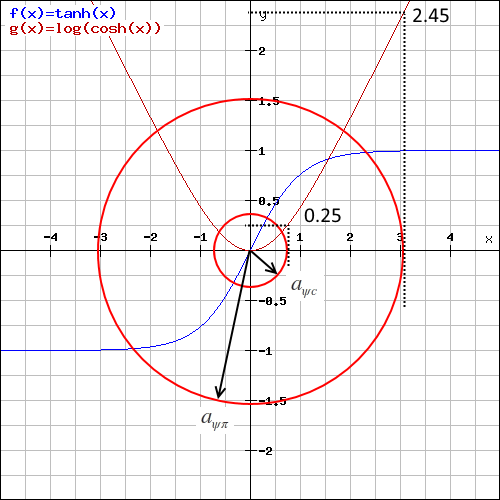
An accumulation of other like particles. At distances greater than \(a_{\psi\,c}\), up to \(a_{\psi\,\pi}\), the attached particle experiences a greater attractive force due to the increasing value of \(F_{\rho}\).
\(a_{\psi\,c}\) is then interpreted as the minimum value for \(a_{\psi}\) that holds up a particle. Values of \(a_{\psi}\) less than \(a_{\psi\,c}\) collapses the particle.
And we have a lumpy issue...Particles of various sizes that stick together. Interestingly,
\(F=\int{F_{\rho}}dx\)
at \(x=a_{\psi\,c}\),
\(F=m\cfrac{c^2}{2}\)
This is the attractive force that holds the particles in the lump together.
New Discrepancies And Hollow Earth
From the previous post "\(\psi\) Gets Inverted And Fourier Xformed" dated 22 Jun 2016, it was suggested that the extend of \(\psi\) is such that from \(x=a_{\psi}\) to the center of the particle, the acceleration due to \(F_{\rho}\) achieve light speed at the center. That is to say,
\(\cfrac{1}{2}mc^2=\int_{0}^{a_{\psi}}{F_{\rho}}dx\)
\(F_{ \rho }=i\sqrt { 2{ mc^{ 2 } } } \, G.tanh\left( \cfrac { G }{ \sqrt { 2{ mc^{ 2 } } } } (x-x_{ z }) \right)\)
with \(x_z=0\),
\(\cfrac{1}{2}mc^2=i2{ mc^{ 2 } }.ln(cosh(\cfrac { G }{ \sqrt { 2{ mc^{ 2 } } } } (a_{ \psi }))\)
this implies,
\(ln(cosh(\cfrac { G }{ \sqrt { 2{ mc^{ 2 } } } }a_{\psi}))=\cfrac{1}{4}\) --- (*)
If this is so, there is a new discrepancy in the calculations for \(\varepsilon_o\) and \(G\) that had previously assumed,
\(ln(cosh(\cfrac { G }{ \sqrt { 2{ mc^{ 2 } } } }a_{\psi}))=ln(cosh(\pi))=2.450311\) --- (**)
Since, the function \(ln(cosh(x))\) is monotonously increasing, the assumed value of \(a_{\psi}\) given by (**) results in light speed before reaching the center under the action of \(F_{\rho}\). The particle is then hollow at the center.
If (*) is correct, then immediately after \(a_{\psi}\), the force in the field around the particle does not obey coulomb's inverse square law but increases until \(ln(cosh(\pi))\) or \(\cfrac { G }{ \sqrt { 2{ mc^{ 2 } } } }a_{\psi}=\pi\), where (**) holds true. Furthermore, if (*) is true,
\(\varepsilon _{ o }=\cfrac { 2 }{ c^{ 2 }}\)
and
\(G_o=\cfrac { c^{ 2 } }{ 8\pi }.\cfrac{3}{4\pi(2c)^3}.\sqrt{3}=6.86e-12\)
A lower value for \(a_{\psi}\) as given by (*) allows for two particles to interact as waves without merging below the particle limit,
\(a_{\psi}=\pi\cfrac { \sqrt { 2{ mc^{ 2 } } } }{ G }\)
had (**) been assumed. But for the case of \(G_o\), the gravitational constant, (**) seems more appropriate.
Have a nice day.
Note: \(\cfrac { G }{ \sqrt { 2{ mc^{ 2 } } } }a_{\psi} =acosh(e^{\cfrac{1}{4}})=0.736904590621\)
Wednesday, June 22, 2016
Eternity At A Black Hole
If this particle is a black hole, the event horizon where an object at light speed orbits the black hole is also where the object makes a splat AFTER being sucked into the center by the belly. This splat is all over the spherical event horizon surface; the object is being Fourier transformed at the point in the center and is evenly distributed over the entire surface area of the event horizon that defines the black hole.
Perpetually...
Perpetually...
Empty On The Inside?
The center of the particle is not a black hole because \(\psi=0\) at \(x=0\). Or is it?
How big SHOULD a particle be? The bound of the particle is where, from the surface of the particle, the total acceleration that a test particle experiences on moving inwards due to \(F_{\rho}\), brings it to light speed \(v_x=c\) along a radial direction. In this way, the particle is able to recycles itself.
\(\psi\) is on a Möbius strip, drawn at its belly towards the center, accelerating to light speed only to return to the same point with light speed, once again drawn at its belly further along the strip towards the center.
For energy density, \(\psi=0\) at \(x=0\) but kinetic energy of the test point, \(KE_{max}=\cfrac{1}{2}mc^2\) at \(x=0\).
Have a nice day.