Tuesday, May 10, 2016

I Was Insane

The innovation from MIT to introduce gold nano-wire into the cathode of the battery to extend it recharge life time highlight the fact that charge distribution within the battery is a limiting issue.  If during recharge, electrons from the anode find a specific path to the cathode and return to the charging power source, the battery is electrically shorted.


The battery being charged has low recharging resistance and draws a high recharging current from the charging power source, but the battery does not get further recharged.  Electrons from the charging power source return to the cathode without participating in any redox reactions to reverse the chemical state of the battery.

Some chargers use a pulsed charge current to break such shorted path, and discharge the battery for short duration as part of the recharging cycle.

Other chargers physically vibrate the battery to shake up the electrolyte.

Others limit the charging current for a specific electrolyte below the threshold for the formation of such electrical shorts, but this prolong charging time and the engineered electrolyte often presents a higher resistance during discharge.  This are the low current but long life batteries.

Have a nice day.  What is a short circuit on being charged?  An Insanity plead.


Check

\(\cfrac{1-r^n}{1-r}\) formula mistake \(\cfrac{1}{1-r^n}\)!

Ding Dong And A Small Peck

It would be wrong to think that \(p_x\) is proportional to \(E=mv^2\) that the \(E\) like an ideal gas follows a Maxwell–Boltzmann distribution.  And so, \(p_x\) follows a Maxwell–Boltzmann distribution.

It is more correct to think of entanglement as an event that happens for a random number of times, \(n_{\lambda\,e\_x}\) over a fix interval when all the particles has light speed \(c\).  That on each encounter a quantum of energy is exchanged and over the fixed internal,

\(p_x=\cfrac{n_{\lambda\,e\_x}.\Delta Q}{mc^2}\)

\(p=\cfrac{n_{\lambda\,e}.\Delta Q}{mc^2}=\cfrac{1}{2c}\) ---(*),  from "Emmy NoEther" dated 6 Jul 2015.

where \(\Delta Q\) is the packet of energy exchanged on each encounter and \(n_{\lambda\,e}\) is the event rate when the interval is fixed at one second.  \(n_{\lambda\,e}\) is estimated as the average of \(n_{\lambda\,e\_x}\) over a large number of fixed intervals.  \(p\) and \(p_x\) are now observed over the fixed interval.

It is an assumption that a discrete quantum of energy is exchanged on each encounter.  Entanglement is a quantum phenomenon when particles behave as waves, it is not an assumption that the particles have light speed, \(c\).

Previously, a large population of particles presents an average fractional entanglement, \(p\) for all time.  Here, one particle is observed over a fixed time interval and it experiences \(n_{\lambda\,e\_x}\) entanglement encounters over the time period.  Averaged over many fixed intervals, we estimate \(n_{\lambda\,e}\), which is related to \(p\) by equation (*).  \(p\) is now qualified as fractional entanglement per time interval.  Here, entanglement results in a fractional loss of energy of amount \(mc^2\) per time interval.

But not everyone loss energy; we choose to focus on the one in the entangled pair receiving (external) energy input, a fraction of which is loss per second; when the fixed observation interval is one second.

Peck was promoting Data Plans door to door...

Note:  \(p_{\small{Q}}=\cfrac{\Delta Q}{mc^2}\)  shall be called the quantum fraction, where \(\Delta Q\) is the packet of energy exchanged on each entanglement encounter.

\(n\) packet loss is considered \(n\) consecutive encounters.  Within each fixed interval it does not matter how long each encounter takes, as long as it is counted.

This way the actual mechanisms of entanglement can be set aside, all we need to know is that entanglement occurs and how many times it occurred over a fixed interval.


Monday, May 9, 2016

Emmy Noether II

From the post "Emmy Noether" dated 6 Jul 2015,

Consider again energy \(mv^2\) imparted onto a particle, a portion, \(p\) of which is loss due to entanglement,

\(E_{loss}=mv^2p\)

Since this particles exist in the time dimension \(t\), and are travelling along time \(t\), the hypothetical force resulting in \(E_{loss}\) is given by,

\(F_{drag}=-\cfrac{d\,E_{loss}}{d\,x}=-\cfrac{d\,E_{loss}}{d\,t}=-2vmp\cfrac{d\,v}{d\,t}\)

If,

\(F=m\cfrac{d\,v}{d\,t}\)

then

\(F_{drag}=-2vpF\)

At terminal velocity \(v=c\), the total force on the particle is zero,

\(\sum{F}=F-F_{drag}=F-2cpF=0\)

this implies,

\(2cp=1\)

The portion \(p\) of energy loss is,

\(p=\cfrac{1}{2c}\)

which is,

\(p=0.0000000016678205\)

This is essentially the results are before.

If the particles are uniform, all have a fractional entanglement of \(p\), then the total number of particle entangled is, \(N\)

\(N=\cfrac{1}{p}=2c\)

But if the particles are not uniformly distributed, but Gaussian


but we adjust the total population of the random variable \(p_x\) as,

\(N_{p_{x}}=N.\sigma\sqrt{2\pi}\)

Each instance of \(p_x\), in the Gaussian distribution represents entanglement between two particles, so

\(N_{\small{G}}=N_{p_{x}}*2=2N.\sigma\sqrt{2\pi}\)

This is the total population of \(p_x\) along one direction, the total population of \(p_x\) in a sphere, in 3D space is,

\(A_v=\cfrac{4}{3}\pi (N_{\small{G}})^3=\cfrac{4}{3}\pi(2N.\sigma\sqrt{2\pi})^3\)

\(A_v=\cfrac{32}{3}(2)^{3/2}(\pi)^{5/2}(N.\sigma)^3\)

But what is \(\sigma\)??

If  \(A_v\) is the Avogadro's constant in \(kg\) then,

\(A_v=6.022140e26\)

in \(1000g\).  So,

\(6.022140e26=\cfrac{32}{3}(2)^{3/2}(\pi)^{5/2}(2*299792458.\sigma)^3\)

where \(N=2c\)

\(\sigma=0.1743\)

What is the significant of \(\sigma\)?  Firstly, \(0\le p_x\le1\) but \(p\lt \sigma\), the spread of \(p_x\) is within
one standard deviation, \(1\sigma\).  More correctly, Gaussian is a bad fit for the distribution of \(p_x\), Maxwell-Boltzmann distribution or Poisson distribution would be considered next.

Win some, Lose some.


Sunday, May 8, 2016

Chalcogenide Glass!

What a find!  As cheap as CD material too.  It is CD material.


The Void Let Them In

The octahedral void exposes \(S\) in \(FeS_2\) on the surface and made it vulnerable to a free \(Li_2\).  One \(Fe-S\) ionic bond is broken with the formation of one \(Li_2-S\) bond.  This one broken bond out of six with a big \(Li\) jammed in the lattice causes the lattice structure to crack, and data from X-ray absorption suggests that \(Li_2FeS_2\) is amorphous.  At room temperature, on recharge the lattice does not reform and a different sets of redox reactions applies which results in the precipitation of \(Fe\) and \(S\).  Both are undesirable in the operation of the battery.

It's the hole's fault, we need a bigger hole.

A mix of smaller "late" transitional metal might allow \(Fe\) to open up.  Cobalt \(Co\) is a suitable candidate.
And \(CoS_2\) (beta form) can serve as a backing lattice to keep \(FeS_2\) structural integrity.  But \(Co\) is further down the reactivity series, it is likely that \(Co\) is reduced by \(Li\) before \(Fe\) in which case we would use \(FeS_2\) as the backing lattice and use \(CoS_2\) to receive \(Li_2\).  \(CoS_2\) will insulate \(FeS_2\) from \(Li_2\) while \(FeS_2\) provides structural integrity.

Another big "late" transitional metal is \(Mn\) with crystal radius of \(0.81\times10^{-10}\)m.  \(Mn\) is more reactive than \(Fe\).  In place of \(Fe\) as the backing lattice and dopant for a reactive \(CoS_2\) layer might open the lattice (\(CoS_2\) doped with \(Mn\) lattice) further and make \(S\) more accessible to \(Li_2\).


Counting Stamps

The way \(Li_2\) displaces a \(Fe\) in the lattice of \(FeS_2\) puts the validity of oxidation numbers into question.  The formula \(FeS_2\) is arrived at after the considering the number of neighbors the basic unit member of the lattice has. In this case, the basic unit member containing \(Fe\) has six \(S\) around it, two of these are connected to another unit member.  Six \(S\) are shared by three other unit members.  This make on average, two \(S\) for each \(Fe\), and thus the formula \(FeS_2\).  When one \(Fe\) is replaced, half of the two \(Fe\) out of six in total is removed.  From the diagram repeated below, \(Fe\)'s oxidation state is reduced by one, from \(+6\) to \(+5\).


But the formula,

\(Li_2FeS_2 \)

indicates that the oxidation state of \(Fe\) has reduced by two.  In the diagram, the oxidation state of \(Fe\) is obtained by counting the number of ionic bonds it has.

And chemistry is more fun than stamp collecting.


It's Not Reusable Because It's Broken

In a \(Li-FeS_2\) battery at room operating temperature,  at the cathode upon first discharge

\(FeS_2 {_{(lattice)}}+2Li^{+}+2e^{-}\rightarrow Li_2FeS_2 {_{(amporhous)}}\) ---(1)

and then a second discharge equation,

\(Li_2FeS_2+2Li^{+}+2e^{-}\leftrightarrow Fe+2Li_2S\) --- (2)

On recharge, equation (2) reverses,

\(Fe+2Li_2S-2e^{-}\leftrightarrow Li_2FeS_2+2Li^{+}\) --- (3)

then,

\(Li_2FeS_2-xe^{-}\leftrightarrow Li_{2-x}FeS_2+xLi^{+}\) --- (4)

but on further recharge,

\(Li_{2-x}FeS_2-(2-x)e^{-}\rightarrow (2-x)Li^{+}+FeS_n+(2-n)S\) ---(5)

where \(x\ge0.8\)

With these background materials...

This is \(Li_2\) when two unpaired orbits, each from one \(Li\), pairs up,


This is the \(FeS_2\) lattice, where each member has six neighbors and each lattice unit is attached to another at two points,


At the cathode, the \(Li\) with an unpaired orbit pairs up another \(Li\) to form \(Li_2\) and attaches itself to the lattice of \(FeS_2\).  This is an ionic bond.


\(Li_2\) replaces one \(Fe\) atom around \(S\) and the replaced \(Fe\) is reduced.

Under lower temperature \(21^{o}C\) to \(30^{o}C\), the lattice starts to crack. This is the first discharge when a new battery come into use. Upon a second discharge via equation (2), hole forms in the lattice with the formation of \(Fe\) and \(Li_2S\).  At this point if a recharge is attempted, the amporhous \(Li_2FeS_2\) (1) reforms within the hole in the lattice.  Upon further recharge, we obtain \(Li\), but we do not return to the ionic lattice of \(FeS_2\), instead we obtain, \(FeS_n\) and free elemental \(S\). The presence of elemental \(S\) causes havoc at the anode.

Structurally the cathode has disintegrated.

Recharging is not a problem at \(400^oC\) with a salt electrolyte, the \(FeS_2\)  lattice (melting point \(1,177-1,188^oC\) is reformed upon full recharge.  Heat increases the orbital radii of the members of the lattice \(Fe\) and \(S\), and makes the \(FeS_2\) lattice more malleable but not melting it completely.  At this temperature the \(FeS_2\) lattice can accommodate \(Li_2\).

Increasing the distance between the ionic elements can also be done using a polar solvent infused into the lattice.  This solvent should not dissolve the compound but space out the members of the lattice as when the
temperature is at \(400^{o}C\).  \(FeS_2\) is not soluble in water, but water introduced into the lattice when the crystal forms might space themselves between the lattice members and make the crystal soft.  Otherwise a more polar solvent has to be found.  Since, Pyrite is soluble in acids, a good candidate is \(HCl\), other acids are physically too big.  \(FeS_2\) doped with \(HCl\).

\(CuS_2-FeS_2\) has wider lattice spacing \(\sqrt{3}.(3.966\times10^{-10})\) m, compared to \(FeS_2\) of  \(\sqrt{3}.(3.38\times10^{-10})\) m.  And with Arsenic \(As\) in the mix,  \(\sqrt{3}.(3.8488\times10^{-10})\) m.(2)

If the lattice is intact after the first discharge via equation (1).  The \(Li_2\) member are simply hanging in the lattice of \(FeS_2\) slightly expanded to accommodate the new member.  And subsequent discharge,

\(Li_2FeS_2-2e^{-}\leftrightarrow FeS_2+2Li^{+}\)

pucks the \(Li_2\) as \(2Li^{+}\) after removing the two electrons, from the lattice.

The crux of the problem is to keep the lattice structure of \(FeS_2\) intact during the charge and discharge cycle. A backing lattice that holds onto the \(FeS_2\) lattice and stretches it to accommodate \(Li_2\) but
itself does not part-take in the redox reactions can be the solution.  Stacked layers of the two lattices will then build the bulk of the cathode.  The backing lattice need not stretch the \(FeS_2\) lattice if a single layer of the bounded lattice (\(FeS_2\)+backing) are use.  In this case, the expose surface of the \(FeS_2\) lattice allows \(Li_2\) to bond freely.  A transport layer that allows \(Li^{+}\) to move freely can be sandwiched between two bounded lattices to build bulk.  Many binary metal chalcogenides (compounds with \(S\), \(Se\) or \(Te\)) have the \(FeS_2\) structure, as do oxides like \(CdO_2\), \(\alpha-K_2O\), \(\beta-Na_2O\)(3). And "Late" transition metal disulfides (Mn, Fe, Co, Ni) almost always adopt the pyrite or the related marcasite motif.   There are many material options for a backing lacttice, insulated from the redox reactions by a few layers of \(FeS_2\) to provide structural integrity.

Note: It is likely that instead of \(Li^{+}\) we have \(LiH^{+}\).  Since, \(H\) after loosing its electron sit inside \(Li\), \(Li^{+}\) and \(LiH^{+}\) is likely to be of comparable in size.

There is no reversing entropy but entropy can be preserved.

References:

(1) In situ Fe K-EDGE X-ray absorption fine structure of a pyrite electrode in a Li/Polyethylene oxide (LiClO4)/FeS2 battery environment.  Dana Totir, In Tae Bae, Yining Hu, Mark R. Antonio and Daniel A. Scherson.  Proceeding Symposium Lithium Battery CONF-961040--23

(2)Schmid-Beurmann P, Lottermoser W Physics and Chemistry of Minerals 19 (1993) 571-577
57Fe-Moessbauer spectra, electronic and crystal structure of members of the CuS2-FeS2
solid solution series.

One set of data from reference (2), (http://rruff.geo.arizona.edu/AMS/AMC_text_files/20081_amc.txt) repeated below, suggests, an atomic center to center of \(\sqrt{3}.(6.25\times10^{-10})\)m.

Pyrite
Oftedal I
Zeitschrift fur Physikalische Chemie 135 (1928) 291-299
Uber die Kristallstrukturen der verbindungen RuS2, OsS2, MnTe2 und AuSb2.
Mit einem Anhang uber die Gitterkonstant von Pyrit
_database_code_amcsd 0017728
5.414 5.414 5.414 90 90 90 Pa3
atom    x    y    z
Fe      0    0    0
S    .625 .625 .625

(3)"Ceramic Materials: Science and Engineering" By C. Barry Carter, M. Grant Norton publisher: Springer Science & Business Media, 4 Jan 2013.

Saturday, May 7, 2016

Hot Battery

A oscillatory battery is a hot battery because the reactions in the device is perpetual.   The chemical reactions do not stop when the battery is not in use.  This can be a limiting issue.


This is \(LiH^{+}\) where a Hydrogen without an electron sits in the unpaired orbit of \(Li\) with a \(He\) core.  This replaces \(H_2O^{+}\) as the positively charged reducing reagent.  The word "carrier" emphasize the fact that this reagent is migrating to the cathode.  \(Li\) plays the role of \(OH\) with a unpaired orbit in \(O\).

\(Li_2O\) is inorganic.  It has a linear structure suggesting that it is strongly ionic.  The unpaired orbits are not involved.  So \(LiOH^{+}\) or \(Li_2{O}^{+}\) where a \(H\) looses an electron and pairs up with an unpaired orbit in \(O\) or a \(Li\) looses an electron and pairs up with an unpaired orbit in \(O\), do not occur.

For the time being,


this is not a new battery.  The membrane is soap resistance material, wax impregnated and perforated that allows \(LiH^{+}\) to pass but not \(OH\).  \(OH\) aided by gravity falls into the charge collector chamber, where it is oxidized.  \(LiH^{+}\) produced are charged and move across the membrane due to repulsion between like charges.  At the cathode, possibly \(MnO_2\) where \(LiH^{+}\) receive an electron, gives up the hydrogen and form \(LiMnO_2\).

Compare this with the oscillatory battery, the \(LiH^{+}\) ion bridge is one of the internal connection of the oscillator.  The second connection occurs outside of the battery, it just the external load connection.  This battery do not oscillate without the external connection.

This is the battery we use everyday.  To view it as an oscillator with a natural frequency may improve its efficiency and battery life.  To find its natural frequency the battery is connect to a tune-able oscillator as load.  Resonance occurs when the peak terminal voltage is maximum as the frequency of the load is changed.
This oscillations at the terminals are sinusoidal with a positive DC value and of non negative value.  The flow of current through the battery does not reverse.


If this resonance exist, the battery can be set into resonance with a switch at resonant frequency and a series rectifying circuit to provide an DC output.


where \(freq_n\) is the resonance frequency.  The switch at \(freq_n\) produces a full wave rectified waveform at the output.  The capacitor represents a waveform smoothing circuit after the diode bridge of a full wave rectifier, the output of which is a stable DC voltage.

Will the battery explode at resonance?


Going Green, Shaken But Not Stirred

It is not chlorophyll but the reduced quinone or palstoquinol molecule that plays the role of \(OH\).  Reactions at both the cathode and the anode collector are two different redox reactions.  The electrolyte at the anode collector is oxidized, at the same time \(OH\) is being reduced producing \(H_2O^{+}\).  At the cathode \(H_2O^{+}\) is being reduced and \(MH\) is being oxidized producing \(OH\).

The problem is to move \(OH\) back to the anode so that the cycle repeats perpetually.

\(H_2O^{+}\) redistributes by heat diffusion and by its charge.

\(OH\) redistributes by heat diffusion only.

When \(H_2O^{+}\) is replaced with \(LiH^{+}\), \(Li\) being lighter improved efficiency, but \(LiOH\) formed in the presence of \(H_2O\) or \(OH\) precipitate under heat and localized high concentration at the cathode kills the battery.  The accumulation of contact hydride, \(MH\) at the anode will also kill the battery, but this can be solved by a suitable choice of metal.

Hydrogen fluoride is poisonous!

The battery can be shaken but not stirred!  Shaking a battery to redistribute \(OH\) inside prolongs its life.

It may not be possible to have both positive and negative charge carriers in the same cauldron.   Opposite charges will tend to bond ionically and neutralize.  A battery actually works because \(OH\) is not charged.

If a negatively charged \(OH\) equivalent can be created, it must also be separated from the positive \(H_2O^{+}\) reductive carrier using a suitable membrane.  Which leads us to an oscillatory battery,


The battery oscillates chemically; a pair of redox reactions at the two electrodes working in opposite directions, producing charged redox carriers separated by a membrane moving in opposite directions.   The carriers produced by oxidization at one site are transport to the second site and are reduced there.  The reduction reaction creates another type of carriers and is transported in the opposite direction to the first reaction site.  It is oxidized there.

Electricity is tap off at the electrodes to drive a load.

Now, we look for a pair of redox reactions that produces charged redox carriers with PH change across the membrane.


The Need To Return

What to do with \(OH\), with an unpaired orbit that donates its electron, generates a positive \(H^{+}\), oxidizes the anode and is generated by the cathode when the positive \(H+\) reduces at the cathode?  Any process that moves this reactants from the cathode to the anode will improve battery life and voltage regulation (A depletion of \(OH\) at the anode decreases electron production there) .

I shall return!

\(OH\) is an oxidative carrier that gives up its \(O\) at the anode.

\(H_2O^{+}\) or \(LiH^{+}\) are reductive carriers that gives up its \(H\) at the cathode.

This way, if ever we have a \(OH^{-}\), this is a CHARGED oxidative carrier.

A charged oxidative carrier will redistribute between the cathode and the anode naturally.

Furthermore, a buildup of \(OH\) causes the build up of \(LiOH\) as the carriers react,

\(LiH^{+}+2OH\rightarrow LiOH\cdot H_2O\)    Lithium hydroxide


 Lithium hydroxide monohydrate is much more soluble in water than in organic solvents, but none the less as its concentration increases locally it will precipitate out of the electrolyte.  Both types of redox carriers are removed from solution and the battery electron production goes dead.

Heat can redistribute a charge neutral oxidative carrier, but in most battery design, the anode charge collector is a pin in a cylindrical cathode along the major axis that has a comparatively high concentration of heat.  The cathode spreads out in the form of a cylinder around the anode has a lower concentration of heat per unit area.  Heat in such designs drives the carriers away from the anode reaction site.  Strictly speaking, the anode reactant are spread in the electrolyte uniformly, a charge collector pin provides the reaction site at which the anode reactant are oxidized.  This way the battery discharge slowly.


A temperature gradient will act on both types of carriers, the diffusion rate at higher temperature will always be higher irrespective of whether the carrier is charged or not

Heat also facilitates the precipitation of \(LiOH\), breaks down the electrolyte and triggers undesirable chemical reactions in the constituent of the battery.  This is how heat kills a battery.

This is a more expensive battery,


The wire cage requires more material and is difficult to form.  The hollow cathode also be difficult to form. But the heat flows from the cathode to the wire cage in aid of \(OH\) carrier return to the anode.  Heat is still concentrated at the cathode because of the small reaction area.  The charged redox carrier, \(H_2O^{+}\) is still aided by its charge to move towards the cathode.

But the real improvement will be the use of chlorophyll and photosynthesis chemistry.


Looking For A Better Battery

Does \(OH\) with an unpaired orbit at \(O\) exist?  What is fuel cell limited by?  A piece of optical (fiber) glass barrier that separates the reactants; not using water as a medium at all.

Hey, alkaline battery has already been invented.

But the concern for \(H_2O^{+}\) was not considered.  Nor the fact that \(OH\) is used up in the anode in the production of \(O_2\) but produced at the cathode when \(H_2\) is released.  So, \(OH\) at the anode is moved to the cathode as the process progresses.  And of course, \(H_2O\) is consumed.

\(OH\) produced at the cathode need to be moved back to the anode.  \(OH\) is not charged.

For an alkaline battery, \(O\) produced at the anode oxidizes \(Zn\) to \(ZnO\), instead being released as a gas.  The electrons produced are driven into an external circuitry and return to the cathode from outside.  At the cathode, \(H_2O^{+}\) reduces \(MnO_2\) to \(Mn_2O_3\) with the production of \(OH\).  The charge carried by \(H_2O^{+}\) is neutralized by the electrons returning to the cathode.

So the production/movement of \(OH\) influence voltage regulation.  The voltage of the battery drops as \(OH\) accumulates at the cathode and depletes at the anode leading to an electron production drop at the anode.

And the internal resistance of the battery is dictated by the movement of \(H_2O^{+}\) produced at the anode, that moves to the cathode.

In a \(Li\) ion battery, the positive charge carrier is in part replaced by \(LiH^{+}\).  This reduces the internal resistance and voltage regulation as \(LiH^{+}\) is lighter than \(H_2O^{+}\) and migrate quickly from the anode.

The role of \(OH\) seem to be replaced with \(SO\) from \(SO_2\) and a list of heavy electrolytes in many batteries.  The accumulation of \(OH\) and its equivalent at the cathode and their depletion at the anode is worst with heavy electrolyte.  Diffusion is the only mechanism by which these reactants redistributes.  Since the battery is initiated by oxidation at the anode first, \(OH\) depletion at the anode is the main reason battery go dead.  They are also the reason many types of batteries are limited to low current applications.

Still the existence of \(OH\) is unproven,  but batteries drop dead all over the place.


Friday, May 6, 2016

Electrolysis Without Ions

Electrolysis...

\(M+H_2O\rightarrow MH+OH\)

\(2MH\rightarrow 2M+H_2\)

\(MH+H_2O\rightarrow M+H_2+OH\)

where \(M\) is a metal with an unpaired orbit and,

\(M+OH\rightarrow MOH\)

If copper, \(Cu\) is used as electrodes, the formation of \(CuH\) will turn both electrodes red.  However, since the equations above do not involve charged ions explicitly, they can occur at both the cathode and the anode during electrolysis.

But...only at the anode (+),

\(2OH\rightarrow O_2+2H^{+}\)

the \(H\) in \(OH\) looses an electron, turns positive and is ejected.  Two \(O\) atoms forms \(O_2\).  The positively charged \(H^{+}\),

\(H^{+}+OH\rightarrow H_2O^{+}\)

forms water with a positive charge, \(H_2O^{+}\) and moves to the cathode.

Only at the cathode (-), because of the positively charged \(H_2O^{+}\)

\(M+H_2O^{+}+e^{-}\rightarrow MH+OH\)

then,

\(2MH\rightarrow 2M+H_2\)

and more importantly, the main \(H_2\) producer,

\(MH+H_2O^{+}+e^{-}\rightarrow M+H_2+OH\)

In this scenario, \(O_2\) gas starts to form at the anode first, after the positively charged water, \(H_2O^{+}\) has migrated to the cathode does \(H_2\) starts to evolve there.

Because of \(OH\) forming \(H_2O^{+}\) with \(H^{+}\), a membrane to allow just \(H^{+}\) is futile as it is \(H_2O^{+}\) that transports the charges in the electrolyte.  Metals without an unpaired orbit and so do not form metal hydride, \(MH\), cannot be used as electrode because the the formation of metal hydride \(MH\) is part of the \(H_2\) production process.

It is possible to block just the formation of \(H_2\) by blocking the passage of \(H_2O^{+}\), as the needed \(OH\) are produce at both electrodes.

The metal hydride \(MH\), must remain structurally on the electrode to act as a catalyst and not contribute to electrode corrosion.  Since \(OH\) is produced at the cathode and \(MH\) is reverted to \(M\) with the evolution of \(H_2\) there, and the production of \(O_2\) does not involve \(MH\), the anode can be made of any conductive and oxidation resistant metal without the concern for metal hydride formation.  In this case \(OH\) will have to first migrate to the anode for \(O_2\) production to start.  (The metal hydride formed at the anode does not revert back to metal, and will eventually insulate the electrode completely.  In practice, the electrodes are swapped periodically.)  To facilitate \(O_2\) production then, \(OH\) can be introduced into the electrolyte as \(NaOH\).  An alkaline is added to water instead of acid or a alkaline metal salt.

It is likely that the production of \(OH\) is the reason behind the increase in efficiency when acid or alkaline salt is added.  For an acid,

\(Hsalt\_part+H_2O\rightarrow OH+H_2+salt\_part\)

and for an alkaline metal salt,

\(Msalt\_part+H_2O\rightarrow OH+MH+salt\_part\)

It is not the conductivity of the electrolyte that matters but the availability of \(OH\).

Next stop, fuel cells...

\(OH\) Is Not A Charged Radical

\(OH\) not being a charged radical but has a unpaired orbit as part of \(O\) is very interesting.

A lot of \(OH\) will give,

\(OH+OH\rightarrow H_2O_2\)

where the unpaired orbits from two \(OH\)s pair up to give hydroperoxide.

The present of an unpaired orbit makes it ready to react with organic radicals by forming covalent bonds.

\(OH\) is totally innocent in the organic world.  \(OH\) is a radical in the organic world because of its unpaired orbit.

By a similar reasoning,

\(CH_3^{+}\)

does not exist, but

\(CH_3\)

with an unpaired orbit as part of \(C\), does exist.


Soap Is Covalent

We have first,

\(Na+H_2O\rightarrow NaH+OH\)

then

\(Na+OH\rightarrow NaOH\)

where the unpaired orbit of \(O\) in \(OH\) pairs up up the unpaired orbit in \(Na\).  This is because \(OH\) must come from somewhere first.  The formation of \(NaH\) is necessary to provide for \(OH\).  Water, \(H_2O\) is not a ready mix of \(H^{+}\) and \(OH^{-}\).  Thus, preventing the formation of \(NaH\) stops \(Na\) from reacting with \(H_2O\).

Where's the gas?  Either,

\(2NaH\rightarrow 2Na+H_2\)

where two \(NaH\) gives up their \(H\) to give \(H_2\) or

\(NaH+H_2O\rightarrow Na+H_2+OH\)

where water contribute one of the \(H\) to form \(H_2\).  \(OH\) is not a charged radical.  Both reaction suggest that \(Na\) is catalytic in extracting \(H_2\) from the solvent if not for the formation of the hydride, \(NaH\).  Furthermore,

\(Na+OH\rightarrow NaOH\)

where the unpaired orbit in \(Na\) pairs up with the unpaired orbit in \(O\), makes \(NaOH\) covalent!  \(NaOH\) is organic.  Which is good news for those who have not used soap yet.

\(NaOH\) is like water, \(H_2O\) but has one of the \(H\) replaced by an alkaline metal, \(Na\).

Note:  It is not just the overall reactions but the sequence by with the reactions proceed that matters here.

What?  \(NaH\) is too reactive to remain in water?  Yes evetually, only \(NaOH\) with \(H_2\) remain in the system.

Salt Dissolving And Metal Extraction

\(H_2O\), because of its partial charge, go between the bonded elements and weakens the ionic bond.  The salt lattice breaks up with some agitations, without explicitly removing the electrons.


\(NaCl\rightarrow Na+Cl\)

both not charged and will undergo further reactions with \(H_2O\).  \(H_2O^{-}\) and \(Na^{+}\) are not formed.  This is an separate issue from the unpaired orbit being filled with \(H\).

When \(Na\) acquires a \(H\),

\(Na+H_2O\rightarrow NaH+OH\)  --- (1)

where \(OH\) is not charged but its Oxygen \(O\) has an unpaired orbit.

Note: \(\bbox[red]{2Na+2H_2O\rightarrow 2NaOH+H_2 (\uparrow)}\)

I know. 

When \(Cl\) acquires a hydrogen from \(H_2O\),

\(Cl+H_2O\rightarrow ClH+OH\) --- (2)

Is \(HCL\equiv ClH\)?  Yes, the bond in \(HCl\) is covalent in nature.

Ionic salt dissolving in water is due to water polar nature that allows it to go between the elements in the ionic bond.  Water donating a Hydrogen to an unpaired orbit is a separate issue from dissolving.  It is possible that other polar liquids dissolve an ionic salt without filling any unpaired orbits.  In this case, the salt break up into its constituent elements without further chemical reactions.

Equations (1) and (2) have implications in the extraction of elements from salt mineral ore, when polar solvents other than \(H_2O\) are considered.  In order that the polar solvent penetrates into the salt lattice it may be necessary to apply high pressure.  For example, water from seawater is first displaced using a polar solvent, then pressure is applied to precipitate the elements of the ionic salt.  The polar solvent is designed such that it does not donate a hydrogen to the extracted elements, as water does in equation (1) and (2).  This way the extracted elements do not undergo further chemical reactions and remain pure.  The elements either separate naturally (as gas and solid) or be separated using a centrifuge.

Metals can be extracted from seawater cheaply, provided the suitable polar solvent that does not donate an hydrogen to the extracted metals can be created.

No need for electrolysis; but still when electrolysis is needed, without charged ions such as \(Na^{+}\), what did happen at the electrodes?


More Doddles...Playing Cupid

Is the single orbit of \(H\), the Hydrogen atom stretchy?


Cocked eyed with a mole on the left....

What can happen with this odd couple?  They must fall in love and bond.

And someone gives someone a free ring,


Neither \(~H\) nor \(OH\) are charged.  Since all elements, with an unpaired orbit, of the ionic bond are just as likely to receive the hydrogen, we have in solution,

\(NaH\)

and

\(ClH\)

and

\(2OH\)

all neutral stable compounds, although all polar due to concentration of charges on the smaller hydrogen orbit.

Depending on the readiness of \(ClH\) and \(NaH\) to give away \(H\), the solution may be PH neutral.  Since \(OH\) is unbonded, an ionic solution tends to be alkaline.  And the displacement of an element with another in a column of the periodic table in an aqueous solution,  is with reference to the elements' affinity for \(H\).

\(2IH+Cl_2\rightarrow I_2+2HCl\)

from a solution of \(NaI\) through which \(Cl_2\) gas is passed,

\(2NaI+Cl_2\rightarrow I_2+2NaCl\)

in an aqueous solution.  This way \(HCl\) is also produced because, first we have

\(NaI+2H_2O\rightarrow IH+NaH+2OH\)

all uncharged, and then,

\(2IH+Cl_2\rightarrow I_2+2HCl\)

If this is true, that \(OH^{-}\) and \(H^{+}\) are conceptual and do not exist in an aqueous solution, what then happens at the electrodes during electrolysis?

Still how does water break up the sharing of the exposed electrons between two paired orbits?


Bond Angle Doddle

Here we doddle as we think about dissolution.


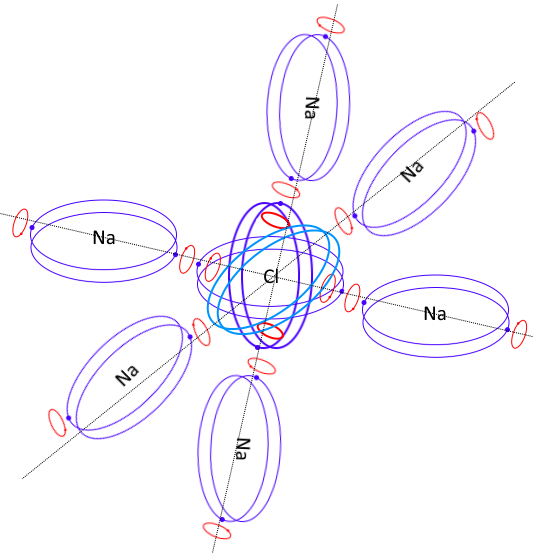
This is the chloride member of the salt \(NaCl\), lattice with the singular unpaired orbit drawn in.  Below this single orbit is three paired orbits with six electrons.  Each of this paired orbits forms two ionic bonds with two \(Na\) members.  The six ionic bonds arrange themselves perpendicularly to the planes of a square and this unit forms a square lattice.


This is the \(Na\) member of the salt \(NaCl\) lattice.  Three paired orbits from the inner \(Ne\) nucleus core forms six ionic bonds with six \(Cl\) members.  The bonds also arrange themselves into a square.

Strictly speaking,


Bond \(ON\) is free to rotate in the circle \(C_n\) and \(OP\) is free to rotate in the circle \(C_p\).  In general, this makes,

\(\angle S\ne\cfrac{180^o}{n}\)

The bond angle is not solely determine by the total number of orbits, \(n\), in the nucleus shell participating in bond formations.  If however, only one of the bond is free to rotate along its orbit then,

\(\cfrac{180^o}{n}\le\angle S\le \left(180^ o-\cfrac{180^o}{n}\right)\)

where \(n\) is the principal quantum number of the nucleus shell participating in bond formations.  If both bonds are free to rotate, and we move one of the bond to one intersection of the two orbits, the bond angle,

\(0\le\angle S\le 180^ o\)

is not restricted at all.


When Things Dissolve...

Is dissolving a chemical reaction with water?

If the unpaired orbits in \(\small{NaCl}\) are involved in the ionic bond between the elements, they will not be able to interact with water as they are, to form an aqueous solution.  Their nature would have changed if they are part of the ionic bond.

Good night...

And They Fell Into Place...

The problem with orbits needing to be paired before forming ionic bond is that, we have

\(H_2Cl_2\)

instead of,

\(HCl\)

which might explain why \(HCl\) is more covalent than ionic.

The good news is

\(Na\) and \(Cl\)

can chain up as

\(-Na-Cl-Na-Cl-\)

where the inner paired orbits of \(Na\) and the paired orbits of \(Cl\) are linked by sharing an outer rolling electron.  The singular unpaired orbit is literally not in the picture.  It is not part of the ionic bond.


Furthermore, there is no reason why paired orbit orthogonal to the chain cannot link up in an ionic way given no obstruction in the space around the chain,


adding a third chain perpendicular to the plane formed by these two, we have,


This structure then forms into the square lattice that we are familiar with \(\small{NaCl}\) where each \(Na\) has six other \(Cl\) neighbors.  Other paired orbits of the nucleus being able to form similar ionic chains can explain many crystalline structures with specific structural angles that the theory based on transfer of electrons and charged ions cannot account for.  Given that all ionic bonds are between paired orbits space evenly, spherically around a spherical nucleus, the angle at any atom is then just,

\(\angle S=\cfrac{180^{o}}{n}\)

where \(n\) the principal quantum number, is the number of paired orbits around the nucleus.  Since, two consecutive ionic bonds can form skipping one or more paired orbits in between, the structural angle can be an integer multiples of  \(\angle S\).

What happened to the the singular unpaired orbit and its electron?   This unpaired orbit could be responsible for the crystal disassociating in water forming an aqueous solution, but is not involved in the ionic bond between the elements.


Lamb Over The Fence

Time averaged, means the positive particle are not on the transverse plane perpendicular to the orbit at the same time, but over a period of their spins, they are once there.


Obviously, the attraction on the negative charge, \(E\) per unit charge, is less when the orbit separation, \(d\) is large.

And when the fence is low, the lamb jumps over...albeit only a part-time escape artiste.

Saving data quota mode...


Ionic Bonds

As more orbits are added to the other shell of the nucleus (ie. as we move across the periodic table in row), the orbital radii of the \(T^{+}\) particles just below the proton layer is squeezed smaller.  The weak fields generated by these particles strengthen.  So progressively, the the electron find itself rolling inside of the proton orbit as the inner orbit radius of the positive temperature particles decrease across the periodic table.

When the electron is inside the proton orbit (right side of the periodic table) the proton is left exposed.  They repel other similarly exposed protons but can acquire another electron and so gain a net negative charge.


When the electron is outside of the proton orbit (high Atomic number elements), it is itself exposed and can be shared with similar proton orbit that has yet to acquire (or has lost) an electron.  A electron rolling outside of the proton orbit, participate in ionic bonding.


Note that this occurs after the proton orbit has been paired with another proton orbit.

When an element with electrons rolling outside its outer proton orbits lost an electron it becomes positively charged and becomes a cation.


In this explanation, it is not necessary that an anion or a cation form first for ionic bonding.  But it is possible that in an aqueous solution, the ionic compound separates into ions that are stabilized by the polarity of water.

Between inside of the proton orbit and outside of it, an electron is in a helical path partly inside and partly outside of the proton orbit around the nucleus.


This however presents a problem, if these are the inert gases at the end of the row in the periodic table, why does this type of orbit occurs after the electron has moved inside?  It is likely that as we move across the row of the periodic table more proton orbits in the outer shell reduces the separation, \(d\) between the paired orbits.  This increases the time-average positive charge along the orbit and pulls the electron partially outwards again.  What is odd is that this happens consistently when the outer shell has four paired orbit of eight members in total.

The nature of the electron's helical orbit, part of the time inside a positive charge's orbit and part of the time outside of the positive charge's orbit, prevents the negative particle from being shared.  If two elements were to share an electron, the sharing positive charges are exposed when the electron is inside either of the two proton orbit pairs. The exposed positive particles will repel and break the bond.  The paired orbits cannot be paired into four without first removing the orbiting electrons which would require high energy.  No electron sharing and no orbits pairing means that the element does not readily part take in chemical reactions; it is inert.

Just rolling along...


Thursday, May 5, 2016

Where \(E\)lephants Can Fly


Since a negative particle in spin produces a different field from a positive particle in spin,


It is best then,

\(g=\cfrac{\tau_{go}}{4\pi}\cfrac{T^{-}v_{\small{T}}\times \hat{r}}{r^2}\)

that we differentiate \(\tau_o\) into \(\tau_{go} \) the resistance to \(T^{-}\) in spin establishing a \(g\) field and \(\tau_{\small{E}o}\)  the resistance to \(T^{+}\) in spin establishing a \(E\) field, in free space.


\(E=\cfrac{\tau_{\small{E}o}}{4\pi}\cfrac{T^{+}v_{\small{T}}\times \hat{r}}{r^2}\)

Similarly for gravity particles, \(G_{\small{B}o}\) for positive gravity particle in spin and,  \(G_{\small{E}o}\) for negative particle in spin.

\(E=\cfrac{G_{\small{E}o}}{4\pi}\cfrac{g^{-}v_{\small{g}}\times \hat{r}}{r^2}\)

and

\(B=\cfrac{G_{\small{B}o}}{4\pi}\cfrac{g^{+}v_{\small{g}}\times \hat{r}}{r^2}\)

Remember that Earth is one big gravity particle from which we derived a gravitational resonance of \(\small{7.489\,\,Hz}\) from the post "Where's The Charge?" dated 15 Dec 2014.

It can be argued that, \(g^{+}\) nuclei constitute \(g^{+}\) matter on a \(g^{+}\) Earth with a cloud of \(g^{-}\) particles that spin eastwards to create a \(E\) field downwards at the North pole making it a negative electric potential.  This generated \(E\) field emanates from the South pole, making that place a positive electric potential.  The effect of spinning \(g^{+}\) particles are shielded by the cloud of \(g^{-}\) particles.

Just as \(p^{+}\) nuclei constitute \(p^{+}\) matter on a \(p^{+}\) Earth that is a store of \(e^{-}\) charges on the surface.  An electric cable is grounded to remove its charges because electrons flow towards Earth as the surface of Earth is a store of \(e^{-}\) particles.  These \(e^{-}\) particles spins eastwards as Earth's spin and generate a \(B\) field emanates from the South poles and penetrates into The North pole.

And so we can postulate that, \(T^{+}\) nuclei constitute \(T^{+}\) matter on a \(T^{+}\) Earth that a cloud of \(T^{-}\) particles envelop.  Which can explain why temperature drops as we gain altitude; as we move away from the \(T^{+}\) particles in Earth's core and ascend into the \(T^{-}\) cloud that surrounds Earth.  As these \(T^{-}\) particles spins, they generate an \(g\) field out of the South pole and into the North pole.  It is expected then that the South pole has less gravity than the North pole.

The logic used here appeals to the big picture where two or more facts stand in parallel to be taken as a whole leading to a further point in its deduction.

If Earth is also a big temperature particle,

\(f=n\cfrac{c}{2\pi a_{\psi}}\)

\(a_{\psi}=6371\,\,km\)  for Earth's radius, and

\(n=1\)

\(f=\cfrac{299792458}{2\pi*6371\times10^3}=7.489\,\,Hz\)

then there is a temperature wave around Earth resonating at \(\small{7.489\,\,Hz}\).

The flying toaster toaster resonating at  \(\small{7.489\,\,Hz}\) from the post "Flying Toaster" dated 19 Aug 2014, is interacting with the \(T\) field (temperature field) of Earth directly and not its gravitational field, \(g\).

In a similar way, a pulsating \(E\) field at  \(\small{7.489\,\,Hz}\) will also fly because Earth is also one big \(p^{+}\) particle.

And that how \(E\)lephants fly.

Note:  \(T\) is synonymous with \(B\), for the time being.  BUT, given that Earth's spin creates a \(T\) field going into the North pole (spinning \(e^{-}\) particles that creates a \(B\) field going into the North pole) then a stream of negative temperature will flow away from the North pole, southwards.  An accumulation of negative temperature particles at the South pole will make that place colder.  Which is the case measured; the South pole is much colder than the North pole.  The thick sheet of ice on which the South pole sits is the result of colder temperature and not the cause of colder temperature.


Wednesday, May 4, 2016

Quadratic Algebra And Poles

Just in case we get to happy, consider,

\(ax^{ 2 }+bx+c=0\)

\( \left\{ x-\cfrac { 1 }{ 2a } \left( -b-\sqrt { b^{ 2 }-4ac }  \right)  \right\} \left\{ x-\cfrac { 1 }{ 2a } \left( -b+\sqrt { b^{ 2 }-4ac }  \right)  \right\} =0\)

\( x=\cfrac { 1 }{ 2a } \left( -b\pm \sqrt { b^{ 2 }-4ac }  \right) =\cfrac { -b }{ 2a } \pm \sqrt { \left( \cfrac { b }{ 2a }  \right) ^{ 2 }-\cfrac { c }{ a }  } \) --- (1)

When,

\( b^{ 2 }-4ac\lt0\)

\( \left\{ x-\cfrac { 1 }{ 2a } \left( -b-i\sqrt { 4ac-b^{ 2 } }  \right)  \right\} \left\{ x-\cfrac { 1 }{ 2a } \left( -b+i\sqrt { 4ac-b^{ 2 } }  \right)  \right\} =0\)

\( x=\cfrac { -b }{ 2a } \pm i\cfrac { \sqrt { 4ac-b^{ 2 } }  }{ 2a } =\cfrac { -b }{ 2a } \pm i\sqrt { \cfrac { c }{ a } -\left( \cfrac { b }{ 2a }  \right) ^{ 2 } } \) --- (2)

Consider,

\( f(x)=ax^{ 2 }+bx+c\)

For the extrememum,

\( f^{'}(x)=0\)

\( 2ax+b=0\)

\( x=-\cfrac { b }{ 2a } \)

which is the real part of the roots of \(f(x)=0\).

At which the function, \(f(x)\) attains the value,

\(f(x)= ax^{ 2 }+bx+c=a\left( \cfrac { b }{ 2a }  \right) ^{ 2 }-\cfrac { b^{ 2 } }{ 2a } +c\)

\(f(x)=  a\left\{\cfrac { c }{ a } -\left( \cfrac { b }{ 2a }  \right) ^{ 2 }\right\}\)

But from (2), given \(a\ne0\),

\( x=\cfrac { -b }{ 2a } \pm i\sqrt { \cfrac { c }{ a } -\left( \cfrac { b }{ 2a }  \right) ^{ 2 } }=\cfrac { -b }{ 2a } \pm i\sqrt {\cfrac{f(x)}{a} } \)

When \(a\) is a constant, a given quadratic \(f(x)\),  \(\sqrt {\left\lvert\cfrac{f(x)}{a}\right\rvert }\) attains extrememum as does \(f(x)\).  So the complex part of the roots of \(f(x)=0\) attains extrememum as \(f(x)\) attains extrememum.  And we have,


where \(B\) minimum is at the intersection of \(real(r_e)\) and \(complex(r_e)\).

Furthermore, from (1), at the extrememum (real roots only) for a given quadratic \(f(x)\),

\(\require{cancel}\)
\( x=\cfrac { -b }{ 2a } \pm\cancelto{0}{ \sqrt { \left( \cfrac { b }{ 2a }  \right) ^{ 2 }-{\cfrac { c }{ a }}  }} \)

\(\left( \cfrac { b }{ 2a }  \right) ^{ 2 }-{\cfrac { c }{ a }}  =0\)

\(b^2-4ac=0\)

This is why the plot of \(real(r_e)\) also passes through the point where \(\cfrac{d\,r_e}{d\,T}\rightarrow\infty\) in the graph above.  In general, given,

\( x=\cfrac { -b }{ 2a } \pm{ \sqrt { \left( \cfrac { b }{ 2a }  \right) ^{ 2 }-{\cfrac { c }{ a }}  }} \)

where \(a\ne0\),

\(\cfrac{d\,x}{d\,{\{a,b,c\}}}=\left(\cfrac { -b }{ 2a }\right)^{'}_{\{a,b,c\}} \pm \cfrac{1}{2\sqrt { \left( \cfrac { b }{ 2a }  \right) ^{ 2 }-{\cfrac { c }{ a }}  }}\left({ \sqrt { \left( \cfrac { b }{ 2a }  \right) ^{ 2 }-{\cfrac { c }{ a }}  }}\right)^{'}_{\{a,b,c\}}\)

when,

\({ { \left( \cfrac { b }{ 2a }  \right) ^{ 2 }-{\cfrac { c }{ a }}  }}=0\)

\(b^2-4ac=0\)

we have,

\(\cfrac{d\,x}{d\,{\{a,b,c\}}}\rightarrow\infty\)

ie. a plot of all real roots \(x\) of the quadratic \(f(x)=0\),  has a pole when,

\(b^2-4ac=0\)

and

\(\left({ \sqrt { \left( \cfrac { b }{ 2a }  \right) ^{ 2 }-{\cfrac { c }{ a }}  }}\right)^{'}_{\{a,b,c\}}\ne0\)

This pole must exist for a general plot of \(x\) in order that the graph curves backwards to give two real roots and at the pole, the plot gives a double root.  For this reason,

\(\left({ \sqrt { \left( \cfrac { b }{ 2a }  \right) ^{ 2 }-{\cfrac { c }{ a }}  }}\right)^{'}_{\{a,b,c\}}\ne0\)

when

\(b^2-4ac=0\)

is always true.

Given a material, the condition to narrow its bandgap (if it is an insulator or semiconductor) or to maximize its electric conductivity (if it is a conductor) is the same,

\({ 1-AT\cfrac { q^{ 2 } }{ \pi (m_{ e }c^{ 2 })^{ 2 }\varepsilon _{ o } }  } =0\)

where,

\(A=\cfrac{\tau_o}{2}\cfrac{qv_{\small{T}}}{\{r^2_{\small{T}}+r_{or}^2\}^{3/2}}.{r_{or}}\)

\(\tau_o\)  is the analogue to \(\mu_o\).  Next stop finding \(\tau_o\)...even if \(v_{\small{T}}=c\), \(r_{\small{T}}\), the orbital radius of the positive temperature particle that generates the weak field is still not available.


Tuesday, May 3, 2016

Rolling Inside

If it is possible that the electron be inside the proton orbit closer to the center of the orbit, the attraction from the weak field acts against the attraction from the proton and reduces the centrifugal force,

\(\cfrac { m_{ e }v^{ 2 } }{ r_{ e } } =\cfrac { q^{ 2 } }{ 4\pi \varepsilon _{ o }r^{ 2 }_{ e } } -qE^{'}_{or}\)

\(E_{or}=\cfrac{\tau_o}{2}\cfrac{Tv_{\small{T}}}{\{r^2_{\small{T}}+(r_{or}-r_{e})^2\}^{3/2}}.({r_{or}-r_{e}})\)

If we again assume that \(r_{e}\lt\lt r_{or}\),

\(qE_{or}=A.T\) and,

\(A=\cfrac{\tau_o}{2}\cfrac{qv_{\small{T}}}{\{r^2_{\small{T}}+r_{or}^2\}^{3/2}}.{r_{or}}\)

then

\( m_{ e }v^{ 2 }.r_{ e }=\cfrac { q^{ 2 } }{ 4\pi \varepsilon _{ o } } -AT.r^{ 2 }_{ e }\)

\( AT.r^{ 2 }_{ e }+m_{ e }v^{ 2 }.r_{ e }-\cfrac { q^{ 2 } }{ 4\pi \varepsilon _{ o } } =0\)

\( r_{ e }=\cfrac { -m_{ e }v^{ 2 }\pm \sqrt { (m_{ e }v^{ 2 })^{ 2 }+4AT\cfrac { q^{ 2 } }{ 4\pi \varepsilon _{ o } }  }  }{ 2AT } \)

Consider only \( r_{ e }\gt0\),

\( r_{ e }=\cfrac { m_{ e }v^{ 2 } }{ 2AT } \left( \sqrt { 1+AT\cfrac { q^{ 2 } }{ \pi \varepsilon _{ o }(m_{ e }v^{ 2 })^{ 2 } }  } -1 \right) \)

A illustrative plot shows that \(r_e\) decreases monotonously with \(T\)


In this case the pull of the weak field due to a spinning positive temperature particle is stronger.  The electron rolls inside the proton orbit.


Does this actually happen?


When A Metal Is Not Electriclally Conductive

We continue from the last post "Just Rolling Along...Conducting Electricity" dated 3 May 2016.

As \(T\) increases, \(r_c\) decreases, since the \(B\) field generated by the spinning electron increases.

\(B=\cfrac{\mu_o}{4\pi}\cfrac{qv\times \hat{r}}{r_c^2}\)

Why should this decrease electric conductivity?  The Lorentz force that acts on passing charges due to this \(B\) field is perpendicular to both the \(B\) field and the velocity of the charge.  A high \(B\) field sends the charge clashing into the structure lattice and reduces its drift velocity.

For high conductivity, \(B\) field should be minimum but non zero.  For a given material, this occurs when,

\(r_c=\cfrac { m_{ e }c^{ 2 } }{ 2AT }\sqrt { AT\cfrac { q^{ 2 } }{ \pi (m_{ e }c^{ 2 })^{ 2 }\varepsilon _{ o } }  -1}\)

is a maximum, ie

\(\cfrac{d\,r_c}{d\,T}=0\)

or

\(\cfrac { q^{ 2 } }{ 4\pi T\varepsilon _{ o }m_{ e }c^{ 2 } } \frac { 1 }{ \sqrt { AT\cfrac { q^{ 2 } }{ \pi (m_{ e }c^{ 2 })^{ 2 }\varepsilon _{ o } } -1 }  } -\cfrac { m_{ e }c^{ 2 } }{ 2AT^{ 2 } } \sqrt { AT\cfrac { q^{ 2 } }{ \pi (m_{ e }c^{ 2 })^{ 2 }\varepsilon _{ o } } -1 } =0\)

\(\cfrac { q^{ 2 } }{ 4\pi \varepsilon _{ o }m_{ e }c^{ 2 } } =\cfrac { m_{ e }c^{ 2 } }{ 2AT } \left( { AT\cfrac { q^{ 2 } }{ \pi (m_{ e }c^{ 2 })^{ 2 }\varepsilon _{ o } } -1 } \right) \)

\( \cfrac { q^{ 2 } }{ 4\pi \varepsilon _{ o }m_{ e }c^{ 2 } } =\cfrac { q^{ 2 } }{ 2\pi \varepsilon _{ o }m_{ e }c^{ 2 } } -\cfrac { m_{ e }c^{ 2 } }{ 2AT } \)

\( \cfrac { m_{ e }c^{ 2 } }{ 2AT } =\cfrac { q^{ 2 } }{ 4\pi \varepsilon _{ o }m_{ e }c^{ 2 } } \)

\( T=\cfrac { Aq^{ 2 } }{ 2\pi \varepsilon _{ o }(m_{ e }c^{ 2 })^{ 2 } } \)

where

\(A=\cfrac{\tau_o}{2}\cfrac{qv_{\small{T}}}{\{r^2_{\small{T}}+r_{or}^2\}^{3/2}}.{r_{or}}\)

A particular temperature exists for which the material is most conductive.  Beyond the maximum value, \(r_c\) decreases monotonously, \(B\) increases monotonously, drift velocity decreases and conductivity decreases.  As temperature decreases, the complex roots changes to real roots.  What was a conductor can change rapidly into a semiconductor after attaining maximum conductivity with decreasing temperature.


And superconductors are all stuck at minimum \(B\), at a specific temperature.

Good night.

Just Rolling Along...Conducting Electricity

We continue from the previous post "Hot And Electrifying" dated 2 May 2016.

When,

\(1-AT\cfrac { q^{ 2 } }{ \pi (m_{ e }c^{ 2 })^{ 2 }\varepsilon _{ o } } \lt 0\)

we have a set of complex roots.

\( r_{ e }=\cfrac { m_{ e }c^{ 2 } }{ 2AT } \{ 1\pm i\sqrt { AT\cfrac { q^{ 2 } }{ \pi (m_{ e }c^{ 2 })^{ 2 }\varepsilon _{ o } }  -1} \} \)


If we interpret the complex part of  \(r_e\) to be perpendicular to \(r_e\) then, the electron now perform circular motion with radius \(r_c\),

\(r_c=complex(r_e)=\cfrac { m_{ e }c^{ 2 } }{ 2AT }\sqrt { AT\cfrac { q^{ 2 } }{ \pi (m_{ e }c^{ 2 })^{ 2 }\varepsilon _{ o } }  -1}  \)

and the distance from the proton is,

\(r_d=real(r_e)=\cfrac { m_{ e }c^{ 2 } }{ 2AT } \)

the electron is no longer in a helical orbit.  It is rolling along with the proton in a circle of radius \(r_r\), outside the proton orbit by a distance of \(r_d\) along the line joining the proton and the center of the paired orbit where the weak field originates.

Both complex roots correspond to the same configuration.


Both radii decrease with increasing temperature.  It is possible then, that \(real(r_e)\rightarrow0\) as \(T\rightarrow\infty\) and the electron clashes into the proton and we have matter/anti-matter total annihilation.

As \(real(r_e)\) changes continuously, there is no bandgap.  A conductive metal!  And it is the rolling electrons along proton orbits that generates the proverbial \(B\) fields that enables electric conduction.


Monday, May 2, 2016

Hot And Electrifying

If a temperature field and an electric field are orthogonal, why should a change in temperature effect electric conductivity?  From these posts,

"Drag and A Sense of Lightness" dated 28 Jul 2014

"Science Fantasy, My Very Own..."  dated 14 Sep 2014

"Band Gap? Just A Kink" dated 15 Sep 2014

"KaBoom " dated 10 Sep 2014

"Oops! Smooth Operator" dated 5 Sep 2014

"Stress When The Heat Is On, Thermal Stress" dated 27 Aug 2014

"Gravity Exponential Form Again" dated 8 Aug 2014

Where a drag factor \(A\) was introduced at electron speed of \(v^2=2c^2\) and later the dependence of \(A\) on temperature \(T\) was formulated based on \(A\) dependence on space density, \(d_s\) and finally, space density dependence on \(T\), temperature.

What a load of rubbish!

Based on the new model where a positive temperature particle in spin generates an \(E\) field and pulls the electron away from the proton.   The electric field from the spinning temperature particle plays a role immediately.  From the post "Drag and A Sense of Lightness" dated 28 Jul 2014,

\(\cfrac { m_{ e }v^{ 2 } }{ r_{ e } } =\cfrac { q^{ 2 } }{ 4\pi \varepsilon _{ o }r^{ 2 }_{ e } } +Av^{ 2 }\) --- (*)

we have instead...

Consider the magnetic field generated by a moving charge,

\(B=\cfrac{\mu_o}{4\pi}\cfrac{qv\times \hat{r}}{r^2}\)

In an analogous way,

\(E=\cfrac{\tau_o}{4\pi}\cfrac{Tv_{\small{T}}\times \hat{r}}{r^2}\)

where \(E\) is the \(E\) field generated by a temperature particle, \(T\) and \(\tau_o\) is a constant analogous to \(\mu_o\) and \(v_{\small{T}}\), the speed of the spinning temperature particle.  Then we wrap this wire into a circle and concentrate the \(E\) field along a line through the center of the circle perpendicular to the plane of the circle, in which case \(\hat{r}\) is always perpendicular to \(v_{\small{T}}\) and \(r\) is the radius of the circle.


At a distance \(r_{or}\) long the line through the center,

\(E_{or}=2\pi Ecos(\theta)=\cfrac{\tau_o}{2}\cfrac{Tv_{\small{T}}}{(r^2_{\small{T}}+r^2_{or})}.\cfrac{r_{or}}{\sqrt{r^2_{\small{T}}+r^2_{or}}}\)

as the radial component of \(E\) cancels around the circle.  \(r_{\small{oT}}\) is the orbital radius of the spinning positive temperature particle.


If we assume that \(d\lt\lt r_{or}\), then

\(r^{'}=r_{or}\)

The \(E\) field due to the spinning positive temperature particle along \(r^{'}\) is approximately the same as the \(E\) field along \(r_{or}\), the line through the center of the temperature particle orbit.

Expression (*) becomes,

\(\cfrac { m_{ e }v^{ 2 } }{ r_{ e } } =\cfrac { q^{ 2 } }{ 4\pi \varepsilon _{ o }r^{ 2 }_{ e } } +qE^{'}_{or}\)

where \(r_{h}=r_{e}\) is just a change in notation, and \(E^{'}_{or}\) is,

\(E_{or}=\cfrac{\tau_o}{2}\cfrac{Tv_{\small{T}}}{\{r^2_{\small{T}}+(r_{or}-r_{e})^2\}^{3/2}}.({r_{or}-r_{e}})\)

The attraction due to the weak field adds to the centrifugal force on the outside of the proton orbit away from the proton orbit center.  Another situation arise when the electron is inside the proton orbit closer the proton orbit center.  This scenario gives rise to other possible energy levels as the electron travel along its helical path in and out of the proton orbit.

If we again assume that \(r_{e}\lt\lt r_{or}\)

\(qE_{or}=A.T\)

where

\(A=\cfrac{\tau_o}{2}\cfrac{qv_{\small{T}}}{\{r^2_{\small{T}}+r_{or}^2\}^{3/2}}.{r_{or}}\) is a constant, then

\(\cfrac { m_{ e }v^{ 2 } }{ r_{ e } } =\cfrac { q^{ 2 } }{ 4\pi \varepsilon _{ o }r^{ 2 }_{ e } }+AT\) 

\(m_{ e }v^{ 2 } .r_e= \cfrac { q^{ 2 } }{ 4\pi \varepsilon _{ o } }+AT.r^2_{e} \)

and we obtain the quadratic,

\(AT.r^2_{e}-m_{ e }v^{ 2 } .r_e+ \cfrac { q^{ 2 } }{ 4\pi \varepsilon _{ o } }=0 \)

from which we once again obtain a kink in the solution of \(r_e\) over temperature,

\(r_{ e }=\cfrac { 1 }{ 2AT } \{ m_{ e }v^{ 2 }\pm \sqrt { m^{ 2 }_{ e }v^{ 4 }-4AT\cfrac { q^{ 2 } }{ 4\pi \varepsilon _{ o } }  } \} \)

\( r_{ e }=\cfrac { m_{ e }v^{ 2 } }{ 2AT } \{ 1\pm \sqrt { 1-AT\cfrac { q^{ 2 } }{ \pi m^{ 2 }_{ e }v^{ 4 }\varepsilon _{ o } }  } \} \)

\( r_{ e }=\cfrac { m_{ e }v^{ 2 } }{ 2AT } \{ 1\pm \sqrt { 1-AT\cfrac { q^{ 2 } }{ \pi (m_{ e }v^{ 2 })^{ 2 }\varepsilon _{ o } }  } \} \)

Since, \( v=c\), ie at light speed,

\( r_{ e }=\cfrac { m_{ e }c^{ 2 } }{ 2AT } \{ 1\pm \sqrt { 1-AT\cfrac { q^{ 2 } }{ \pi (m_{ e }c^{ 2 })^{ 2 }\varepsilon _{ o } }  } \} \)

Unlike the treatment in the post "Band Gap? Just A Kink" dated 15 Sep 2014,  we admit both roots of the quadratic.   An illustrative plot is shown below,


We see that the rate of change of \(r_e\) with \(T\) tends towards infinity at the kink point,

\(\cfrac{\partial\,r_e}{\partial\,T}\rightarrow\infty\) 

where,

\(1-AT\cfrac { q^{ 2 } }{ \pi (m_{ e }c^{ 2 })^{ 2 }\varepsilon _{ o } } =0\)

There is no discontinuity (not considering infinite gradient) in the \(r_e\) verses \(T\) graph, but the argument for a high kinetic energy barrier that must be surmounted in both directions of increasing \(r_e\) and decreasing \(r_e\) corresponding to high to low energy transition and low to high energy transition of the electron respectively, is the same.  This kinetic energy barrier was presented as the bandgap.  

High values of \(r_e\) are achieved with low values of \(T\).  But \(T\) is an independent variable, what happen to \(r_e\) when \(T\) is high?

\(T\) does not get higher than one positive temperature particle.  It is possible to have a \(2T\) particle as the result of a radioactive decay, just as a \(2p\) proton is created after nucleus collapses inward after the ejection of \(g^{+}\) and \(T^{+}\) particles from the nucleus.

When we apply heat, the negative temperature particles around the nucleus is driven away.  The remaining \(T^{+}\) particle makes the material hot.  In a cloud of negative temperature particles, the effective magnitude of the positive temperature particle is reduced.  As heat is applied, with the departure of negative temperature particles, the effective magnitude of the positive temperature particle increases.  This is how \(T\) changes with ambient temperature.

\(T\) is quantized, \(T\) changes by integer multiples of a particle \(T\).  It is possible that given \(T\), as in the case of insulators and semiconductors,


\(1-AT\cfrac { q^{ 2 } }{ \pi (m_{ e }c^{ 2 })^{ 2 }\varepsilon _{ o } } \gt 0\)

in which case two distinct solutions to \(r_e\) exist separated by a forbidden zone.  It is possible to inject energy via a photon and propel an electron across the forbidden zone, but heat alone will bring the electron only up to \(r_v\).  As \(T\) increases, the vertical line on the graph above moves to the right, towards the kink point; the bandgap narrows as temperature is increased.


There Were Two Voices...

And since these electrons have two orbital radii, the correct perturbation to the orbital radii generates two ranges of radiations.  One range of radiation corresponds to a change in \(r_h\) and the other a change in \(r_{or}\).  \(r_h\) responds to electric fields, as the electron is held by a proton via an electric field.  \(r_{or}\) responds to temperature, as the proton is held by the weak field due to a spinning positive temperature particle.

Since,

\(r_e=r_{or}(1+\cfrac{r_{h}}{r_{or}})\)

and if we attribute the fractional increase in the g-factor from two as solely due to \(r_e\),

\(g=2.00231930436182\)

\(\cfrac{r_{h}}{r_{or}}=0.00231930436182\)

and because the radiated frequency is inversely proportional to the orbital radius,

\(\cfrac{f_h}{f_o}=\cfrac{1}{0.00231930436182}=431.164\)

\(f_h=431.164f_o\)

where \(f_h\) is the high radiated frequency due to a change in \(r_h\) and \(f_o\), the low frequency radiation due to a change in \(r_{or}\).

A dual tone symphony.  Which brings us to temperature effects on electric conductivity...


Star Crossed Lovers

The problem with paired orbit is,


the electrons have two orthogonal spins, each.  Up, down or both Up (both Down is equivalent to both Up).  The electron spins in the same sense at the greatest distance apart across the diagonal of the orbit.

The electrons cannot spin in the opposite sense on the plane of the torus because they would then approach each other face-on twice in a period.  Each time requiring high kinetic energy on approach, and as kinetic energy converts to potential energy, the electrons orbital velocities change.

They don't meet.


Sunday, May 1, 2016

Lamb Shifts, g-factor And Effective Orbit Radius

If in fact, two electrons in a paired parallel orbits participate in a single spin (as oppose to a single electron in one orbit), then either a electron is seen as being able to produce two times the angular momentum or, that a single electron produces half a spin; we have an explanation for the electron spin g-factor.  Possible path of the electron orbit are shown below,


Since, the g-factor is measured to be slightly greater that two, the helical path is more likely, as then, the electron is partly (half the time period) outside of  the orbit of the positive particle.  A greater orbital radius gives greater angular momentum and magnetic moment given the same orbital speed, \(c\).  An orbital path strictly within the orbit of the positive particle will give an g-factor of less than two.

The radius of the helix, \(r_h\) gives one more variable to effect the total energy of the electron other than just the principal quantum number, \(n\).  A lower helix radius bring the orbiting negative particle closer to the orbit of the positive particle and reduces the g-factor to closer to two.  Such changes in \(r_h\) can explain the Lamb Shift.  For \(2p\) orbits, more orbits pack around the nucleus than a \(2s\) configuration.  The more tightly packed \(2p\) orbits have lower helix radii and so a g-factor closer to two than \(2s\) orbits.  At the same orbital speed, a lower orbital radius has less angular momentum.  Assuming that both \(2s\) and \(2p\) configurations are at about the same orbital distance (positive particle) from the nucleus.

Note:  Any circle centered at the orbit's center, inside the orbit, has smaller radius than the orbit.  A helical path will spent more time outside of the orbital path than inside, because the swing of the helical orbit in the plane of the helix is more outside the positive particle orbit.


A particle in a circular helical orbit (a torus) transcribes an orbit of effective radius larger than the value given by the radius of the orbit through the center of the helix.


This effective radius is the result of considering the time the particle spent inside and outside the actual orbit through the center of the helix.

Given \(r_{or}\), the planar radius of the orbit and \(r_h\), the rotating radius of the helix, this effective radius, \(r_e\) should be fixed.

\(r_{e}=r_{or}.\cfrac{2\pi(r_{or}+r_{h})}{2\pi r_{or}}\)

\(r_{e}=r_{or}(1+\cfrac{r_{h}}{r_{or}})\)

From which we might obtain the change in \(r_h\) producing a Lamb Shift by measuring the change in magnetic moment, g-factors and the orbital radius.

And my data quota is...too little.  Have a nice day.