Thursday, May 8, 2014

Until Next Time


From the post "Space Density Compression Ratio",

\( { d }_{ s }(x)={ e }^{ -\frac { 1 }{  r } x }({ d }_{ e }{ -d }_{ n })+{ d }_{ n }\)

where \(r\) is the radius of the planet and \({d}_{n}\) is a constant, the baseline space density of empty free space. This equation suggests that space compression above normal space about a volume of denser space decreases exponentially radially from the volume.  It also suggests that since we are dealing with surface density \({d}_{s}(x\) = 0\()\), below \(r\) things can be hollow, as long as the surface density is established.

\(\frac{{ d }_{ B }-{ d }_{ n }}{{ d }_{ e }-{ d }_{ n }} =\frac{{g}_{B}(0)}{{g}_{e}(0)}\frac { { r }_{ eo } }{ { r }_{e } }\) = 7.191e8

When surface gravity reaches 5.07071e18 ms-2 light does not escape and time speed is zero.  The size of the black hole when this is achieved can vary.  Gravity is proportional to the first derivative of space density not the absolute value of space density.  As long as a space density profile that provides the appropriate gradient is achieved, time stops.  A space density gradient that results in a surface gravity of 5.07071e18 ms-2 will stop time.  One way is where one end of such a profile is open to free space.  In that case, the space compression ratio on the surface will have to be 7.191e8 in order to stop time.  The \(\gamma (x)\) expression is,

\(\gamma(x)=\sqrt{1-\frac{2{G}_{o}}{{c}^{2}{r}_{e}}{e}^{-\frac{{g}_{o}{r}_{e}}{{G}_{o}}(x)}}\)

Simplifying further, because \(\frac{2{G}_{o}}{{c}^{2}{r}_{eo}}=1\) and \({G}_{o}= {g}_{o}{r}^{2}_{e}\)

\(\gamma(x)=\sqrt{1-\frac{{r}_{eo}}{{r}_{e}}{e}^{-\frac{1}{r}_{e}(x)}}\)

where \({r}_{eo}\) = 0.00886 m is the size of the black hole where the surface gravity does not allow light to escape and \({r}_{e}\) is the radius of the sphere, the surface of which has a surface gravity as a result of a space density profile along its radial line.  If the surface space compression ratio is 7.191e8 it will be a black hole.  Time stop inside this black hole.  If the black hole is made bigger, hollow thin sphere of radius \({r}_{e}\), ie \(\frac{{r}_{eo}}{{r}_{e}} \) = 1,

\(\gamma(x)=\sqrt{1-{e}^{-\frac{1}{r}_{e}(x)}}\)

A plot of the time dilation function when \({r}_{e}\) = \({r}_{eo}\) = 3m, (1-e^(-x/3))^(0.5) is shown below,


At 14 m away time returns to normal, below the surface x < 0, inside the hollow sphere, time dilation can go to zero.  All gravitational effects inside the sphere cancel, just like gravity inside Earth is solely due to the mass below, all gravitational effects of the mass above cancel out.

Venus

Venus data are as follows,

radius = 6052 km, mass  = 4.867E24 kg, orbit radius = 108208000 km, average orbit speed = 35.02 kms-1, gravity 8.87 kms-2.

Velocity at the aphelion (108939000*0.0000113)^(0.5) = 35.086 kms-1

Velocity at the perihelion (107477000*0.0000113)^(0.5) = 34.850 kms-1

Based on the model previously developed, the two final rotating vectors are,

vi = ( 35.086 + 34.850)/2 = 34.968 kms-1

vp = 35.086 - 34.968 = 0.118 kms-1

The perpendicular component suggest that Venus was captured with very little initial velocity.
The centripetal force keeping Venus in orbit is,

\({F}_{v}\) = (35.02)^2/108208000 = 0.0000113 kms-2.

which can be calculated theoretically base on surface gravity,

\({F}_{v}\)=\(\frac{{M}_{v}}{{M}_{v}+{M}_{s}}{g}_{v}\) = 0.00887*4.867E24/(4.867E24+9.942779860e27) = 0.00000434 kms-2.
                                                         
And the orbital velocity associated with this value is,

v = \(\sqrt{{O}_{v}{F}_{v}}\) = (108208000*0.00000434)^(0.5) = 21.670 kms-1

Orbital velocity can also be calculated from,

v = \(\sqrt{3{g}_{v}{r}_{v}}\) = (3*0.00887*6052)^(0.5) = 12.69 kms-1

Both velocity are calculated based on energy concerns, the former on change in PE as Orbs increases and the latter on decrease in GPE at that orbital distance.

At this point we are stuck.  Either surface gravity be adjusted or the relative sun and planet mass be adjusted.  Or we assume that Venus has very little initial velocity when it was captured by the sun.  A check of Venus orbital distance and Sun radius show that gravity due to the Sun,

 \({g}_{s}\)e^(-108208000/696342 ) = \({g}_{s}\)e^(-155.4) is negligible. But still unless the two theoretical values tally up, surface gravity or relative planet mass can both be in error.  Or the theory is in error.

If we assume that the theoretical results should telly up then Venus surface gravity is

\({g}_{v}\) = 21.670^2/(3*6052) = 0.02586  kms-2.

We check this value with,

\({F}_{v}\)=\(\frac{{M}_{v}}{{M}_{v}+{M}_{s}}{g}_{v}\) = 0.02586*4.867E24/(4.867E24+9.942779860e27) = 0.0000126 kms-2

which compares well with the calculated value of 0.0000113 kms-2 , based on orbital measurements.

New Venus surface gravity is 25.86 ms-2 .


Wednesday, May 7, 2014

And Mary Goes Round and Round and Round

All these calculations and more depended on surface gravity of the planet and the mass of the planet.  Surface gravity can be determined from a low orbiting moon, like Phobos of Mars.  That quantity is then used to determine the mass of the planet using data from another orbiting moon or the planet orbit around the Sun. Together with the measured radius, the mean density of the planet is found.  Only with the blessing of a closer moon...

So consider Mertis of Jupiter,

Orbital radius = 128000 km
                       
Orbital period = 0.29478*24*60*60 = 25468.992 s.

Orbital angular velocity = 2*pi/ 25468.992 = 0.000247 rads-1.

Centripetal force, \({F}_{J}\) = \(w^2 r\) = (0.000247)^2*128000 = 0.007809 kms-2

The surface gravity of Jupiter is then estimated to be, 48.724 kms-2.  The gravity of Jupiter is given by
g = 48.72*e^(-x/69911) kms-2.

A check with Jupiter second closest moon, Adrastea orbiting at 129000 km with a period of 0.29826 days confirms the near value of 0.007669 kms-2 as the centripetal force as given by the expression for Jupiter gravity,  g = 48.72*e^(-x/69911) at x = 129000.

The we consider Jupiter orbit about the Sun,

Orbital radius = ( 816520800 + 740573600 ) / 2 = 778547200 km.

Orbital speed =  13.07 kms-1.

Centripetal force, \({F}_{J}\) = \(\frac{v^2}{r}\) = (13.07)^2/778547200 = 2.194e-7 kms-2

But, centripetal can also be calculated from,

\({F}_{J}= \frac{ {M}_{J}}{{M}_{J} + {M}_{s}}{g}_{J}\),   so

\({M}_{J} = {M}_{s}. \frac{{F}_{J} }{({g}_{J}-{F}_{J})}\),

where \({M}_{J}\) is the mass of Jupiter and \({M}_{s}\) is the mass of the Sun.

\({M}_{J}\) = ( 9.942779860e27)*2.194e-7/(48.724-2.194e-7 ) =8.9567e+21 kg

A value that needs to be checked, as does the new Sun mass estimate made previously.  Ridiculously small!

And here we are stuck for more data, on surface gravity, or planet mass, or the lack of a moon about another moon.  If there's another way to estimate surface gravity...


Deimos, the Spaceship Escapes

Deimos has an orbital speed of,

\({v}_{d}\) = 2*pi*23460/(30.313*60*60) = 1.351 kms-1

And so requires a centripetal force of,

\({F}_{d}\) = ((1.351)^2)/23460 = 0.0000778 kms-2
                                                   
Gravity due to Mars at a distance of 23460 km is too low to account for this force.  The gravity at this point from the equation 0.00783*(1-e^(-x/3390) is 0.000007732 where Mars gravity has been adjusted from 3.71 to 7.83.  The model based on space density also fails.  The mass of this moon is too small to attain a significant force to be orbiting at such high speed.  The influence of gravity from Mars is greater.

Centripetal force = 0.000007732 + 2e15 / (3.22518e24 + 2e15)*0.000003 = 0.000007732 kms-2

where Deimos surface gravity is 0.000003 kms-2.

Deimos orbiting speed = (0.000007732 * 23460)^(0.5) = 0.425 kms-1

and a period of 2*pi*23460/(0.425*60*60) = 96.34 hrs.

At this distance from Mars, Deimos has a GPE of -26.517 km2s-2.  GPE of Mars with the adjusted gravity value is -26.547 km2s-2.  Therefore, the escape velocity of Deimos is

(2*(26.547-26.517))^0.5 = 0.245 kms-1 upwards.

Considering orbiting speed also, (0.245^2+0.425^2)^(0.5) = 0.491 kms-1.  At an measured speed of 1.351 kms-1 Deimos has the escape velocity to leave Mars' gravity pull.  And it seems, it is doing so slowly.

Speed due to \(\triangle GPE\) is \(\sqrt{3{g}_{d}{r}_{d}}\) = (3*0.000003*6.2)^(0.5) = 0.00747 kms-1 which is small.

The conclusion is, either Deimos is a spaceship capable of generating gravity towards Mars 10 times normal and so keep itself in orbit at high speed, or it is on its way leaving the gravitational field of Mars.

Phobos

Phobos is close to Mars at 9377 km and has a radius of 11.27 km.  An equation for the gravity profile is

\(g=-{g}_{ma}e^{-\frac{x}{{r}_{ma}}}+{g}_{p}e^{(-\frac{Orbs}{{r}_{p}}+\frac{x}{{r}_{p}})}\)

\(g\) = -0.003711*e^(-x/3390)+0.0000057*e^(x/11.27-9377/11.27) in kms-2.

A plot is shown below


At an orbital radius of 9377 km, phobos is still under the gravity influence of Mars.  The gravity on the satellite, from the equation is  -0.00023 kms-2.  But based on measurements,

Phobos orbital speed 2*pi*9377/(7.66*60*60) = 2.137 kms-1

Centripetal force, \({F}_{ma}\) = (2.137)^2/9377 = -0.000487 kms-2.

The negative sign indicates that it is pointed towards Mars. The minimum value of that part of the curve is -0.00023; the theoretical value and calculated value will tally only if the gravity of Mars is increased to \({g}_{ma}\) = 0.007833 kms-2.

Therefore a new estimate for the mass of Mars based on centripetal force on Mars orbit around the Sun is

9.942779860*10^(27)*0.00000254/ (0.007833 - 0.00000254) = 3.22518*10^(24) kg    from

\({M}_{ma} = {M}_{s}. \frac{{F}_{ma} }{({g}_{ma}-{F}_{ma})}\),

where \({M}_{ma}\) is the mass of Mars and \({M}_{s}\) is the mass of the Sun.


Tuesday, May 6, 2014

浮生世港万帆离
目追尽缘天海线
寄泪流云风带咸
夕红残影爱一人 《忆爱》
风静日朗佈端午
怀石沉心腔满恨?
生不利时可旷世
龙舟追魂莫叹迟 《裹心》

Pull Here, Push There

We know that \({F}_{ob}\) acts on the system of total mass \({M}_{e} + {M}_{s}\), the force per unit mass is

\({Fp}_{ob} = \frac{1}{{M}_{e} + {M}_{s}}{F}_{ob}\),

Let the forces on the masses be,

\({F}_{e}\),  \({F}_{m}\)

These forces act on both ends of the system keeping Orbs constant, the force per unit mass must be equal for the acceleration to be equal (and opposite).

\(\frac{{F}_{e}} {{M}_{e}} = \frac{{F}_{m}}{ {M}_{m}} \)

and are equal to \({Fp}_{ob} \); because that is the force per unit mass restraining the system as a whole. Therefore,

\(\frac{{F}_{e}} {{M}_{e}} = \frac{1}{{M}_{e} + {M}_{s}}{F}_{ob}\)

And so,

\({F}_{e}= \frac{ {M}_{e}}{{M}_{e} + {M}_{s}}{F}_{ob}\)

\({F}_{m}= \frac{ {M}_{m}}{{M}_{e} + {M}_{s}}{F}_{ob}\)

The direction of these forces are such that they oppose the increase in Orbs, the orbital distance, acting on the masses at both ends of the system.

Monday, May 5, 2014

Moon, Did It Again.

The Moon has a mean orbital speed of v = 1.03 kms-1, and a mean orbital distance of  384400 km.  So the centripetal force is,

\({F}_{mo}\) = \(\frac{{v}^{2}}{{O}_{mo}}\) = 1.03^2/384400 = 0.00000275 kms-2

But the calculated \({F}_{mo}\) based on \({g}_{mo}\) = 0.00162 kms-2 is,

\({F}_{mo}\) = 7.34767309*10^22/(7.34767309*10^22+5.97219*10^24)*0.00162 =0.0000197 kms-2

which is too high,  Moon's gravity should be adjusted to,

\({g}_{mo}\) = 0.00000275*(7.34767309*10^22+5.97219*10^24)/ (7.34767309*10^22)=0.000226 kms-2

At the apogee, orbital distance is 406740 km, based on the model developed,

\({v}_{mo1} + {v}_{mo2}\) = (406740*0.00000275)^(0.5) = 1.058  kms-1

And the perigee of 356410 km,

\({v}_{mo1} - {v}_{mo2}\) = (356410*0.00000275)^(0.5) = 0.990  kms-1

And so,

\({v}_{mo1}\)  = (1.058+0.990 )/2 = 1.024 kms-1

Compare this with that derived from \(\triangle GPE\)

\({v}_{mo}\) = (3*0.000226*1738)^(0.5) = 1.085 kms-1

The Moon has only a small perpendicular initial velocity component of,

\({v}_{ip}\) = 1.085 - 1.024 = 0.061 kms-1

The other orthogonal component is

\({v}_{ir}\) = \({v}_{mo2}\)  = 1.058 - 1.024 = 0.034 kms-1

Therefore the initial velocity of the Moon just before capture is,

\({v}_{i}\) = (0.061^2 + 0.034^2 )^(0.5) = 0.0698 kms-1

and the attack angle is tan-1 (-0.034/0.061) = -29.134 degrees to the perpendicular of the radial orbital line between earth and the Moon..

The Moon gravity has been adjusted downwards based on the centripetal force calculated from the measured data of mean speed and orbital distance.  This has implication landing on the Moon.  Gravity on the Moon it seems is very light. \({g}_{mo}\) = 0.000226 kms-2 .

The velocity of the Moon obtained from considering a decrease in \(GPE\), \(\triangle GPE\)

\(v\) = \(\sqrt{3{g}_{m}{r}_{m}}\) = (3*0.000226*1737)0.5 = 1.09 kms-2 which is consistent with the measured value of 1.03.

Onion Earth, What a Spin, Daily

Consider the Earth Moon system separated by a distance Orbs,

The C.G. of such a system is at \({C.G.}_{em}\) = \(\frac{{M}_{m}}{({M}_{e}+{M}_{m})}\).Orbs

  \({C.G.}_{em}\) = 7.34767309*10^22/(7.34767309*10^22+5.97219*10^24)*(384400+6371+1737) = 4700.39 km.

from the center of  Earth.   This point is called the barycenter.  It is about this center that the Moon is rotating, which explains the giant Moon phenomenon. The Moon orbit is both distorted and off center.  It is largest when it is at the closest point in its orbit and, at the same time, closest to Earth on the same side as Earth about the system C.G.

The system C.G. is inside Earth (radius = 6371 km).  Earth center and the Moon center and the system C.G. are all on the same plane.  Earth rotates about the system C.G. perpendicular to this plane, with centripetal force of,

\({F}_{e}=\frac{{M}_{e}}{{M}_{e}+{M}_{m}}{F}_{ob}\)

\({F}_{ob}\) = \({g}_{m}\) = 0.000226  kms-2  adjusted Moon gravity based on earlier calculations.

\({F}_{e}\) = 5.97219*10^24/(7.34767309*10^22+5.97219*10^24)*0.000226 =0.000223 kms-2

\(\frac{{v}^{2}}{R}={F}_{e}\)

\(v^2 = {F}_{e}.R\)

Kinetic Energy in such a point mass system,

\(K.E. = 0.5mv^2 = 0.5m{F}_{e}.R\)

For a rigid body about an off center axis

\(K.E. = 0.5*I*w^2\)

where \(I = 0.4m*r^2 + m*R^2 = 0.4m6371^2 + m4700^2\),

\(I/m = 0.4*6371^2 + 4700^2\)

Assuming that in establishing a force \({F}_{e}\), the amount of K.E. imparted is the same whether it is a point mass or rigid body system,

\(0.5* I *w^2\) = \(0.5*m*{F}_{e}.R\)

Therefore,

\(w = (\frac{{F}_{e}.R}{(I/m)})^{0.5} =  (\frac{{F}_{e}.R}{( 0.4*r^2 + R^2 )})^{0.5}\)

\(w\) = ( 0.000223*4700 / ( 0.4*6371^2 + 4700^2 ))^(0.5)

which gives a spin angular velocity of  \(w\) =0.000165 rads-1 

Which gives a period of 2*pi/(0.000165*60*60)=10.55 hrs.  This is too fast, a 10 hr day!

It is possible to model Earth as an hollow sphere in which case,

\(w\) = ( 0.000223*4700 / ( 0.6667*6371^2 + 4700^2 ))^(0.5) and the period of this spin is 11.95 hrs.

Both a hollow sphere and a inner solid sphere,

\(w\) = ( 0.000223*4700 / ( 0.6667*6371^2 + 0.4*6371^2 + 4700^2 + 4700^2 ))^(0.5)  and the period is 15.94 hrs.

And Earth modeled as a thin hollow sphere of crust, three thick hollow spheres of mantle from (r1=1221, r2=3480) the outer core, (r1=3480 to r2=5651) the lower mantle, (r1=5651,r2=6371) the upper mantle, and a solid inner core (r=1221), each acting independently under \({F}_{e}\).  Link to details of Inner Earth.

\(w\) = ( 0.000223*4700 / (0.6667*6371^2 + 4700^2 +
                                    0.4*((6371^5-5651^5)/(6371^3-5651^3)) + 4700^2+
                                    0.4*((5651^5-3480^5)/(5651^3-3480^3)) + 4700^2+
                                    0.4*((3480^5-1221^5)/(3480^3-1221^3)) + 4700^2+
                                    0.4*1221^2 + 4700^2 )^(0.5)
         = 0.0000775  rads-1.

and the period is 22.5 hrs.  This is closer to the expected value of 23.9 hrs.  Unfortunately, Moon gravity has been adjusted to 0.000223  kms-2 based on measured orbital speed and orbital radius.  Based on the same model of Earth, but with a Moon gravity value of 0.00162 kms-2.  The calculated period is 8.60 hrs.

Sunday, May 4, 2014

Look at the Tools I've Got to Work with...

Consider the following table of gravity values,

Planet Density, d Radius, r Est. Gravity, ge*d*r^3 /de*re^3 Gravity, g
Earth 5515 6378.1 - 9.798
Mercury 5427 2439.7 0.5396187681 3.7
Venus 5243 6051.8 7.9570393314 8.87
Mars 3933 3396.2 1.0549251963 3.71
Moon 3350 1738.1 0.1204445163 1.62
Pluto 1750 1195 170.3312091696 11.15
Sun 1408 695500 3243485.82145521 274
Jupiter 1326 71492 3317.6747704011 24.92
Uranus 1270 25559 145.1955281771 8.87
Saturn 687 60268 1029.7576378577 10.44

The 4th column is an estimate of gravity based on

gravity = \(\frac{d*r^3}{de*re^3}\).\({g}_{e}\)

Because gravity is directly proportional to density and radius3

For the case of  Mars,

\({g}_{m}\) = (3933*(3396.2)^3) / (5515*(6378.1)^3) * 9.798 = 1.0549 ms-2.

The published data are not consistent.

The estimation using

\({G}_{o}.density.\frac{4}{3}\pi{(r1)}^3m. \frac{1}{(r1+x)^2}\) is wrong, because after the estimation, the estimated value is applicable only to the original formula involving the factor \(\frac{1}{(r1+x)^2}\) not a new formula with a factor of \(\frac{1}{(r2+x)^2}\), where r2 radius of the body for which surface gravity is to be estimated.  In all cases, x must be set to zero for the estimation to be valid, ie. x = 0.  Furthermore both the formulas are for point mass and does not apply to values x < r1 nor can  r1 < x < r2, if both formulas are to be considered together.  The following graph illustrate the point that 5/(1+x)^2 and 125/(5+x)^2 are simply different.


The graphs plotted are:

blue curve          1/((1+x)^2)
red curve       125/((5+x)^2)
green curve        5/((1+x)^2)
grey curve          5/((5+x)^2)

Notice the intersection at x = 0 between the green and red curve, that's what the approximation is about.  But for values other than x = 0, they are simply two different curves.  The grey curve is often used after the calculation to estimate gravity, which is clearly wrong.

Saturday, May 3, 2014

Spin too much

Earth has too much spin.  If there was angular momentum before Earth was captured by the Sun, ie. Earth spinning very fast,  after capture, this momentum would have been divided between rotation and spin in linear proportion to the angular moments of inertia,

moment of inertia about axis =  0.4*\({r}^2_{e}\) = 0.4*6371^2 = 1.63*10^7 m2

moment of inertia about sun  =  0.4*\({r}^2_{e}\) +  \({O}^2_{e}\) = 1.63*10^7 + 149598261^2 =2.237*10^16 m2

Proportion of angular momentum with spin \(\cfrac{0.4*{r}^{2}_{e}}{2*0.4*{r}_{e}^{2} + {O}^{2}_{e}}\) = 0.00000000072

Proportion of angular momentum with rotation   \(\cfrac{0.4*{r}^{2}_{e} +  {O}^{2}_{e}}{2*0.4*{r}^{2}_{e} +  {O}^{2}_{e}}\) = 0.9999999992

Since moment of inertia for rotation is large compared to the moment of inertia for spin, almost none of the initial angular momentum is allocated to spin, but yet,

angular momentum of spin = 0.4*\({r}_{e}\)v =0.4*6371*0.4651 = 1.1850*10^3 km2s-1

angular momentum of rotation = \({O}_{e}\)V = 149598261*29.78 = 4.4550*10^9  km2s-1

actual angular momentum \(\cfrac {spin}{rotation}\) = 0.00000026

where Earth spin speed, v = 0.4651 kms-1,\({r}_{e}\) = Earth radius = 6371 km and \({O}_{e}\) is orbital distance and V is Earth's Rotational speed.

Earth must have acquired more spins through collisions after being captured by the Sun.  (Every thing is in per unit mass, so the unit may not add up.)

Friday, May 2, 2014

And Mars bars No Bound...

Certain measurements are more difficult than others.  Orbital distance and orbital period can be accurately measured but not planet mass.

So it is more likely that given average orbital speed and average orbital distance the we have a good estimate of the planet mass, by calculating centripetal force, \({F}_{m}\)

\({O}_{avg}\) = ( aphelion + perihelion )/2 = ( 249 209 300 +206669000 )/2 = 227939150 km

\({F}_{m} = \cfrac{{V}^{2}_{avg}}{{O}_{avg}}\) = ((24.077)^2)/227939150 = 0.00000254 kms-2

And we move on to orbital speed at the aphelion,

(249 209 300*0.00000254 )^(0.5) = 25.15 kms-1

Orbital speed at the perihelion,

(206 669 000*0.00000254 )^(0.5) = 22.91 kms-1

And the orbital speed from considering \(\triangle GPE\) alone is,

\( v =\sqrt{3{g}_{m}{r}_{m}} \) = (3*0.003711*3390 )^(0.5) = 6.143 kms-1

The actual Mars orbital speed is measured as 24.077 kms-1

In a similar way based on the model for Earth where the final orbital velocity is the sum of two rotating velocities, \({V}_{m1}\) and \({V}_{m2}\),  and Mars has a initial velocity \({V}_{i}\) when it was captured by the Sun,

\({V}_{m1} - {V}_{m2}\) =  25.15 kms-1

\({V}_{m1} + {V}_{m2}\) =  22.91 kms-1

\({V}_{m1}\) = ( 25.15 + 22.91 )/2 = 24.03  kms-1  and

\({V}_{m2}\) = 25.15 -  24.03 = 1.12 kms-1

The parallel component of the final orbiting velocity is the sum of the velocity the body would have considering a decrease in GPE alone and the parallel component of the initial approach velocity. To find the parallel initial velocity component,

\({V}_{m1}\) = \(\sqrt{2*\triangle GPE} + {V}_{ip} \) = 6.143 + \({V}_{ip}\) = 24.03  kms-1

 \({V}_{ip}\) = 24.03-6.143 = 17.89  kms-1

The second smaller rotating velocity is the perpendicular component of  the initial velocity, \({V}_{i}\).

\({V}_{ir}\) = 1.12 kms-1

\({V}_{i} =\sqrt{{V}^{2}_{ip} + {V}^{2}_{ir}}\) = ((1.12)^2 + (17.89)^2)^(0.5) = 17.92 kms-1

And the attack angle tan-1\((\cfrac{{V}_{ir}}{{V}_{ip}}\)) = tan-1(-1.12/17.89) = -3.582 degrees to perpendicular of the orbital line joining Mars and the Sun.

So, Mars approached the Sun with an initial velocity \({V}_{i}\) = 17.92 kms-1 and was captured by the Sun.


白翁床上坐
周天苦思索
椭圆困心绪
生蛋方解脱  《坡叩,坡叩,坡叩》

Up Up and Away....Super Super Superposition.

Previously when we looked at the intersection of the GPE components, one due to Earth alone and the other due to the Moon, both independent of each other,  we found that all Orbs (orbital distance) are possible.  The motion of the bodies exist in the absence of external forces and is in a field where energy is conserved.

To account for orbital eccentricity, it is proposed that Earth speed is the superposition of 2 velocity components

\({V}_{e1} - {V}_{e2}\) = (\({F}_{e}\)*perihelion)^(0.5) = (0.000005886*147098290)^(0.5) = 29.42 kms-1

where the velocities subtracted and

\({V}_{e1} + {V}_{e2}\) = (\({F}_{e}\)*aphelion)^(0.5) = (0.000005886*152098232)^(0.5) = 29.92 kms-1

where the velocities added.  And so,

\({V}_{e1}\) = (29.42+29.92)/2 = 29.67  kms-1  and

\({V}_{e2}\) = 29.92 - 29.67 = 0.25  kms-1

The smaller component is rotating with same period as the first larger component and the two sum in a vector manner.  Imagine the smaller vector rotating at the tip of the larger vector, as the latter sweeps through in circular motion.

An exaggerated plot is shown below.


The following equations were plotted:

((149.560)^2-x^2)^(0.5)
-((149.560)^2-x^2)^(0.5)
30*cos((pi/2)*x/149.56)+((149.560)^2-x^2)^(0.5)
30*cos((pi/2)*x/149.56)-((149.560)^2-x^2)^(0.5)

The first larger velocity is in circular motion as a result of a drop in GPE and under the constrain of Orbs not increasing without energy input.  This larger component is of two parts, one due to \(\triangle GPE\) and the other, a parallel velocity component of the initial velocity \({V}_{i}\) when Earth was captured by the Sun.

\({V}_{e1}\) = \(\sqrt{2*\triangle GPE} + {V}_{ip} \) = 13.69 + \({V}_{ip}\) = 29.67  kms-1

\({V}_{ip}\) = 29.67 - 13.69 = 15.98  kms-1

The second smaller velocity is the perpendicular component of \({V}_{i}\).

\({V}_{ir}\) = 0.25 kms-1

\({V}_{i} =\sqrt{{V}^{2}_{ip} + {V}^{2}_{ir}}\) = ((0.25)^2 + (15.98)^2)^(0.5) = 15.98 kms-1

Earth was captured at the part of the orbit where there was no deviation from the circular path, in the direction of the final orbital path.  At that point the velocity component pointing towards the Sun was 0.25 kms-1.  This conclusion comes from examining the situation after the capture.

Earth was capture by the Sun with an initial velocity of  15.98 kms-1.  At an attack angle of tan-1\((\frac{{V}_{ir}}{{V}_{ip}}\)) = tan-1(-0.25/15.98) = -0.896 degrees to perpendicular of the orbital line joining Earth and the Sun.

After Earth's capture, both \({V}_{e1}\) and \({V}_{e2}\) rotate with the same period, as they are both in the same gravitational field, under the same set of conditions.  The larger rotating vector is simulated by a circle and the smaller periodic vector simulated by the cosine function.

I love it when I make things simpler...

Earth's Orbit Radius

The average orbital speed of earth is 29.78 kms-1,

This gives a average orbit radius of,

\({O}_{avg}\) = \(\cfrac{{V}^{2}_{avg}}{{F}_{e}}\) = ((29.78)^2)/0.000005886 = 150670812 km

This value compares very well with the measured value of

( aphelion + perihelion )/2 = ( 152098232 + 147098290 )/2 = 149598261 km

What is more important is the use of the adjusted \({{F}_{e}}\) based on the new estimate of Sun's Mass.

\({F}_{e}=\cfrac{{M}_{e}}{{M}_{e}+{M}_{s}}{F}_{ob}\)

\({F}_{ob}={g}_{e}\)

\({{F}_{e}}\) = 5.97219*10^24/(9.942779860*10^(27)+5.97219*10^24 )*0.00980665 = 0.000005886  kms-2.

Thursday, May 1, 2014

What's Worth a Spin

Earth's spin is 465.1 ms-1. That gives a Spin Kinetic Energy of,

\(SKE\) = 0.4*\(\cfrac{{v}^{2}}{2}\) = 0.4*0.5*(0.4651)^(2) =  0.0433 km2s-2

the 0.4 factor is the result of moment of inertia of  Earth modeled as a sphere, I = 0.4mr2.

From,

\(\triangle GPE = 3\cfrac{{g}_{e}{r}_{e}}{2} \)

\(\triangle GPE\) = 1.5*0.0098065*6371 = 93.716  km2s-2

Assuming that SKE is converted from a change in total \(GPE\), ie \(\triangle GPE\), energy available for \(RKE\) is,

\(RKE\) = 93.716 - 0.0433 = 93.6727 km2s-2

And so 

\({V}_{e}\) = ( 2*93.6727 )^(0.5) = 13.69 kms-1

Which is very much the same as calculated before, but still compared the measured speed of 29.78  kms-1, although of the same order, is still way off.

Earth Revisited

We know that a change in Orbs changes \(GPE\).

\({F}_{ob}=\cfrac{d{GPE}_{e}}{d Orbs}=-{ g }_{ e }e^{ -\cfrac { Orbs }{ { r }_{ e } }  }+{ g }_{ e }e^{ (\cfrac { x-Orbs }{ { r }_{ e } }) },  {F}_{ob}( x = Orbs ) = {g}_{e}\)

A force develops that opposes an increase in Orbs.  It acts on the system and is shared by both the Sun and Earth.  It is proposed that \({F}_{ob}\) is divided among the two bodies in proportion to their masses.

\({F}_{e} + {F}_{s} = {F}_{ob}\)

\({F}_{e}=\cfrac{{M}_{e}}{{M}_{e}+{M}_{s}}{F}_{ob}\),  and

\({F}_{s}=\cfrac{{M}_{s}}{{M}_{e}+{M}_{s}}{F}_{ob}\)

 and acts as a centripetal force keeping Orbs constant.

\({F}_{e}\)=5.97219*10^24/(1.98855*10^30+5.97219*10^24)*0.00980665 = 0.0000000295 kms-2

It is this force that provides the centripetal force, ie

\(\cfrac{{V}^{2}_{o}}{{O}_{e}}={F}_{e}\) and so Earth's Orbital speed is

\({V}_{e}=\sqrt{{O}_{e}{F}_{e}}\) = (149597870*0.0000000295)^(0.5) = 2.100 kms-1

This compares very badly with the measured average speed of 29.78 kms-1

The previous theoretical answer based on \(\triangle GPE\) was \({V}_{e}\) = 13.69 kms-1 which was proven consistent once.  By logic, bravery and an inflated ego... if the Sun mass is estimated wrongly, by calculating backwards assumming that 13.69 is the consistent answer we have a new estimated Sun Mass

\({M}_{s}\) = 9.942779860*10^(27) kg

And that's how the Sun slim downed.

Fob Again on the Moon

We know that a change in Orbs, the orbital distance surface to surface, changes GPE.

\({F}_{ob}=\cfrac{d{GPE}_{m}}{d Orbs}=-{ g }_{ m }e^{ -\cfrac { Orbs }{ { r }_{ m } }  }+{ g }_{ m }e^{ (\cfrac { x-Orbs }{ { r }_{ m } } ) }= {g}_{m}\)

A force develops that opposes an increase in Orbs.  It acts on the system and is shared by both the Moon and Earth.  It is proposed that it is divided among the two bodies in proportion to their masses.

\({F}_{e} + {F}_{m} = {F}_{ob}\)

\({F}_{m}=\cfrac{{M}_{m}}{{M}_{e}+{M}_{m}}{F}_{ob}\),  and

\({F}_{e}=\cfrac{{M}_{e}}{{M}_{e}+{M}_{m}}{F}_{ob}\)

 and acts as a centripetal force, keeping Orbs constant.

\({F}_{m}\) = 7.34767309*10^22/(7.34767309*10^22+5.97219*10^24)*0.00162

\({F}_{m}\) = 0.0000197 kms-2
                     
This force acts as centripetal force, therefore

\(\cfrac{{v}^{2}_{m}}{{o}_{m}} = {F}_{m}\) 

\({v}_{m}\) = ((384400+6371)* 0.0000197)^(0.5) = 2.77 kms-1

This answer is consistent with the value obtained from considering a decrease in \(GPE\), \(\triangle GPE\)
where v=2.90  kms-1.

Both theoretical answer are consistent.  

The Fool and His Moon

Apparently, I don't know the Moon at all.  Earth is a satellite of the Sun, orbital speed of Earth should then be,

\({V}_{e}=\sqrt{3{g}_{e}{r}_{e}}\) = (3*0.00980665*6371)^(0.5)

\({V}_{e}\)=13.69 kms-1

In actual fact, Earth average orbital speed is 29.78  kms-1. The formula used over-estimated Moon speed but under-estimated Earth's speed. That could only mean one thing; I am a fool. Part of the drop in GPE should have been converted to Spin Kinetic Energy as Earth is spinning about its tilted axis.  That would suggest even less calculated speed.

The other explanation is, Earth has already acquired certain velocity when it was captured by the Sun.


Wednesday, April 30, 2014

And Around They Go.

The centripetal force develops as soon as the satellite enters into the gravitational field, that means it will arc around instead of approaching straight on.  The satellite has a tendency to perform circular motion about a gravitational field.  Which means unless it is travelling very fast, it will mostly go around instead of a head on collision.

Hey....

If you lift equations from here please check it.  This blog is without any sort of review.

Romancing the Moon

In general, the gravity profile of a two body system can be derive from assuming a space density profile

\({ d }_{ s }(x)=Ae^{(-\cfrac{x}{{r}_{e}})}+Be^{(-\cfrac{Orbs}{{r}_{m}}+\cfrac{x}{{r}_{m}})}+C\)

from which we derive gravity, with the appropriate boundary conditions

\(g=-{g}_{e}.e^{-\cfrac{x}{{r}_{e}}}+{g}_{m}.e^{(-\cfrac{Orbs}{{r}_{m}}+\cfrac{x}{{r}_{m}})})\)

The expression for gravity is then integrated to give Gravitational Potential Energy, GPE

GPE = \({g}_{e}{r}_{e}(1-e^{-\cfrac{x}{{r}_{e}}}) + {g}_{m}{r}_{m}(e^{\cfrac{-Orbs}{{r}_{m}}}-e^{(-\cfrac{Orbs}{{r}_{m}}+\cfrac{x}{{r}_{m}})})\)

It was assumed that at x = 0, GPE = 0.

We have also derived an expression for gravity inside the Moon,

\(gm(1-\cfrac { x-Orbs }{ { r }_{ m } } )\)

and the corresponding GPEm

\({GPE}_{m} = {g}_{e}{r}_{e} -\cfrac{3{g}_{m}{r}_{m}}{2}+\cfrac{{g}_{m}{r}_{m}}{2}(1-\cfrac{x-Orbs}{{r}_{m}} )^{2}\)

where the boundary condition is obtained from GPE when x = Orbs.

It is proposed that the amount of reduction in GPE from the maximum value attained, GPEmax, at the C.G.,  is converted to Rotational Kinetic Enegry, RKE.

\(RKE =\triangle GPE={GPE}_{max} - {GPE}_{m}( x ={r}_{m} + Orbs) =3\cfrac{{g}_{m}{r}_{m}}{2} \),

\(x ={r}_{m} + Orbs\) is at the C.G. of the Moon and \({GPE}_{max} = {g}_{e}{r}_{e}\)

RKE turns out to be a constant, because GPE(x = Orbs) is constant for all Orbs large, Orbs being the distance between the bodies, surface to surface and GPEm is independent of Orbs.  It follows then orbital speed is also constant.  If this decrease in GPE is converted to Rotational Potential Enegry, RPE

\(\cfrac{1}{2}{v}^{2}= RKE=3\cfrac{{g}_{m}{r}_{m}}{2}\)     and so,

\( v =\sqrt{3{g}_{m}{r}_{m}} \)

Furthermore, when we differentiated GPE with respect to Orbs,

\(\cfrac{d GPE(Orbs)}{d Orbs}={F}_{ob}=-{ g }_{ m }e^{ -\cfrac { Orbs }{ { r }_{ m } }  }+{g}_{m}e^{(-\cfrac{Orbs}{{r}_{m}}+\cfrac{x}{{r}_{m}})}\)

we obtain a force per unit mass opposing an increase in Orbs without energy input, despite a positive gravity outwards.   This is the force that accounts for the centripetal force needed for orbital motion.

Moon dear, how I know thee....

System GPE not at Zero.

If we examine the graphs of GPE with varies Orbs,
0.0000980665*63.71*(1-e^(-x/63.71)-0.0000162*17.37*e^(-a/17.37+x/17.37) where a is made to vary from 3400 to 4000 in increments of 100.


We notice that the descends of the graphs are parallel.  All intersections with the x-axis beyond Orbs is a fix distance from Orbs at about 3 times re.  Which is outside the Moon.  This is impossible, the GPE of a system is based on the position of the C.G.  The system is not at the lowest GPE possible.  The force Fob acting through the C.G. of the Moon, the system does not fall to the lowest GPE.

If we consider gravity variation beyond Orbs, inside the Moon, as simply,

\(g={g}_{m}(1-\cfrac{x-Orbs}{{r}_{m}})\) where gravity due to earth is completely negligible.

Integrating this, we obtain work done by Moon's gravity which is negative as it is opposite to the direction of Earth's gravity.

\({GPE}_{m} = C -\cfrac{{g}_{m}{r}_{m}}{2}+\cfrac{{g}_{m}{r}_{m}}{2}(1-\cfrac{x-Orbs}{{r}_{m}} )^{2}\)

where \({GPE}_{m}(x = Orbs) = GPE(x = Orbs) ={g}_{e}{r}_{e}-{g}_{m}{r}_{m}\), for Orbs large

\({GPE}_{m} = {g}_{e}{r}_{e} -\cfrac{3{g}_{m}{r}_{m}}{2}+\cfrac{{g}_{m}{r}_{m}}{2}(1-\cfrac{x-Orbs}{{r}_{m}} )^{2}\)

And so we have a new expression for GPE along the line joining Earth and the Moon as

GPE(x) for x ≤ Orbs,  

\(GPE(x) = {g}_{e}{r}_{e}(1-e^{-\cfrac{x}{{r}_{e}}})+{g}_{m}{r}_{m}(e^{\cfrac{-Orbs}{{r}_{m}}}-e^{(-\cfrac{Orbs}{{r}_{m}}+\cfrac{x}{{r}_{m}})})\)

which is the same as ge*re*(1-e^(-x/re)) + gm*rm*(e^(-Orbs/rm)-e^(x/rm-Orbs/rm)).

and GPEm(x) for Orbs + rm > x > Orbs.

\({GPE}_{m}(x) = {g}_{e}{r}_{e} -\cfrac{3{g}_{m}{r}_{m}}{2}+\cfrac{{g}_{m}{r}_{m}}{2}(1-\cfrac{x-Orbs}{{r}_{m}} )^{2}\)

When x = rm+Orbs, ie. at the C.G. of the Moon,

GPEm=\({g}_{e}{r}_{e}-\cfrac{3{g}_{m}{r}_{m}}{2}+\cfrac{{g}_{m}{r}_{m}}{2}(1-\cfrac{x-Orbs}{{r}_{m}} )^{2}\)

= 0.00980665*6371-1.5*0.00162*(1737) =  58.253 km2s-2

The total change in GPE is

\(\triangle GPE = {GPE}_{max} - {GPE}_{m}   \),  where \({GPE}_{max}= {g}_{e}{r}_{e}\)

\(\triangle GPE= {g}_{e}{r}_{e} - {GPE}_{m}(x = {r}_{m}+Orbs) =3\cfrac{{g}_{m}{r}_{m}}{2} \)

\(\triangle GPE \) = 1.5*0.00162*1737 = 62.478 - 58.253 = 4.225 km2s-2.   This decrease in GPE is converted to Rotational KE, we have, for Moon speed

\(\frac{1}{2}.{v}^{2}_{o}=3\cfrac{{g}_{m}{r}_{m}}{2}\)= 4.225

\({v}_{o}=\sqrt{3{g}_{m}{r}_{m}}\)

\({v}_{o}=\sqrt{}\)8.44182 = 2.90 km-1

Interestingly, GPE(x = Orbs) = 59.66  is the same for all values of Orbs, perigee and apogee.  The drop in GPE inside the Moon is also the same for valid Orbs.  This explains why Moon speed at these two extreme points are the same.  Both points have the same decrease in GPE at the C.G.  In fact the Moon has almost constant speed.

v=2.90 km-1 a better approximation of 1.03 kms-1 but it came from assuming that the system is not at its lowest GPE only slightly less.  The good part is the conclusion that Moon speed is almost a constant throughout its orbit, which is what is observed.

Tuesday, April 29, 2014

Time Flies, a Month is Much Faster Now

According to some wives' tales  Fob = 0.00162*e^((x- 4066.96)/17.37) must act through the C.G. in which case  Fob is a constant Fob = 0.00162*e, where e=2.718.

That means v = ((Orbs+6371)*0.00162*e)^(0.5).

When the moon is at its perigee Om =  363104+6371 = 369475 km

v = ((369475)*0.00162*e)^(0.5) = 40.3 kms-1.

When the moon is at its apogee Om =   406696+6371 = 413067 km

v = ((413067)*0.00162*e)^(0.5) = 42.6  kms-1.

The average orbital speed is v = 41.4   kms-1.  Which is still one order higher than 1.03   kms-1

And where did all the GPE go?  GPE increases plateau off then decreases.  What is it converted to?  If it is converted to rotational KE, rotation about Earth at radius r = Orbs + re then,

GPE = Rotational KE = \(\cfrac{1}{2}.{v}^{2}_{o}\) = 63  numerically obtained from graph

vm = 11.22   kms-1.

Which is closer to 1.03  kms-1 but not much better.  (Note:  per unit mass all)
But the Moon has no spin.  So, where did the extra orbital speed go? 100 vs 1.....


天文庞数
倚对微数
曲线悬崖
无穷积分
红蓝交错
隐能化零
无功何力
自力无功
天符应道
万物得序

Spins, Wives' Tales and The Force

From examining the the GPE equation....

The point x, where GPE is minimum, is the point where this force Fob acts will always be greater than Orbs. This conclusion is drawn from the fact that the negative area under the gravity curve is compensated for by the positive area under the curve on the far side.  We started with a higher gravity body on the near side.

Orbs is the point on the surface of the Moon where gravity is 1.62 ms-2,.. It should act at the C.G.  If this force does not act at the C.G., then a torque will develop and the body will spin.  If the body is orbiting clockwise, (an arbitrary a reference) then a point of action less than the C.G. will cause the body to spin anti-clockwise and a point of action beyond the C.G. will cause the body to spin clockwise.

This spin creates a Rotational Kinetic Energy component that will decrease the GPE plateau so that the drop from the plateau value will find a new x position on the x-axis.  A rise in GPE will effect a new position in the positive x direction, whereas a decrease in GPE will cause the new intercept on the x-axis to be less than the current position.  GPE rises on a decrease in spin speed and falls with a increase in spin.  The system spins up or down till Fob finds the C.G.  No external forces are acting on this two body system, and so the total energy of the system is conserved.  The present of some other gravitational field may cause Fob to shift and so causes a body to spin up or spin down.  The passage of Gravitation Waves, for example may cause a planet to spin.

Yes,  Fob is on the line through the C.G.  A spin develops because of inertia. The body is already in circular motion, because Orbs is constrained to be a fixed value and kinetic energy of the system is not necessarily zero.

The same phenomenon can be seen when a magnet pulls on a metal ball suddenly while guiding it in circular motion.   Whipping the metal ball into a spin.

 Fob develops because GPE seeks a minimum and remains a minimum because there are no external forces acting on the system.  A change in orbital configuration will require energy input; in orbital motion the system total energy remains constant still.  Fob is not doing any work.

This then is the mystery of spinning planets.  Did I just discovered a new force or what?!  I have found the Force.


Escape from this Ugly Blog

I agree, this is an ugly blog.  Let escape from here,


This is an integral plot of 0.00980665*e^(-0.000156961*x), Earth's gravity in exponential form.  The integral to infinity will give the total GPE.  If a body were to escape Earth's gravity field totally then, it needs at least this amount of kinetic energy.

(0.5)V2 = 63 (from the plateau value on the graph), therefore V = 11.22 kms-1.

Which is consistent with established facts.


The Force is closer...NOT!

The centripetal force is given by  \({ F }_{ ob }={ g }_{ m }(e^{ (\cfrac { x-Orbs }{ { r }_{ m } } ) }-e^{ -\cfrac { Orbs }{ { r }_{ m } }  })\).

When the Moon is at its perigee, Orbs = 363104 km.  We plot the GPE component graph to find GPE=0.  This graph has been zoomed to show x=3684, where GPE=0 at this value of Orbs.


From calculation, with x=3684, Fob = 0.0000162*e^((x-3631.04)/17.37) where x is in 100 km, Fob=0.03417 kms-2.  From,

\(\cfrac{{v}^{2}}{{O}_{m}}={F}_{ob}\)

Om = x + re = 361200+6371 = 367571 km.

v=((367571)*0.03417)^(0.5) = 112 kms-1

Similarly,

When the Moon is at its apogee, Orbs = 406696 km. Similarly this graph has been zoomed to show x=4120 where GPE=0.


From calculation, with x=4120, Fob = 0.0000162*e^((x- 4066.96)/17.37)  the value of Fob=0.0343 kms-2.  From,

Om = x + re =  403500+6371 = 409871 km.

v=((409871)*0.0343)^(0.5) = 118 kms-1 

These values average to v= 115  k ms-1, the quoted average Moon speed is 1.03  k ms-1.

Compare to the quoted value of Moon velocity, v = 1.03 km s-1, the calculated answer is at the next two higher order.

This is not good.  Big numbers meet with small numbers and then the exponential e....

The exponent of the exponential terms in all this expression are astronomical distances   They are large values that are difficult to measure.  The exponential being very sensitive and gives very small numbers when inverted.  These are the contributing errors to the calculations.

Monday, April 28, 2014

The Force is Strong with You... Too Strong

The Moon  and Earth system is not subjected to any forces, conservation of energy still holds.  And since GPE=0, we still have,

\({v}^{2}_{t}+{v}^{2}_{s}={c}^{2}\)

But from previously, we have seen that gravity is acting outwards on the Moon side and orbital radius, Orbs does not increase because of energy needed.  So, if Orbs is to remain constant and \({v}_{s}\) is not zero then there must be a force acting as the centripetal force that keeps the Moon in circular motion.  Where's the force that's with you?

Look at

\(\cfrac { dGPE(Orbs) }{ dOrbs } =-{ g }_{ m }e^{ -\cfrac { Orbs }{ { r }_{ m } }  }+{ g }_{ m }e^{ (\cfrac { x-Orbs }{ { r }_{ m } } ) }\)

Consider this,

\(d GPE(Orbs)= {F}_{ob} d(Orbs) \)where

 \({ F }_{ ob }={ g }_{ m }(e^{ (\cfrac { x-Orbs }{ { r }_{ m } } ) }-e^{ -\cfrac { Orbs }{ { r }_{ m } }  })\)

Integrating both sides,

\(\int d GPE(Orbs) =GPE(Orbs)=\int{F}_{ob} d(Orbs) \)

We get an energy term on the L.H.S, and an integration along distance on the R.H.S.  This suggests that Fob is a force acting along Orbs. From

\(\cfrac{d GPE(Orbs)}{d Orbs} > 0\)

incremental work done along Orbs is positive, and since the initial energy expression GPE,  is the integration of gravity (made negative, a reasoned but arbitrary negative sign) to give a positive expression along x, this suggests that Fob is also in the direction of gravity.  Fob is pointing towards earth.  Fob is the centripetal force.

From \(\cfrac{{v}^{2}}{{O}_{m}}\)= force needed per unit mass to keep an object in circular motion at radius Om and speed v, we have

\(v=\sqrt { {O}_{m}{ g }_{ m }(e^{ (\cfrac { x-Orbs }{ { r }_{ m } } ) }-e^{ -\cfrac { Orbs }{ { r }_{ m } }  })}\)

Theoretically, the body is parked at the lowest GPE point, where GPE=0.  It is through this point that the Fob acts.  This figure is also the orbit of the Moon measured from the surface of Earth.  But Om is measured from the center of the earth, that is Om = x + re.

Sunday, April 27, 2014

Park Here. Or Any Where?!

The gravity profile between earth and the moon indicates that for most part, gravity is zero, and the GPE component graph of this two body system shows that it is possible to obtain a minimum energy system for all orbital radii beyond the initial curve up of the earth GPE component.  An intercept at the plateau part of this curve provides a gravity pointing outwards at that location.

The following plot is the gravity profile between Earth and the Moon, also split into two components, Earth side,

\(-{g}_{e}e^{-\cfrac{x}{{r}_{e}}}\)

Moon side,

\(+{g}_{m}e^{(-\cfrac{Orbs}{{r}_{m}}+\cfrac{x}{{r}_{m}})}\).

An actual plot of -9.80665*e^(-x/637.1)+1.62*e^(a/1737+x/173.7) where a goes from -385000 to -200000 is below.


The graph also shows that varies orbital radii are possible.  Since gravity is zero or pointing outwards, textbook derivation of equating gravitational force with centrifugal force that provide for circular motion is falsehood.  So, why the Moon keeps going round and round?

And We Meet Again...at GPE=0

From the expression for GPE,

\(GPE=C-{g}_{e}{r}_{e}e^{-\cfrac{x}{{r}_{e}}}-{g}_{m}{r}_{m}e^{(-\cfrac{Orbs}{{r}_{m}}+\cfrac{x}{{r}_{m}})}\)

If GPE=0 when x=0,

\( C={ g }_{ e }{ r }_{ e }+{ g }_{ m }{ r }_{ m }e^{ -\cfrac { Orbs }{ { r }_{ m } }  }\)

We can plot two component curves

\({g}_{e}{r}_{e}(1-e^{-\cfrac{x}{{r}_{e}}})\) which is totally independent of the satellite.

and

\({g}_{m}{r}_{m}(e^{\cfrac{-Orbs}{{r}_{m}}}-e^{(-\cfrac{Orbs}{{r}_{m}}+\cfrac{x}{{r}_{m}})})\) which is totally independent of the other body. The negative of this component is plotted to give a sum of zero for GPE.  The actual curve plotted are,
 0.0000980665*63.71*(1-e^(-x/63.71)) and  0.0000162*17.37e^(-3549.96/17.37+x/17.37).


This a graph of the two GPE components.  The x-axis has been scaled to give 100 km.  We can see two intercepts, one at x=0 and the other approximately at x=38250.  The oribital radius as measured from the Earth's center is then Om= 382500+6371=388871 km.

The graph below is when Orbs is allowed to vary from 20000 to 384400.  This is why solution for Orbs can not be obtained from considering GPE(x) or gravity, g(x), an intercept occurs for every values of Orbs.


Graph of GPE components at varies Orbital distances, Orbs.

Till We Meet Again...at GPE=0


The following graph shows Gravitational Potential Energy between Earth and the Moon.  The graph has been scaled on the x-axis to show 100 km.


The graph 0.009807*6371*(1-e^(-x/63.71)+0.00162*1737*(e^(-384400/1737))-e^(x/17.37-384400/1737)) shows that beside a zero at x=0 there is another minimum GPE point at x = Orbs, as expected.  This suggests that Orbs, the orbital distance of the Moon, can be calculated.

Saturday, April 26, 2014

And the Moon falls.....in love.

We see that given two bodies, close at a distance Orbs, with surface gravity \({g}_{e}\) and \({g}_{m}\)
have a gravity profile given by,

\(g=-{g}_{e}e^{-\cfrac{x}{{r}_{e}}}+{g}_{m}e^{(-\cfrac{Orbs}{{r}_{m}}+\cfrac{x}{{r}_{m}})}\)

We have also seen that integrating this expression with respect to x give us Gravitational Potential Energy, GPE,

\(GPE=-\int{g}dx=\int{+{g}_{e}e^{-\cfrac{x}{{r}_{e}}}-{g}_{m}e^{(-\cfrac{Orbs}{{r}_{m}}+\cfrac{x}{{r}_{m}})}}dx\)

\(GPE=C-{g}_{e}{r}_{e}e^{-\cfrac{x}{{r}_{e}}}-{g}_{m}{r}_{m}e^{(-\cfrac{Orbs}{{r}_{m}}+\cfrac{x}{{r}_{m}})}\)

If GPE=0 when x=0,

\( C={ g }_{ e }{ r }_{ e }+{ g }_{ m }{ r }_{ m }e^{ -\cfrac { Orbs }{ { r }_{ m } }  }\)

If we differentiate GPE with respect to Orbs,

\(\cfrac{d GPE(Orbs)}{d Orbs}=-{ g }_{ m }e^{ -\cfrac { Orbs }{ { r }_{ m } }  }+{g}_{m}e^{(-\cfrac{Orbs}{{r}_{m}}+\cfrac{x}{{r}_{m}})}\)

Which is a positive term for all values of Orbs.  That means it will take energy to increase the value of Orbs; that energy input is required to pull the bodies further apart.

And from the graph of gravity along the line joining the two centers of  the bodies, we see that gravity is pointing away, to greater distance apart, at the end points.  In the case of the Moon and Earth,  gravity at the Moon side is pointing away from Earth. The Moon has a tendency to fall in the direction of gravity which is away from Earth.  It will not fall to Earth, simply because gravity is outwards on the Moon side. And it will not drift way unless energy is supplied to the system.

And that's why the Moon can only fall in love.


Technically, the Moon

Consider space density function of the form,

\({ d }_{ s }(x)=Ae^{(-\cfrac{x}{{r}_{e}})}+Be^{(-\cfrac{Orbs}{{r}_{m}}+\cfrac{x}{{r}_{m}})}+C\)

where \({r}_{e}\) and \({r}_{m}\) are radius of the bodies, Orbs is their distance apart (surface to surface) and A, B are constants to be determined.  C disappears after differentiation.

Then we let the inverse relationship between time speed squared \({v}^{2}_{t}\)and space density, \({ d }_{ s }(x)\) to be,

\({v}_{t}^{2}=F-D{ d }_{ s }(x)\) where \(F, D\) are constants.

Differentiating this with respect to x,

\(2{v}_{t}\cfrac{d{v}_{t}}{dx}=-D\cfrac{d({d}_{s}(x))}{dx}\)

From the energy conservation equation,

\({v}^{2}_{t}+{v}^{2}_{s}={c}^{2}\)

Differentiating with respect to time and since total energy does not change with time,

\(2{v}_{t}\cfrac{d{v}_{t}}{dt}+2{v}_{s}\cfrac{d{v}_{s}}{dt}=0\)

\({v}_{t}\cfrac{d{v}_{t}}{dx}\cfrac{dx}{dt}+{v}_{s}g=0\), since \(g=\cfrac{d{v}_{s}}{dt}\) and \({v}_{s}=\cfrac{dx}{dt}\)

\(g=-{v}_{t}\cfrac{d{v}_{t}}{dx}\)

From previously, \({v}_{t}\cfrac{{v}_{t}}{dx}=-\cfrac{D}{2}\cfrac{d({d}_{s}(x))}{dx}\)

\(g=\cfrac{D}{2}\cfrac{d({d}_{s}(x))}{dx}\)

And so,

\(g=\cfrac{D}{2}(-\cfrac{A}{{r}_{e}}e^{-\cfrac{x}{{r}_{e}}}+\cfrac{B}{{r}_{m}}e^{(-\cfrac{Orbs}{{r}_{m}}+\cfrac{x}{{r}_{m}})})\)

We know that the distance between the Moon and Earth is 384400 km, Earth's radius re = 6371 km, Moon's radius rm = 1737 km , Earth's gravity = 9.807 m s-2, Moon's gravity = 1.62 ms-2.

When x=0,g=-AD/2 re = 9.807

\(g=-{g}_{e}.e^{-\cfrac{x}{{r}_{e}}}+{g}_{m}.e^{(-\cfrac{Orbs}{{r}_{m}}+\cfrac{x}{{r}_{m}})}\)

When x = Orbs = 384400-6371-1737 = 376292,  g = BD/(2rm) = 1.62 all higher negative power of  e are ignored.  And so we have an expression for gravity between Earth and the Moon

g(x)=-9.807*e^(-x/63.71)+1.62*e^((x-3762.92)/17.31)


This graph has been scaled on the x-axis by 10 km.  It illustrate the gravity between Earth and the Moon.  But still, why wouldn't the Moon falls?

Mass Orgy? Only if the Moon Falls.

If the conversation of energy across space and time, and the change in time speed over space leads to gravity where everybody is accelerating towards one another, then soon there will be a mass orgy in the center of the universe.  So why wouldn't the moon fall to earth?

Along the line of space density conceptualization, where space is most compressed at the surface of the body, we would them expect the space density to be high, at first, on moving from earth towards the moon.  It then decreases along a exponential profile, reaches a floor value, but then rises up again on the surface of the moon.

We have seen from previously, that gravity is the first derivative of the space density profile,

\(g=D.\cfrac{d({d}_{s}(x))}{dx}\)

where D is a constant of proportionality dependent on the way the space density profile is established.

We also know that space density around a body can be presented as,

\({ d }_{ s }(x)={ e }^{ -bx }({ d }_{ e }{ -d }_{ n })+{ d }_{ n }\) where  \(b=\cfrac{1}{r}\)

where \(r\) is the radius of the body modeled as a sphere, and \({d}_{e}\), \({d}_{n}\) are boundary conditions.  This is the singular body space density profile.

In a similar way,  the space density profile between two bodies can be modeled as,

\({ d }_{ s }(x)=Ae^{(-\cfrac{x}{{r}_{a}})}+Be^{(-\cfrac{Orbs}{{r}_{b}}+\cfrac{x}{{r}_{b}})}+C\)

This equation is the sum of 2 singular body space density profile, with one reversed on the x-axis and translated to Orbs unit apart.  Each of the singular profile is scaled by A, B respectively, and a floor value C is added.

We know that gravity on earth surface is -9.8 ms-2, and on the moon surface +1.62  ms-2 . Earth radius is about 6 times that of the moon, and the distance between Earth and the Moon is about 221 times the radius of the Moon.  A and B are chosen in order that, the end points of the derivative of the profile (at x = 0 and x = 221 are at about -9.8 and 1.6.  We will set the floor value to 10 arbitrarily. We model space density between the moon and earth in the first approximation to be,

\({ d }_{ s }(x)=68.52e^{(-x/6)}+1.62*e^{(-221+x)}+10\)

If gravity between earth and the moon, is just the derivative of this space density function ie. D = 1,  we have, for illustration only,


Observe that the red curve, the derivative of the blue profile is at -9.8 x = 0 on the earth side.  Its absolute value decreases reaching zero and then rises up again to 1.6 positive, on the Moon side x=221.  On the earth side, gravity is pointed at earth's center (negative value) and on the Moon side gravity is pointed away from earth towards the Moon (positive).  This space density profile models the change in gravity along the line between Earth and the Moon centers.

Space Density Compression Ratio

Consider a space density function of the form,

\({ d }_{ s }(x)=A{ e }^{ -bx }+B\)  where A, B and b are constant to be determined.

At  \({ d }_{ s }(0)={ d }_{ e }\) space is compressed, its space density is \({d}_{s}\), on surface of earth. And \({ d }_{ s }(x\rightarrow \infty )={ d }_{ n }\) where at long distance, space is relaxed and the corresponding space density is \({d}_{n}\).

We have,

\({ d }_{ s }(x)={ e }^{ -bx }({ d }_{ e }{ -d }_{ n })+{ d }_{ n }\)

Then we let the inverse relationship between time speed squared \({v}^{2}_{t}\)and space density, \({ d }_{ s }(x)\) to be,

\({v}_{t}^{2}=C-D{ d }_{ s }(x)\) where \(C, D\) are to be determined.

We know that as \(x\rightarrow \infty, { d }_{ s }(x)\rightarrow{ d }_{ n }\)where space is relaxed and time speed is \(c\),

\({v}_{t}^{2}={c}^{2}\), \({ d }_{ s }(x)={ d }_{ n }\)

\(C={c}^{2}+D{d}_{n}\) then,

\({v}_{t}^{2}={c}^{2}-D({ d }_{ s }(x)-{d}_{n})\)

If we then consider the time dilation equation from previously, (The use of this equation is still valid because a linear approach can be consider as a first approximate to an exponential one.  Consider the power series expansion of \(e\).)

\({ v }_{ t }= \sqrt {{ c }^{ 2 }-\cfrac { 2{ G }_{ o } }{ (x+r_{ e }) }}\)

when \(x=0\)

\({ v }^{2}_{ t }={ c }^{ 2 }-\cfrac { 2{ G }_{ o } }{ (r_{ e }) }\)

 \({v}_{t}^{2}={c}^{2}-D({ d }_{ e } -{d}_{n})\) where \({ d }_{ s }(0)={ d }_{ e }\)

we have,

\(\cfrac { 2{ G }_{ o } }{ (r_{ e })}=D({ d }_{ e } -{d}_{n})\)

therefore,

\(D=\cfrac{ 2{ G }_{ o } }{r_{ e }({ d }_{ e } -{d}_{n})}\)

Hence,

\({v}_{t}^{2}={c}^{2}-\cfrac{ 2{ G }_{ o }({ d }_{ s }(x)-{d}_{n}) }{r_{ e }({ d }_{ e } -{d}_{n})}\)

So,

\(\gamma (x)^{ 2 }=1-\cfrac{ 2{ G }_{ o }({ d }_{ s }(x)-{d}_{n}) }{{c}^{2}r_{ e }({ d }_{ e } -{d}_{n})}\)

Comparing this with the equation obtained from gravity,

\(\gamma (x)^{ 2 }=1-\cfrac { 2{ G }_{ o } }{ { c }^{ 2 }{ r }_{ e } } { e }^{ -\cfrac { { g }_{ o }{ r }_{ e } }{ { G }_{ o } } (x) }\)

\({ e }^{ -\cfrac { { g }_{ o }{ r }_{ e } }{ { G }_{ o } } (x) }=\cfrac{({ d }_{ s }(x)-{d}_{n}) }{({ d }_{ e } -{d}_{n})} \)

But, \({ d }_{ s }(x)={ e }^{ -bx }({ d }_{ e }{ -d }_{ n })+{ d }_{ n }\)

\({ e }^{ -\cfrac { { g }_{ o }{ r }_{ e } }{ { G }_{ o } } }={ e }^{ -b }\)

So, \(b=\cfrac { { g }_{ o }{ r }_{ e } }{ { G }_{ o } }=\cfrac{1}{{r}_{e}}\)

because \({g}_{o}=\cfrac{{G}_{o}}{{r}^{2}_{e}}\)

We have for the case of earth,

\( { d }_{ s }(x)={ e }^{ -\cfrac { 1 }{ { r }_{e } } x }({ d }_{ e }{ -d }_{ n })+{ d }_{ n }\)

Similarly, for black hole

 \({ d }_{ sB }(x)={ e }^{ -\cfrac {1 }{ { r }_{eo } } x }({ d }_{ B }{ -d }_{ n })+{ d }_{ n }\)

Differentiating both expressions

\(\cfrac{d({ d }_{ s }(x))}{dx} =  -\cfrac { 1 }{ { r }_{e } }{ e }^{ -\cfrac { 1 }{ { r }_{e } } x }({ d }_{ e }{ -d }_{ n })\)

\(\cfrac{d({ d }_{ sB }(x))}{dx} =  -\cfrac { 1 }{ { r }_{ eo } }{ e }^{ -\cfrac { 1 }{ { r }_{eo } } x }({ d }_{ B }{ -d }_{ n })\)

Since both are proportional to gravity,

\(\cfrac{{g}_{e}(x)}{{g}_{B}(x)} = \cfrac { { r }_{ eo } }{ { r }_{e } }\cfrac{{ e }^{ -\cfrac { 1 }{ { r }_{e } } x }({ d }_{ e }{ -d }_{ n })}{{ e }^{ -\cfrac { 1 }{ { r }_{eo } } x }({ d }_{ B }{ -d }_{ n })}\)

and so,

\(\cfrac{{ d }_{ B }-{ d }_{ n }}{{ d }_{ e }-{ d }_{ n }} =\cfrac{{g}_{B}(x)}{{g}_{e}(x)}\cfrac { { r }_{ eo } }{ { r }_{e } } { e }^{ (\cfrac { 1 }{ { r }_{eo }}-\cfrac { 1 }{ { r }_{e } }) x}  \)

when \(x\) = 0,

\(\cfrac{{ d }_{ B }-{ d }_{ n }}{{ d }_{ e }-{ d }_{ n }} =\cfrac{{g}_{B}(0)}{{g}_{e}(0)}\cfrac { { r }_{ eo } }{ { r }_{e } }.1  \)

Therefore, the relative amount of space compression around a black hole is,

\(\cfrac{{ d }_{ B }-{ d }_{ n }}{{ d }_{ e }-{ d }_{ n }}\) = (5.07071e18/9.80665)*(0.00886/6371000) = 7.191e8


Gravity around a Black Hole

The actual gravity of such a black hole is,

\(g=-\cfrac{{G}_{o}}{(x+{r}_{eo})^2}\)

\({g}_{eo}=-\cfrac{{G}_{o}}{{r}_{eo}^2}\) = -3.980484e14/(0.00886)^2 = -5.07071e18 ms-2

And the corresponding gravity equation is,

\(g=-{g}_{eo}{e}^{-\cfrac{{g}_{eo}{r}_{eo}}{{G}_{o}}(x)}=-{g}_{eo}{e}^{-\cfrac{1}{{r}_{eo}}(x)}\)

\(g\) = -(5.07071e18)*e^(-112.86690*x)


This graph of g = -(5.07071*10^18)*e^(-112.86690*x) has been scaled in the x-axis by \(\cfrac{1}{1000}\) and in the y-axis by \(10^{14}\).  But it is still possible to calculate from the formula \({x}_{e}\) when \(g={g}_{o}\) around a black hole.

9.80665 = (5.07071*10^18)*e^(-112.86690*\(x_e\))

\({x}_{e}\) =  ln((5.07071*10^18)/9.80665)/112.86690 = 0.3613 m.

Friday, April 25, 2014

Time Dilation \(\gamma(x)\) around a BlackHole

When the radius of earth \({r}_{e}\) is shrunk to \({r}_{eo}\) = 0.00886 m light will not escape from it.  The actual gravity of such a black hole is,

\(g=-\cfrac{{G}_{o}}{(x+{r}_{eo})^2}\)

\({g}_{eo}=-\cfrac{{G}_{o}}{{r}_{eo}^2}\) = -5.07071e18 ms-2

And the corresponding gravity equation is,

\(g=-{g}_{eo}{e}^{-\cfrac{{g}_{eo}{r}_{eo}}{{G}_{o}}(x)}\)

The corresponding time dilation field equation \(\gamma(x)\) is,

\(\gamma(x)=\sqrt{1-\cfrac{2{G}_{o}}{{c}^{2}{r}_{eo}}{e}^{-\cfrac{{g}_{eo}{r}_{eo}}{{G}_{o}}(x)}}\)

\(\cfrac{2{G}_{o}}{{c}^{2}{r}_{eo}}=1\)

\(\cfrac{{g}_{eo}{r}_{eo}}{{G}_{o}}=\cfrac{1}{{r}_{eo}}\) = 112.86681715575618 m-1

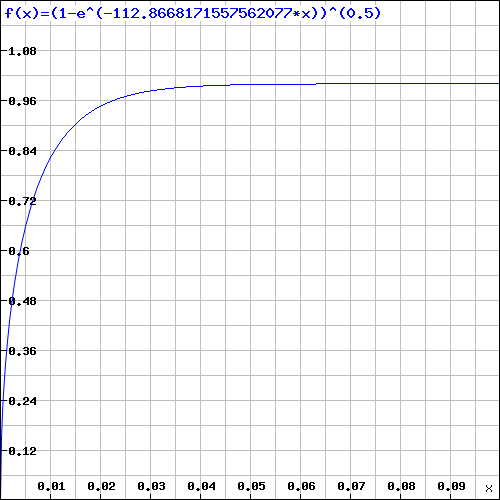
\(\gamma(x)=\sqrt{1-e^{-112.866x}}\)


This is a graph of time dilation \(\gamma(x)\) = (1-e^(-112.866*x))^(0.5) around a black hole.  Time returns to normal very quickly at about 0.065 m.  So much for time travel around a black hole; a 6.5 cm disk around which time dilation occurs is way smaller than expected.

Time Dilation \(\gamma(x)\) around Earth

We know that

\({g}_{o}\) = 9.80663 ms-2,  \({r}_{e}\) = 6371000 m

\({G}_{o}\) = 3.980484e14,  \(\cfrac{{g}_{o}{r}_{e}}{{G}_{o}}\) = 1.56961e−7

\(g=-{g}_{o}{e}^{-\cfrac{{g}_{o}{r}_{e}}{{G}_{o}}(x)}\)

\(g=-{g}_{o}{e}^{-\cfrac{1}{{r}_{e}}(x)}\)

\(g\) = -9.80665*e^((-1.56961e−7)*x)

And so,

\(\gamma(x)=\sqrt{1-\cfrac{2{G}_{o}}{{c}^{2}{r}_{e}}{e}^{-\cfrac{{g}_{o}{r}_{e}}{{G}_{o}}(x)}}\)

\(\gamma(x)=\sqrt{1-1.3903267*10^{-9}{e}^{-1.56961*{10}^{−7}}(x)}\)

The following show \(\gamma(x)\) with \(x\) scaled by 1000.


As far living on earth is concern, time dilation is very small and it changes very little with the corresponding decrease in gravity as we move away from the gravitational field.

Time Dilation \(\gamma(x)\)

Since,

\(g=-\cfrac { 1 }{ 2 } .\cfrac { d{ v }_{ t }^{ 2 } }{ dx }\)

and

\(\cfrac{{v}_{t}^{2}}{{c}^{2}}=\gamma(x)^{2}\)

\(g=-\cfrac {{c}^{2} }{ 2 } \cfrac { d\gamma(x)^{ 2 } }{ dx }\)

because gravity is given by,

\(g=-{g}_{o}{e}^{-\cfrac{{g}_{o}{r}_{e}}{{G}_{o}}(x)}\)

We have an expression for time dilation \(\gamma\),

\( \cfrac { d\gamma(x)^{ 2 } }{ dx }=\cfrac{2{g}_{o}}{{c}^{2}}{e}^{-\cfrac{{g}_{o}{r}_{e}}{{G}_{o}}(x)}\)

\(\gamma(x)^{ 2 }=\int {d \gamma(x)^{ 2 }}=\int{\cfrac{2{g}_{o}}{{c}^{2}}{e}^{-\cfrac{{g}_{o}{r}_{e}}{{G}_{o}}(x)}dx}\)

\(\gamma(x)^{ 2 }=A-\cfrac{2{G}_{o}}{{c}^{2}{r}_{e}}{e}^{-\cfrac{{g}_{o}{r}_{e}}{{G}_{o}}(x)}\)

When \(x\rightarrow\infty\), \(\gamma(x)^2\rightarrow1\), because \({v}_{t}=c\) when space is normal.

\(\gamma(x)^{ 2 }=1-\cfrac{2{G}_{o}}{{c}^{2}{r}_{e}}{e}^{-\cfrac{{g}_{o}{r}_{e}}{{G}_{o}}(x)}\)

As such a gamma field, the change in \(\gamma=\cfrac{{v}_{t}}{c}\) over \(x\) is given by

\(\gamma(x)=\sqrt{1-\cfrac{2{G}_{o}}{{c}^{2}{r}_{e}}{e}^{-\cfrac{{g}_{o}{r}_{e}}{{G}_{o}}(x)}}\)

This is an expression for time dilation over a gravitational field.


Gravitational Potential Energy

Another way to look at the time dilation equation

\({ v }_{ t }^{ 2 }={c}^{2}-{\cfrac{2{G}_{o}}{{r}_{e}}}{e}^{-\cfrac{{g}_{o}{r}_{e}}{{G}_{o}}(x)}\)

is to see that \(\cfrac{1}{2}{ v }_{ t}^{ 2 }\) is kinetic energy per unit mass.  On entering a gravitational field, part of its total energy across space and time dimensions is converted to the term,

\({\cfrac{2{G}_{o}}{{r}_{e}}}{e}^{-\cfrac{{g}_{o}{r}_{e}}{{G}_{o}}(x)}\)

If we compared time dilation equation to

\(\cfrac{1}{2}{ v }_{ t }^{ 2 }+\cfrac{1}{2}{ v }_{ s}^{ 2 }=\cfrac{1}{2}{c}^{2}\)

Then,

\(\cfrac{1}{2}{ v }_{ s}^{ 2 }={\cfrac{{G}_{o}}{{r}_{e}}}{e}^{-\cfrac{{g}_{o}{r}_{e}}{{G}_{o}}(x)}\)

\(|P.E|={\cfrac{{G}_{o}}{{r}_{e}}}{e}^{-\cfrac{{g}_{o}{r}_{e}}{{G}_{o}}(x)}={{g}_{o}{r}_{e}}{e}^{-\cfrac{1}{{r}_{e}}(x)}\)  ----(*)

Traditionally we called expression (*) the Gravitational Potential Energy (per unit mass). It is actually energy converted from the total energy of a body in free space to Kinetic Energy in the space dimension, as it enters a gravitational field.  GPE is a 'loss' from the total energy, so has a negative value,  the body however gain an equivalent amount of Kinetic Energy.  The velocity so developed is in the direction of gravity, towards denser space.  Loss as GPE is zero where x is far away at infinity where KE is zero also.  The odd thing was, why such a conversion from GPE to KE even occurs.  The answer is denser space. A gravitational field is just a region of compressed space.


Thursday, April 24, 2014

Time, Time Speed, Aging

If we look at the expression for gravity

\(g=-\cfrac { 1 }{ 2 } .\cfrac { d{ v }_{ t }^{ 2 } }{ dx }\)

Integrating both

\(-2\int { { g } } dx=\int { d{ v }_{ t1 }^{ 2 } } ={ v }_{ t1 }^{ 2 }\)

The left hand side is negative given that g decreases with increasing x.

We have seen that g is of the form, \(g=-{g}_{o}{e}^{-\cfrac{{g}_{o}{r}_{e}}{{G}_{o}}(x)}\), therefore

\(\int { { g } } dx=\cfrac{{G}_{o}}{{r}_{e}}{e}^{-\cfrac{{g}_{o}{r}_{e}}{{G}_{o}}(x)}+A\)

And,

\({ v }_{ t1 }^{ 2 }=C-{\cfrac{2{G}_{o}}{{r}_{e}}}{e}^{-\cfrac{{g}_{o}{r}_{e}}{{G}_{o}}(x)}\)

Since, \({ v }_{ t1 }^{ 2 }={c}^{2}\) when \(x\rightarrow\infty\), where \({d}_{s} \)is at normal space density. \(C={c}^{2}\) and so,

\({v}_{t}=\sqrt{{c}^{2}-{\cfrac{2{G}_{o}}{{r}_{e}}}{e}^{-\cfrac{{g}_{o}{r}_{e}}{{G}_{o}}(x)}}\)

We have an expression similar to before except \(\cfrac{1}{(x+{r}{e})^2}\) is replaced with \({e}^{-\cfrac{{g}_{o}{r}_{e}}{{G}_{o}}(x)}\).

Similarly, time dilation \(\gamma\),

\(\cfrac{{v}_{t}}{c}=\gamma=\sqrt{1-{\cfrac{2{G}_{o}}{{c}^{2}{r}_{e}}}{e}^{-\cfrac{{g}_{o}{r}_{e}}{{G}_{o}}(x)}}\)

 In a gravity field time speed is less than time speed at normal space density, \(c\). We experience a shorter second and so, age faster than when gravity is zero where time speed is higher. At higher time speed very second is longer than at slower time speed, if 10 seconds at lower time speed fit into 9 seconds in higher time speed then those at slower time speed is aging 10% faster. Most will think the opposite, that higher time speed mean "time flies" and so age faster or that a second is used up faster. Higher time speed produces a longer second based on a standard second at some standard time speed. A lower time speed travels a shorter second. In the same standard time frame, there are more "short time speed" seconds than "high speed time" seconds.  Those at high time speed age less.


Imagine Time has markers make out in space, as space stretches out the time markers stretches out too.  X per second means X marks one second.  It is confusing because X is also measured in seconds.  Time speed should be measured based on some standard time interval for a second, and so X has to be adjusted by a factor inversely proportional its time speed, when taking physics measurements across different time speeds. Do not be confused by slow-motion cinematic effects, at different time speeds, all will experience time in the same way, within that time speed.

All physics have common expressions across all time speeds within that time speed.  The factor, \({\cfrac{{c}}{{v}_{t}}}\) adjustment is needed only when one has to define a standard time interval at speed c, in order to discuss across different time speeds.


浊绿沉溺魂
漩洑没草莘
泪溢断肠浪
呜呼寄风荡
垂额唏嘘短
目钝吟悲长
三问窘天地
生死总不仁 《沉船》

Graph of Gravity Exponential Form

We know that

\({g}_{o}\) = 9.80663 ms-2,  \({r}_{e}\) = 6371000 m

\({G}_{o}\) = 3.980484e14,  \(\cfrac{{g}_{o}{r}_{e}}{{G}_{o}}\) = 1.56961e−7

\(g=-{g}_{o}{e}^{-\cfrac{{g}_{o}{r}_{e}}{{G}_{o}}(x)}\)

\(g=-{g}_{o}{e}^{-\cfrac{1}{{r}_{e}}(x)}\)

\(g\) = -9.80665*e^((-1.56961e−7)*x)

The graph below compare the above equations with \(g = -\cfrac{{G}_{o}}{{(x+6371000)}^{2}}\)


Nice, very nice.  Here's a scale by 1000 on the x-axis version.


Very nice indeed.


Gravity Exponential Form

Consider s space density function of the form,

\({ d }_{ s }(x)=A{ e }^{ -bx }+B\)  where A, B and b are constant to be determined.

At  \({ d }_{ s }(0)={ d }_{ e }\) space is compressed, its space density is \({d}_{s}\), on surface of earth. And \({ d }_{ s }(x\rightarrow \infty )={ d }_{ n }\) where at long distance, space is relaxed and the corresponding space density is \({d}_{n}\).

We have,

\({ d }_{ s }(x)={ e }^{ -bx }({ d }_{ e }{ -d }_{ n })+{ d }_{ n }\) ----(1)

Then we let the inverse relationship between time speed squared \({v}^{2}_{t}\)and space density, \({ d }_{ s }(x)\) to be,

\({v}_{t}^{2}=C-D{ d }_{ s }(x)\) where \(C, D\) are to be determined.

We know that as \(x\rightarrow \infty, { d }_{ s }(x)\rightarrow{ d }_{ n }\)where space is relaxed and time speed is \(c\),

\({v}_{t}^{2}={c}^{2}\), \({ d }_{ s }(x)={ d }_{ n }\)

\(C={c}^{2}+D{d}_{n}\) then,

\({v}_{t}^{2}={c}^{2}-D({ d }_{ s }(x)-{d}_{n})\)

If we then consider the time dilation equation from previously, (The use of this equation is still valid because a linear approach can be consider as a first approximate to an exponential one.  Consider the power series expansion of \(e\).)

\({ v }_{ t }= \sqrt {{ c }^{ 2 }-\cfrac { 2{ G }_{ o } }{ (x+r_{ e }) }}\)

when \(x=0\)

\({ v }^{2}_{ t }={ c }^{ 2 }-\cfrac { 2{ G }_{ o } }{ (r_{ e }) }\)

 \({v}_{t}^{2}={c}^{2}-D({ d }_{ e } -{d}_{n})\) where \({ d }_{ s }(0)={ d }_{ e }\)

we have,

\(\cfrac { 2{ G }_{ o } }{ (r_{ e })}=D({ d }_{ e } -{d}_{n})\)

therefore,

\(D=\cfrac{ 2{ G }_{ o } }{r_{ e }({ d }_{ e } -{d}_{n})}\)

Hence,

\({v}_{t}^{2}={c}^{2}-\cfrac{ 2{ G }_{ o }({ d }_{ s }(x)-{d}_{n}) }{r_{ e }({ d }_{ e } -{d}_{n})}\)

Differentiating both side with respect to time

\(2{v}_{t}\cfrac{d{v}_{t}}{dt}=-\cfrac{2{G}_{o}}{{r}_{e}({d}{e}-{d}{n})}\cfrac{d({d}_{s}(x))}{dx}\cfrac{dx}{dt}\)

\({v}_{t}\cfrac{d{v}_{t}}{dt}=-\cfrac{{G}_{o}}{{r}_{e}({d}{e}-{d}{n})}\cfrac{d({d}_{s}(x))}{dx}{v}_{s}\) ----(2)

But from the energy equation,

\({v}^{2}_{t}+{v}^{2}_{s}={c}^{2}\) differentiating it

\(2{v}_{t}\cfrac{d{v}_{t}}{dt} + 2{v}_{s}\cfrac{d{v}_{s}}{dt}=0\), since \(\cfrac{d{v}_{s}}{dt}=g\)

\(2{v}_{t}\cfrac{d{v}_{t}}{dt} = -2g.{v}_{s}\)

\(g.{v}_{s}=-{v}_{t}\cfrac{d{v}_{t}}{dx}\) substitute into (2)

and so,

\(g=\cfrac{{G}_{o}}{{r}_{e}({d}_{e}-{d}_{n})}.\cfrac{d({d}_{s}(x))}{dx}\)

From (1), differentiating with respect to x,

\(\cfrac{d({d}_{s}(x))}{dx}=-b{e}^{-b(x)}({d}_{e}-{d}_{n})\) subsitute into the above we have,

\(g=\cfrac{{G}{o}}{{r}_{e}}.(-b).{e}^{-b(x)}\)

But we know that at \(x=0\),

\(g={g}_{o}=-b\cfrac{{G}_{o}}{{r}_{e}}\), therefore,

\(b=\cfrac{{g}_{o}{r}_{e}}{{G}_{o}}=\cfrac{1}{{r}_{e}}\)    \(\because {g}_{o}=\cfrac{{G}_{o}}{{r}^2_{e}}\)

And so we have an expression for gravity,

\(g=-{g}_{o}{e}^{-\cfrac{{g}_{o}{r}_{e}}{{G}_{o}}(x)}\) the negative sign indicates the direction of g.

This expression is based on compression of free space, in a exponential manner.

Wednesday, April 23, 2014

遨游天体间
无形得牵引
绕旋蕾裙浮
伊人执手舞
扣指目持惜
不俏永恒几 《万有引。爱》

Tuesday, April 22, 2014

Linear Approximation to Space Density Compression

Consider

\( { v }_{ t }^{ 2 }=\cfrac { A }{ { d }_{ s } }\) where A is a constant

that shows time speed is inversely proportional to space density.  So

\( { c }^{ 2 }=\cfrac { A }{ { d }_{ normal} }\)

ie. \(A={c}^{2}{d}_{normal}\)

with the understanding that at normal space density time \({d}_{normal}\) speed is c.  And

\({ d }_{ s }=-a(x+{ r }_{ 0 })+{ a }_{ 0 }\)  ----(*)

that gives linear space density change.  And

\(g=-\cfrac { 1 }{ 2 } .\cfrac { d{ v }_{ t }^{ 2 } }{ dx } =-\cfrac { 1 }{ 2 } .\cfrac { d }{ dx } (\cfrac { A }{ { d }_{ s } } )=\cfrac { A }{ 2 } .\cfrac { 1 }{ { d }_{ s }^{ 2 } } .\cfrac { d{ d }_{ s } }{ dx }\)

\(g=-G.\cfrac { 1 }{ { (-a(x+{ r }_{ o })+{ a }_{ 0 }) }^{ 2 } } =-\cfrac { G }{ { a }^{ 2 } } \cfrac { 1 }{ { (x+\cfrac { { a{ r }_{ o }-a }_{ o } }{ a } ) }^{ 2 } } =-\cfrac { G }{ { a }^{ 2 } } \cfrac { 1 }{ { (x+{ r }_{ e }) }^{ 2 } }=-{ G }_{ 0 }.\cfrac { 1 }{ { (x+{ r }_{ e }) }^{ 2 } }\)

that expresses gravity derived from considering the energy conservation equation and changing space density affecting time speed.  Looking at \({G}_{o}\)

\(G=\cfrac{Aa}{2}\) and so,

\({G}_{o}=\cfrac{G}{{a}^{2}}=\cfrac{A}{2a}\)

Therefore

\(a=\cfrac{{c}^{2}{d}_{normal}}{2{G}_{o}}=\cfrac{{d}_{normal}}{{r}_{eo}}\), since \({r}_{eo}=\cfrac{2{G}_{o}}{{c}^{2}}\)

When \(x=0\) the space density equation gives

\({d}_{s}={d}_{earth}=-\cfrac{{d}_{normal}}{{r}_{eo}}({ r }_{ 0 })+{ a }_{ 0 }\)

so,

\({ a }_{ 0 }={d}_{earth}+\cfrac{{d}_{normal}}{{r}_{eo}}{ r }_{ 0 }\)

and so (*) becomes

\({d}_{s}(x)=-\cfrac{{d}_{normal}}{{r}_{eo}}(x+{ r }_{ 0 })+{d}_{earth}+\cfrac{{d}_{normal}}{{r}_{eo}}{ r }_{ 0 }\)

\({d}_{s}(x)=-\cfrac{{d}_{normal}}{{r}_{eo}}(x)+{d}_{earth}\) or

\({d}_{s}(x)=-\cfrac{{c}^{2}{d}_{normal}}{2{G}_{o}}(x)+{d}_{earth}\)

We see clearly the absurdity of this formulation but as a first linear approximation it is OK.  The factor

\(\cfrac { 1 }{ { d }_{ s }^{ 2 } } .\cfrac { d{ d }_{ s } }{ dx }\)

needs further consideration, in order that the space density equation make more sense.  Consider, the expansion.

\({e}^{-b(x+{r}_{e})}={e}^{-b{r}_{e}}(1-bx+.....)=(-{e}^{-b{r}_{e}}bx+{e}^{-b{r}_{e}}....).\)

then \({d}_{s}(x)={e}^{-b(x)}{e}^{-b{r}_{e}}\), where \({e}^{-b{r}_{e}}={d}_{earth}\), \( b=\cfrac { { c }^{ 2 }{ d }_{ normal } }{ 2{ G }_{ o }{d}_{earth} }\) and \({ e }^{ -\cfrac { { c }^{ 2 }{ d }_{ normal } }{ 2{ G }_{ o }{d}_{earth} } { r }_{ e } }={ d }_{ earth }\)

where \(a, b\) are constants and \({r}_{e}\) is defined such that x=0 is on the surface of earth where space is most compressed.  By comparing coefficients, we have a consistent expression,

\({ d }_{ s }(x)={ e }^{ -\cfrac { { c }^{ 2 }{ d }_{ normal } }{ 2{ G }_{ o }{d}_{earth}} (x) }{ e }^{ -\cfrac { { c }^{ 2 }{ d }_{ normal } }{ 2{ G }_{ o }{d}_{earth} } { r }_{ e } }+{d}_{normal}\)

The last term is added because we know that \(x\rightarrow \infty \), \({d}_{s}\rightarrow{d}_{normal}\) and the term constant term \(e^{-b{r}_{e}}\) is modified to

\({ e }^{ -\cfrac { { c }^{ 2 }{ d }_{ normal } }{ 2{ G }_{ o }{d}_{earth} } { r }_{ e } }={ d }_{ earth }-{d}_{normal}\).

\({ d }_{ s }(x)={ e }^{ -\cfrac { { c }^{ 2 }{ d }_{ normal } }{ 2{ G }_{ o }{d}_{earth}} (x) }({ d }_{ earth }-{d}_{normal})+{d}_{normal}\)

This derivation however, will lead to unfamiliar expressions, although we have seen the first approximation to be the same as textbook derivation.  Have a nice day.

No Prime \(E[{N}_{x}]\)

Consider again,

\({\prod _{ 1 }^{ { N }_{ x }}{ (\frac { 1 }{ 2 } )(\frac { 2 }{ 3 } )(\frac { 4 }{ 5 } )(\frac { 6 }{ 7 } )...\frac{{P}_{N}-1}{{P}_{N}}}}\)

This term can be evaluated for all \({N}_{x}\) but the summation of its product with \({N}_{x}\) is not.  It is possible to evaluate \(E[{N}_{x}]\) for a bounded set but not for all primes.  The proof that there are infinite numbers of primes suggests that the tail of the Probability \({N}_{x}\)of  being Prime graph is never zero.  And as \({N}_{x}\) tends towards infinity, the term

\(\frac{{N}_{x}-1}{{N}_{x}}=1-\frac{1}{{N}_{x}}\) is divergent with respect to \(\int { (1-\frac { 1 }{ { N }_{ x } } ) } d{ N }_{ x }\).


Monday, April 21, 2014

Black Hole Mass Density

From previously,  if earth were to shrink to a radius of \({r}_{o}=0.00886\)m then it is dense enough to be a black hole.  Since,

\(\cfrac { { r }_{ e }^{ 3 } }{ { r }_{ o }^{ 3 } } =\cfrac { { d }_{ o } }{ { d }_{ e } }\) , earth density, \({d}_{e}\) = 5.52 g/cm³, earth radius, \({r}_{e}\)=6371 km

We have mass density of this black hole, \({d}_{o}\)


\({ d }_{ o }=\cfrac { { r }_{ e }^{ 3 } }{ { r }_{ o }^{ 3 } } { d }_{ e }\)=(6371000/0.00886)^3*5.52= 2.0524*10^27 g/cm³

Space permeates through all matter.  This density may be the limit beyond which space cannot penetrate.

Moving Space

 The existence of Casimir Effect suggests that there cannot be arbitrarily small volume of space.  Imagine constructing a box of length less than the gap dimension between Casimir parallel plates.  Such a box will collapse onto itself. One can then imagine, the whole universe as being made of up such cubes of Casimir Effects dimension and no smaller.

X out of Y and X out of Y

Why would the probabilities of being prime be an indication of the distribution of numbers around primes?  If \({N}_{x}\) has a probability of \(\frac{x}{y}\) of being a prime, that means out of y numbers x are prime around that locality where \({N}_{x}\) is.  Conversely, such probabilities are also good indications of the distribution of primes, for x out of y numbers are prime, around the same area.

I am not sure what Riemann and Euler did to prime numbers, but it seems overtly complicated and a pole at s=1 is ugly, especially if you don't think it effects the numbers around it by taking limits and assigning finite values to s, the complex variable.